Headless Magento Development: What Works, What Doesn’t, and When You Actually Need It
Three months ago, I sat across from the founder of a mid-sized fashion brand in Baner. They’d just spent ₹18 lakhs on a “headless” Magento store that was supposed to be lightning-fast and ultra-flexible.
It was fast, sure. But every time they wanted to add a simple promotional banner or change the checkout flow, they had to call their developers. Two weeks and another ₹40,000 later, they’d get their changes. “I thought headless was supposed to make things easier,” he said, pushing a cup of cold coffee around the table.
Here’s the thing about headless Magento architecture—it’s genuinely powerful when you need it. But I’ve watched too many businesses jump into it because some agency convinced them it was the future, without asking whether it was the right future for them.
Let me walk you through what headless Magento actually is, when it makes sense, and when you’re honestly better off with traditional Magento development. No fluff, just what I’ve learned working with ecommerce clients across Pune—from small D2C brands to manufacturers in Chakan selling B2B.
What Headless Magento Actually Means (Without the Jargon)
Think about traditional Magento this way: the front-end (what customers see) and the back-end (where you manage products, orders, inventory) are married. They live together in one system. When you want to change how your store looks, you’re working within Magento’s templating system.
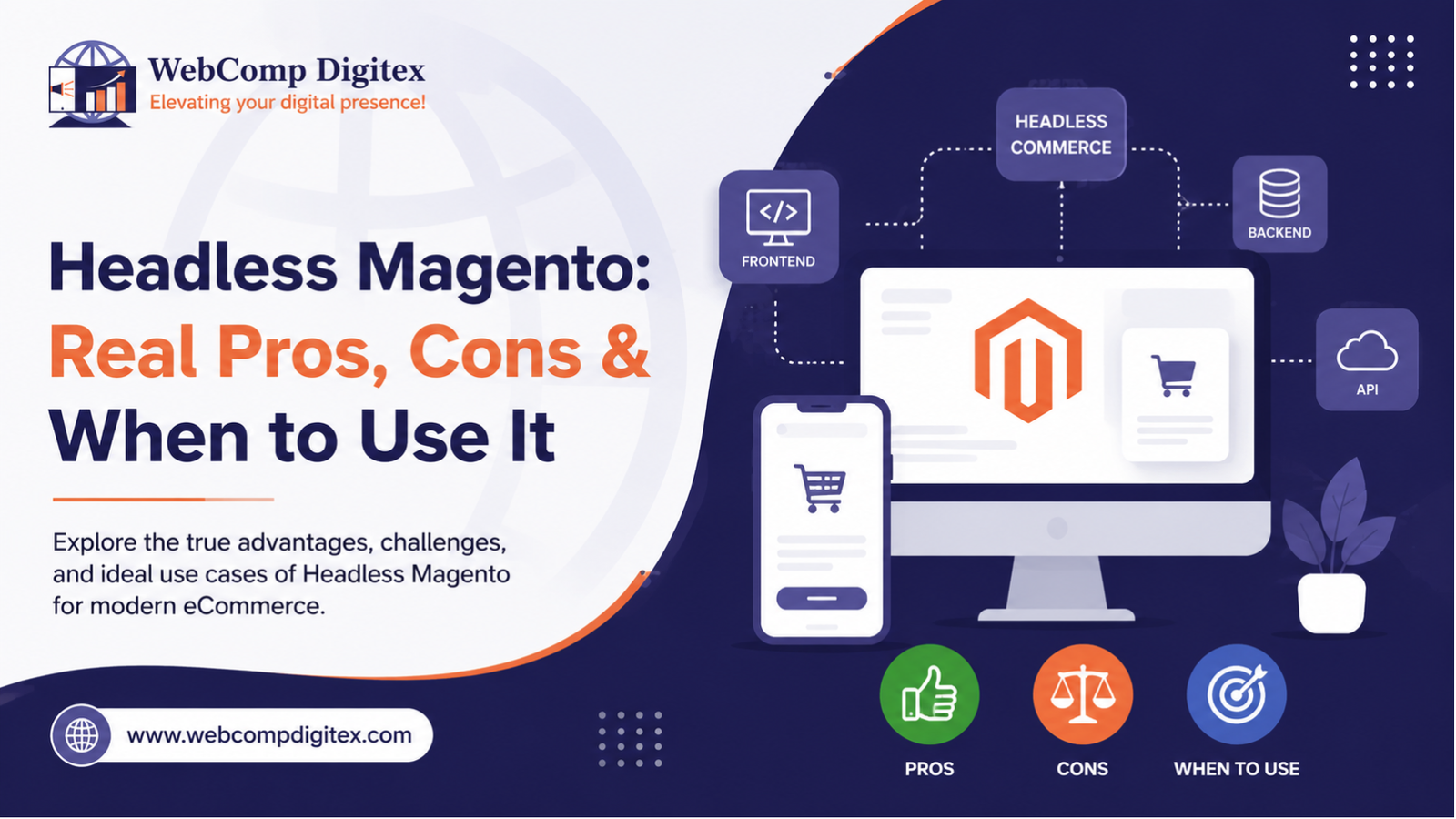
Headless architecture divorces them. The back-end stays Magento—handling all your ecommerce logic, inventory, orders, payments. But the front-end? That can be anything. React. Vue.js. Next.js. A progressive web app. Even a mobile app pulling data from the same Magento back-end.
They talk to each other through APIs. Your front-end says “hey, show me all products in the ‘winter collection’,” and Magento’s API responds with that data. Your front-end displays it however you want.
At Webcomp Digitex, we explain it to clients like this: imagine your store’s brain (Magento) can now control multiple bodies (your website, mobile app, smart TV interface, whatever). Same brain, different faces.

The Real Advantages (When They Actually Matter)
Speed That Actually Converts
I’m not going to lie—when done right, headless Magento stores are fast. We worked with an electronics retailer in Kharadi who went headless with a React front-end. Their product pages went from 4.2 seconds to 1.1 seconds load time.
But here’s what the case studies don’t tell you: that speed improvement came from three things working together. Yes, the modern front-end framework helped. But we also optimized their image delivery, fixed their caching strategy, and cleaned up years of extension bloat in their Magento install.
Could we have gotten them to 1.8 seconds with traditional Magento? Probably. Would that extra 0.7 seconds have mattered? For them, yes—they had mobile users on 3G connections making quick purchase decisions. For a B2B industrial parts supplier we work with in Pimpri-Chinchwad? Honestly, their buyers spend 15 minutes comparing specs anyway.
Design Freedom That’s Actually Useful
This is where headless shines if you have the team for it. Your developers aren’t constrained by Magento’s templating system. Want a completely custom product page layout? Build it. Want to integrate your ecommerce store experience into your blog? Do it. Want your checkout flow to work nothing like a typical checkout? Go ahead.
One client—a luxury home decor brand in Koregaon Park—used this to create this really immersive product experience. 3D room visualizations, drag-and-drop furniture placement, the whole thing built in Three.js. Their Magento back-end just handled the cart and checkout. Their conversion rate jumped from 1.8% to 4.3%.
But that team had two full-time front-end developers and a UI/UX designer. They were doing ₹3+ crores annual revenue. The investment made sense.
Omnichannel That Isn’t Just Marketing Speak
Here’s a use case that actually matters: you want your ecommerce website, mobile app, and in-store POS system all pulling from the same product catalog, inventory, and customer data.
With headless Magento development, your web app can be one front-end, your mobile app another, your in-store tablets another—all talking to the same Magento API. Real-time inventory across channels. Customer picks up their loyalty points wherever they shop.
We implemented this for a healthcare supplements brand with stores across Pune. Their website (built with Next.js), their iOS/Android apps, and their retail locations all connected to one Magento back-end. A customer adds items to their cart online, walks into their Hinjewadi store, and the staff can see that cart and complete the sale. It just works.
The Hidden Costs Nobody Talks About
Let me be straight with you—this is where agencies lose trust. They sell the benefits and hide the costs until you’re committed.
Development Time and Money Upfront
A traditional Magento store might take us 8-12 weeks and ₹5-8 lakhs for a solid mid-market build at Webcomp Digitex. Headless? Double that. Sometimes triple.
Why? Because you’re essentially building two systems. Your Magento back-end still needs all the usual setup—extensions, payment integrations, shipping logic, product attributes. But now you’re also building a completely custom front-end from scratch.
That fashion brand I mentioned? Their ₹18 lakh budget wasn’t unreasonable for what they wanted. But they hadn’t budgeted for what came after.
Ongoing Maintenance Gets Complicated
Here’s something I’ve learned from actual experience: when your site breaks at 2 AM (and ecommerce sites always break at the worst times), who do you call?
With traditional Magento, most issues live in one place. But with headless, the problem could be in your Magento back-end, your API layer, your front-end code, or how they’re talking to each other. You need developers who understand the full stack.
That means higher retainer costs. We’re honest with clients—if you go headless, expect to budget ₹30,000-50,000/month minimum for maintenance and support. Compare that to ₹15,000-25,000 for traditional Magento.
Content Changes Aren’t Always Simple Anymore
In traditional Magento, your marketing team can log into the admin panel and change a homepage banner, add a promotional block, or adjust product descriptions. Non-technical folks can do this.
With headless, it depends on how your front-end is built. If you’ve integrated a headless CMS like Contentful or Strapi, sure. But I’ve seen implementations where changing a simple text block requires a developer to update the React code and redeploy.
That fashion brand founder? That’s exactly what he was dealing with. Every marketing campaign needed developer time.
When Headless Magento Actually Makes Sense
After working with dozens of ecommerce businesses—from Wakad startups to established MIDC manufacturers—I’ve noticed patterns in who benefits from headless architecture.
You’re Already Doing Serious Revenue
I wouldn’t recommend headless unless you’re doing at least ₹2 crore annually, preferably more. Not because it won’t work for smaller stores, but because the investment doesn’t justify the returns. Your development budget is better spent on marketing, inventory, or customer service.
You Have Technical Resources
Either you have developers in-house or you’re committed to working with a web application development agency long-term. Headless isn’t a “set it and forget it” solution. It’s a living system that needs ongoing technical attention.
Your Customer Experience Demands It
If your competitive advantage is the shopping experience—something truly custom that can’t be achieved with Magento themes and extensions—headless makes sense.
That luxury decor brand? Their immersive 3D experience was their selling point. They weren’t competing on price; they were competing on experience.
You Need Real Omnichannel
If you’re genuinely selling across web, mobile apps, physical stores, and maybe even voice assistants or smart TVs, the shared back-end architecture is powerful. But be honest—do you actually need all those channels right now, or is it something you think you might want someday?

When You Should Stick with Traditional Magento
Most businesses, honestly, should start here.
If you’re a growing D2C brand doing ₹50 lakhs to ₹1.5 crore annually, if your team is primarily non-technical, if you need to move fast and adjust your store frequently—traditional Magento (or Magento with PWA Studio) gives you 90% of what headless offers at half the cost and complexity.
We worked with an organic food brand in Aundh who almost went headless because they read it was “the future.” We talked them into a well-optimized traditional Magento store instead. ₹6.5 lakhs, done in 10 weeks. Their team can manage content themselves. Load times are under 2 seconds. They’re growing 40% year-over-year.
Could they switch to headless later if they need it? Sure. But why solve for problems you don’t have yet?
The Middle Ground: PWA Studio
Here’s something worth knowing—Magento’s PWA Studio is kind of a middle ground. You get a progressive web app front-end (fast, app-like experience) that’s still tightly integrated with Magento. It’s not fully headless, but it gives you many of the performance benefits without the full complexity.
For clients who want speed and mobile experience but don’t need total front-end freedom, PWA Studio is worth considering. At Webcomp Digitex, we’ve implemented it for several clients who wanted something between traditional and headless.
What the Migration Actually Looks Like
Say you’re convinced headless is right for you. What’s the actual process?
From what we’ve done at Webcomp Digitex, expect this:
Planning and API Design (2-3 weeks): Map out what data your front-end needs from Magento. Which APIs will you use? Custom ones? How will authentication work? This phase matters more than people think.
Back-end Setup (3-4 weeks): Get your Magento installation configured, extensions installed, APIs tested. This is similar to traditional Magento development.
Front-end Development (6-10 weeks): Build your actual storefront. This varies wildly based on complexity. A straightforward React storefront might take 6 weeks. Something custom with lots of interactions? Double that.
Integration and Testing (2-3 weeks): Get everything talking properly. Test edge cases. What happens when inventory runs out mid-checkout? How do promotions apply? Does abandoned cart recovery work?
Launch and Optimization (ongoing): You don’t just launch and walk away. Monitor performance in GA4, watch for API bottlenecks, optimize based on real user data from Hotjar or similar tools.
Questions You Should Ask Any Agency
If you’re talking to agencies about headless Magento, here’s what to ask:
“Can I see a headless store you’ve built, and can I talk to that client?” Don’t accept excuses. If they’ve done this work, they should have references.
“What happens when I need to change something?” Get specific about which changes require developer time versus what your team can handle.
“What’s the ongoing maintenance cost?” Get a real number, not “it depends.” It always depends, but they should give you a range based on your scope.
“Have you done ecommerce website development for businesses like mine?” Industry matters. B2B manufacturing has different needs than D2C fashion.
The Honest Reality Check
Look, headless Magento architecture is legitimately powerful. But I’ve been doing Magento development for over a decade, and I’ve watched trends come and go. Remember when everyone said Magento 1 was dead and you had to migrate immediately? Many stores ran profitably on Magento 1 for years after that.
The same applies here. Headless isn’t the only future of ecommerce. It’s a future, appropriate for certain businesses at certain stages.
That fashion brand I started with? We helped them migrate back to a well-built traditional Magento store with PWA Studio. Took four weeks, cost ₹4.5 lakhs. Their marketing team can make changes again. The site is still fast. They’re actually growing now instead of fighting their platform.
Sometimes the best technology choice isn’t the newest one. It’s the one that matches where your business actually is.
If you’re doing ₹5+ crores annually, have technical resources, need genuinely custom experiences or omnichannel capability—yes, explore headless. Get a proper web application development agency who’s done it before to assess your needs.
But if you’re earlier in your journey, invest in solid traditional Magento development, great hosting, clean code, and smart extensions. Get your operations smooth, your marketing dialed in, and your team comfortable with the platform. You can always go headless later when the business genuinely needs it.

Frequently Asked Questions
What’s the main difference between headless and traditional Magento?
Traditional Magento has the front-end and back-end connected—you manage everything in one system. Headless separates them completely. Your front-end (what customers see) is built independently and pulls data from Magento through APIs. Think of it like Magento becomes just your ecommerce engine, and you can build any kind of storefront on top of it.
Does headless Magento always make websites faster?
Not automatically. I’ve seen poorly built headless stores that are slower than well-optimized traditional Magento stores. Speed comes from good architecture, proper caching, optimized images, and clean code—whether you’re headless or not. Headless can be faster because modern front-end frameworks handle things efficiently, but it’s not magic. You still need developers who know what they’re doing.
Can I manage content myself with headless Magento?
It depends entirely on how your front-end is built. If your developers integrated a headless CMS like Contentful, Strapi, or Sanity, then yes—you can manage content like you would in WordPress. But if your content is hardcoded into your React or Vue.js front-end, you’ll need developers for every change. This is something to discuss upfront with your web application development agency.
How much does headless Magento development cost in India?
Based on what we see at Webcomp Digitex and talking with other agencies in Pune, expect ₹12-25 lakhs for a solid headless implementation, depending on complexity. That’s roughly double what traditional Magento costs. Ongoing maintenance also runs higher—₹30,000-50,000/month versus ₹15,000-25,000 for traditional setups. If an agency quotes significantly less, ask detailed questions about what’s included.
Should a small ecommerce business go headless?
Honestly? Probably not yet. If you’re doing under ₹2 crore annual revenue, your money is better spent on marketing, inventory, and customer experience within a traditional Magento setup. Headless makes sense when you have specific technical requirements—unique customer experiences, true omnichannel needs, or traffic that demands maximum performance. Most small businesses grow faster by focusing on business fundamentals, not architecture complexity.
Can I switch from traditional Magento to headless later?
Yes, absolutely. Your Magento back-end stays mostly the same—you’re just building a new front-end that talks to it through APIs. We’ve done this migration for several clients at Webcomp Digitex. It’s actually less risky than a full platform migration because you’re not changing your core ecommerce logic. That said, it’s still a significant project requiring proper planning and testing.
Let’s Figure Out What Actually Works for Your Business
Here’s what I really believe: the right architecture is the one that helps your business grow, not the one that sounds impressive in meetings.
If you’re sitting in Pune wondering whether headless Magento makes sense for your ecommerce store, let’s just talk about it. No sales pitch, no commitment—just an honest conversation about where your business is and what makes sense technically and financially.
At Webcomp Digitex, we’ve built both traditional and headless Magento stores for businesses across manufacturing, healthcare, fashion, and more. We’re a web application development agency that actually cares about whether you’re making the right choice, not just closing a deal.
We’ll look at your revenue, your team, your growth plans, and your actual customer experience needs. Maybe headless is perfect for you. Maybe traditional Magento with great optimization is smarter. Maybe PWA Studio is the sweet spot. We’ll tell you what we honestly think.
Call us at +91-9960802498 or visit webcompdigitex.com. Let’s figure this out together.
We’re based in Pune, we’ve worked with businesses from Hinjewadi to Pimpri-Chinchwad, and we’ve seen what actually works in the real market—not just in case studies. Sometimes the best technology decision is the boring one that lets you focus on selling instead of fighting your platform.


