Custom Magento Plugin Development That Actually Extends Your Store (Not Just Adds Bloat)
A healthcare equipment distributor in Pimpri-Chinchwad called us last April, frustrated. They’d hired three different developers over 18 months to build custom plugins for their Magento store. They had a plugin for custom B2B pricing, another for dealer territory management, and one more for medical certification uploads during checkout.
All three plugins worked. Sort of.
The store had slowed to a crawl. Admin panel took 8-12 seconds to load. Product pages sometimes timed out. And here’s the thing that really hurt — their Google Ads cost-per-conversion had jumped from ₹890 to ₹2,340 because the slow site killed their conversion rate.
The plugins weren’t broken. They just weren’t built right.
Here’s what I mean. Most businesses think about custom plugin development the way they think about adding rooms to a house. Need a feature? Add a plugin. Need another? Add one more. But Magento doesn’t work like that. At Webcomp Digitex, we’ve built custom plugins for manufacturing units in Chakan, real estate portals in Hinjewadi, and healthcare stores across Pune. And honestly? About 60% of the plugin requests we get shouldn’t be plugins at all.
Let me walk you through what actually matters when you’re extending your Magento store’s capabilities.
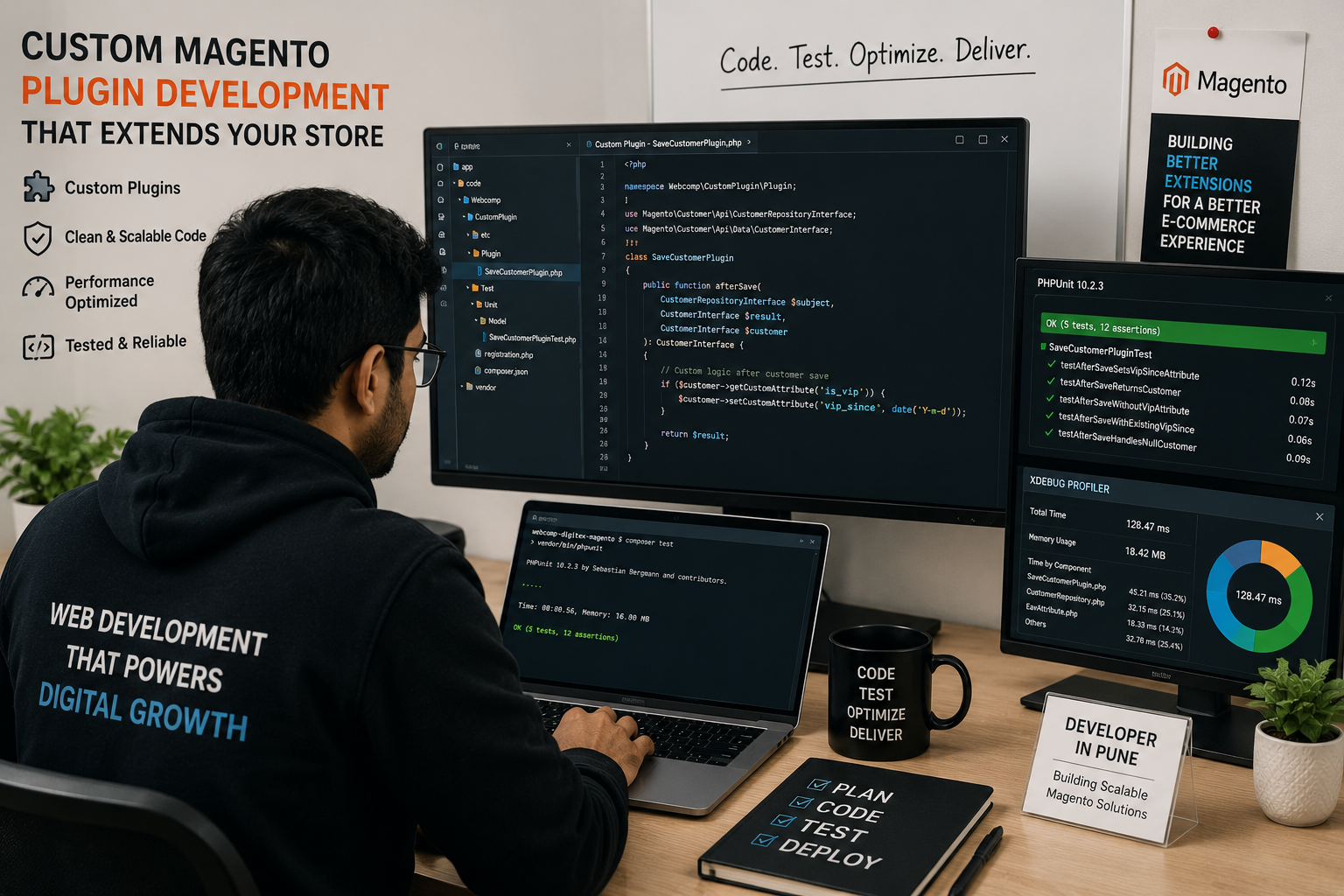
Myth #1: Every Custom Feature Needs a Custom Plugin
This is the biggest misconception we see. A jewelry retailer in Baner wanted a plugin to show “matching items” on product pages. They’d already contacted two agencies. Both quoted them ₹85,000-₹1,20,000 for custom plugin development.
We built it with Magento’s native related products feature and some custom frontend work. Cost them ₹18,000. Done in two weeks.
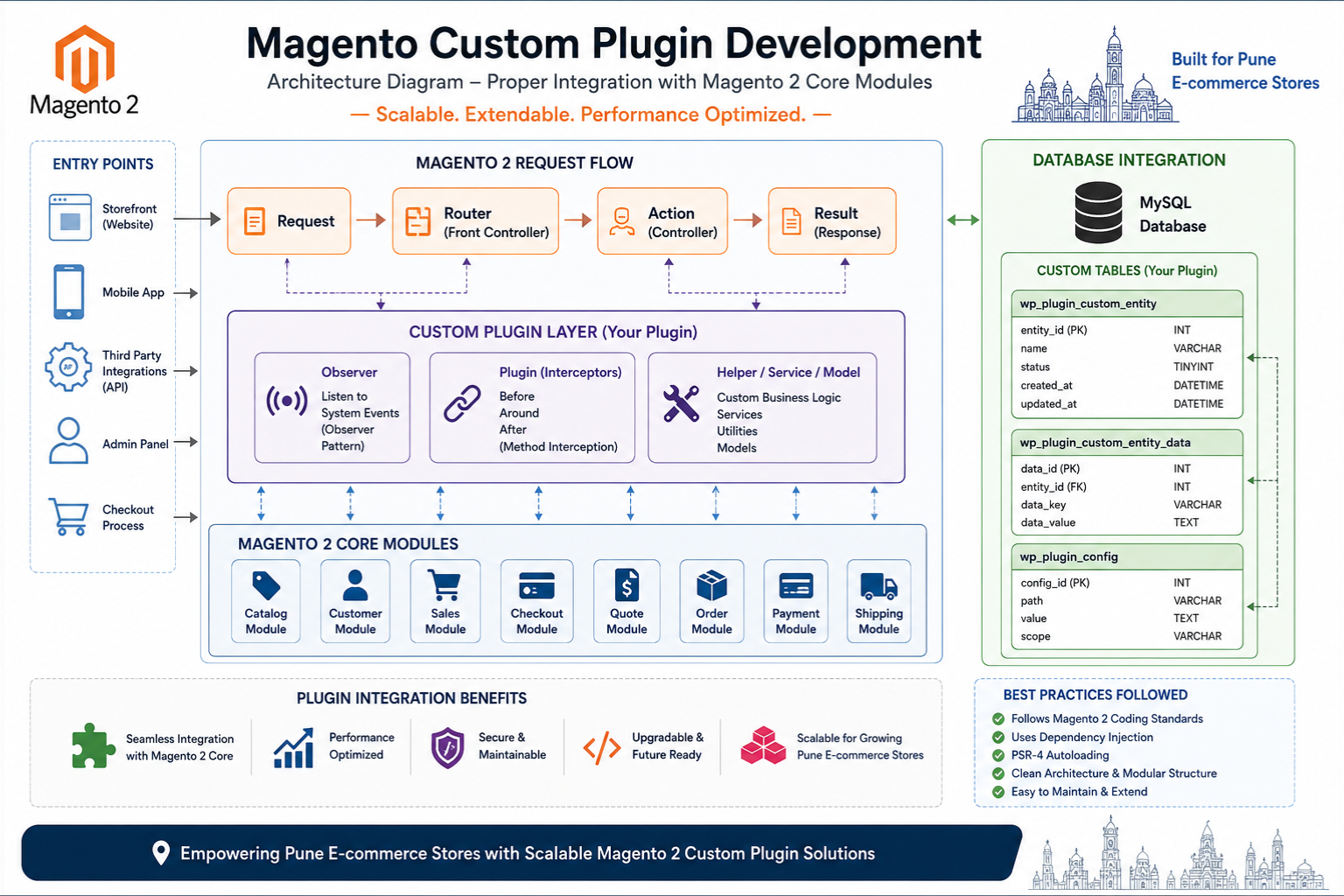
Think about it this way. Magento 2 already has a massive architecture. It has events, observers, plugins (interceptors), preferences, dependency injection — all these hooks into the system. Sometimes you need a full module. Sometimes you just need to tap into what’s already there.
Here’s what only someone who’s actually done this work would know: check your `vendor` folder first. Look at what Magento core modules already do. I’ve seen developers build entire inventory management plugins when they could’ve extended `Magento_CatalogInventory` with about 200 lines of code.
A manufacturing client we worked with in MIDC Bhosari needed custom pricing rules based on customer credit limits and order history. Sounds complex, right? We extended Magento’s quote collectors and added a custom price rule. Not a standalone plugin. Just smart use of what Magento already provides.
Before you commission custom plugins development for Magento, ask yourself:
- Can Magento’s native features do 70% of this already?
- Are we trying to force an e-commerce platform to be an ERP?
- Is this actually a frontend customization disguised as a backend need?
That healthcare distributor I mentioned earlier? Two of their three plugins could’ve been handled with proper use of customer groups and tier pricing. One plugin — the certification upload one — genuinely needed to be built. But it should’ve been built differently.
Myth #2: More Features Mean Better Performance for Your Business
I’m going to be blunt here. This is backwards.
A Pune-based electronics store added six custom plugins over eight months. Each one solved a specific problem. Bulk order requests. Custom gift wrapping options. Installation scheduling. Corporate billing. Service warranty registration. Express delivery slot selection.
Revenue went up 34%. That’s good, right?
But their operational costs went up 58%.
Why? Because every plugin added steps to their order processing. Their team was manually handling data from six different plugin interfaces. Nothing talked to each other. Customer support was checking five different places to answer one question about an order.
Look, custom plugin development isn’t about features. It’s about capability that drives actual business outcomes.
When we work with clients at Webcomp Digitex, we start with a reverse question: what manual process is killing your team right now? Not what feature sounds cool. What’s actually broken?
For that electronics store, we rebuilt their entire setup. Instead of six separate plugins, we built one integrated order management extension that:
- Pulled all custom order attributes into one interface
- Automated 80% of the data entry their team was doing manually
- Created a single dashboard for customer support
- Reduced order processing time from 12 minutes to 3 minutes
Did it have fewer visible “features” than the six plugins combined? Yes. Did it perform better for their business? Absolutely.
Here’s a specific number that matters. A real estate services company in Wakad wanted custom plugins for property document management, site visit scheduling, and EMI calculator integration. We built it as one cohesive module instead of three separate ones. Their admin users went from jumping between four different screens to complete a lead workflow to handling everything in one place. Lead response time dropped from 4 hours to 45 minutes. Conversion rate went from 2.8% to 4.1% in three months.
That’s what performance actually means.
Myth #3: Custom Plugin Development Is Just Coding the Feature
This one drives me kind of crazy because it’s where most projects go wrong.
A manufacturing unit in Chakan that supplies automotive parts needed a plugin for dealer-specific pricing with approval workflows. They hired a developer. He built exactly what they asked for. It worked perfectly.
For about six weeks.
Then they upgraded Magento to patch a security vulnerability. The plugin broke. Completely. The developer was unreachable. They couldn’t process dealer orders for three days. Lost about ₹12 lakhs in that period because dealers moved orders to competitors.
Here’s what nobody tells you about custom plugin development: the code is maybe 40% of the actual work. The rest is:
Architecture decisions — How does this fit with Magento’s dependency injection? Are we using plugins (interceptors) or observers? What happens when core Magento code changes?
Database schema design — Are we adding tables or extending existing ones? How do we handle upgrades and data migration? What about database indexing for performance?
Compatibility planning — What happens when the store owner wants to upgrade Magento? What if they add another extension that touches the same functionality?
Performance impact — Are we adding database queries on every page load? How does this affect caching? What happens when the catalog has 50,000 products instead of 5,000?
Testing and documentation — Not just “does it work” but “does it work when X, Y, and Z also happen?”
At Webcomp Digitex, we use a specific checklist for every custom plugin we build. It includes automated tests with PHPUnit, compatibility checks against common third-party extensions (like Amasty, Aheadworks modules), and performance profiling with New Relic and Magento’s built-in profiler.
I’m not saying this to sound impressive. I’m saying it because I’ve seen too many Pune businesses get burned by cheap custom plugins development for Magento that technically works but fails in real-world conditions.
That automotive parts supplier? We rebuilt their dealer pricing plugin. This time properly. Used Magento’s plugin architecture to intercept price calculation. Built proper database schemas with declarative schema (so upgrades don’t break things). Added automated tests. Documented every hook and customization point.
They’ve upgraded Magento twice since then. Plugin still works. Zero downtime.
Myth #4: You Need a Custom Web Application Development Company for Magento Plugins
Here’s something that might surprise you.
About 30% of the “custom plugin” projects we see at Webcomp Digitex aren’t actually Magento problems. They’re business process problems that need web application development services, not e-commerce extensions.
A healthcare chain in Pune wanted to add inventory management, supplier ordering, and multi-location stock transfers to their Magento store. They were looking at quotes of ₹8-12 lakhs for custom plugin development.
But here’s the thing. Magento is an e-commerce platform. It’s really good at selling things. It’s not great at being an ERP system.
We built them a lightweight web application using Laravel that handled inventory and supplier management. It talked to Magento through REST APIs for stock levels and product data. Magento stayed clean and fast. The inventory system had the custom workflows they actually needed.
Cost? About ₹4.2 lakhs. And their Magento store didn’t slow down because we weren’t forcing it to do things it wasn’t designed for.
Think about it this way. If you need a screwdriver, you don’t modify a hammer. You get a screwdriver. And maybe you keep both in the same toolbox.
Sometimes the right answer is Magento + a custom web application that work together. Not one bloated Magento installation trying to do everything.
Now, this doesn’t mean you should split everything out. A custom plugin makes sense when:
- The feature directly relates to the buying experience (checkout, product display, cart behavior)
- It needs tight integration with Magento’s catalog, pricing, or order data
- It’s customer-facing and needs to work within Magento’s frontend
- It genuinely extends e-commerce capability, not general business process
But if you’re adding manufacturing workflows, complex approval chains, external vendor management, or detailed reporting that spans multiple business systems? You probably need a custom web application development company that can build something purpose-fit and integrate it properly.
We worked with a furniture manufacturer in Kharadi who sold both B2B and B2C through Magento. They needed custom manufacturing tracking — when the order went to production, which artisan was working on it, raw material consumption, delivery logistics coordination.
That’s not a Magento plugin. That’s a manufacturing execution system.
We built them a separate web app that integrated with Magento at three points: when an order was placed, when it was ready to ship, and for tracking updates customers could see. Magento stayed fast. The manufacturing system had all the complexity it needed.
Their Magento page load time? Still under 2 seconds. That’s what proper architecture looks like.
What Actually Works: Our Custom Plugin Development Process at Webcomp Digitex
Look, I’ve spent twelve years doing this. Here’s what actually works when you need to extend your Magento store’s capabilities.
First, we map the business process, not the feature list. We literally sit with your team — whether you’re in Hinjewadi or Pimpri-Chinchwad, we’re coming to your office — and watch how work actually flows. Where do things get stuck? What’s taking too much time? What’s being done manually that shouldn’t be?
For a Pune-based industrial equipment seller, this process revealed that their “we need a custom quote request plugin” was actually “our sales team wastes 6 hours a day copy-pasting data between Magento, email, and Excel.” Different problem. Different solution.
Second, we audit what you already have. Your Magento installation, your current extensions, your server environment, your data structure. We use tools like Magento Commerce Optimizer, code quality checks with PHPCS, and database analysis with MySQLTuner.
This isn’t just technical showing off. A real estate portal we worked with in Baner wanted a custom search plugin. Turned out their existing search was slow because nobody had reindexed their catalog properly in eight months. Fifteen minutes of maintenance solved their “we need custom development” problem.
Third, we prototype fast. Not full development. Quick proof-of-concept using Magento’s developer mode and local environments. We show you what it’ll actually look and feel like. You test it with real scenarios. We adjust.
This catches problems early. A manufacturing client wanted dealer commission tracking. In our prototype phase, they realized their commission rules were way more complex than they’d explained. We caught that before writing production code. Saved probably ₹1.5 lakhs in revisions.
Fourth, we build with Magento’s architecture, not against it. This means:
- Using plugins (interceptors) for modifying existing class methods
- Event observers for responding to Magento actions
- Dependency injection, not ObjectManager::getInstance()
- Service contracts and repositories for data access
- Proper use of Magento’s caching system
This isn’t academic. A custom integration we built for a healthcare client handles 3,000+ orders a month. Full-page cache still works. Admin panel is still fast. Why? Because we used Magento’s architecture properly.
Fifth, we test like the real world is messy. Because it is. We test:
- With your actual product catalog size
- With other extensions you’re actually using
- With your server configuration (not some ideal setup)
- With multiple admin users doing things simultaneously
- With upgrades and patches applied
That automotive parts client I mentioned earlier? We tested their dealer pricing plugin with 47,000 products and 12 admin users. Found a race condition that would’ve caused duplicate pricing records during high traffic. Fixed it before launch.
Sixth, we document and transfer knowledge. Your team needs to understand what was built and why. We don’t just hand over code. We train your admins, create documentation, and make sure you’re not dependent on us for every small change.
How to Know If You Actually Need Custom Plugin Development
Here’s a simple framework we use at Webcomp Digitex.
Start with these questions:
Can I do this with Magento’s native features + theme customization? (Try this first. Use Google Search Console and GA4 to see if users are even using the feature you think you need.)
Is there an existing marketplace extension that does 80% of this? (Sometimes paying ₹8,000 for an existing extension beats ₹80,000 for custom development.)
Does this directly impact conversion rate or average order value? (If not, maybe it’s not worth the investment yet.)
Am I trying to make Magento do something it fundamentally wasn’t designed for? (That’s when you need web application development services, not a plugin.)
Here’s when custom plugin development makes real sense:
You need B2B functionality specific to your industry (like that medical certification upload or dealer territory management)
You’re integrating with proprietary systems (your ERP, your warehouse management, your CRM — things that aren’t standard integrations)
You have unique pricing or inventory rules that aren’t standard (complex tier pricing based on multiple factors, consignment inventory, drop-shipping with specific business rules)
You need customer-specific workflows that directly affect buying behavior (custom approval processes, quote-to-order workflows, subscription variations)
A textile manufacturer in MIDC needed custom plugin development because their pricing depended on fabric type, order quantity, customer credit rating, and current raw material costs. No marketplace extension handles that combination. Custom plugin was the right answer.
But honestly? Maybe 40% of the “custom plugin” requests we get at Webcomp Digitex would be better served by:
- Proper configuration of existing Magento features
- A good marketplace extension
- Theme and frontend customization
- A separate web application that integrates with Magento
- Sometimes, just better business processes
I’m not trying to talk you out of custom development. We do it regularly and we’re good at it. But I’d rather solve your actual problem than sell you something that sounds impressive but doesn’t work right.
The Real Cost of Bad Custom Plugin Development
Let me give you some specific numbers from businesses we’ve helped fix.
Store #1 — Healthcare Equipment Distributor (Pimpri-Chinchwad)
- Had three poorly-built custom plugins
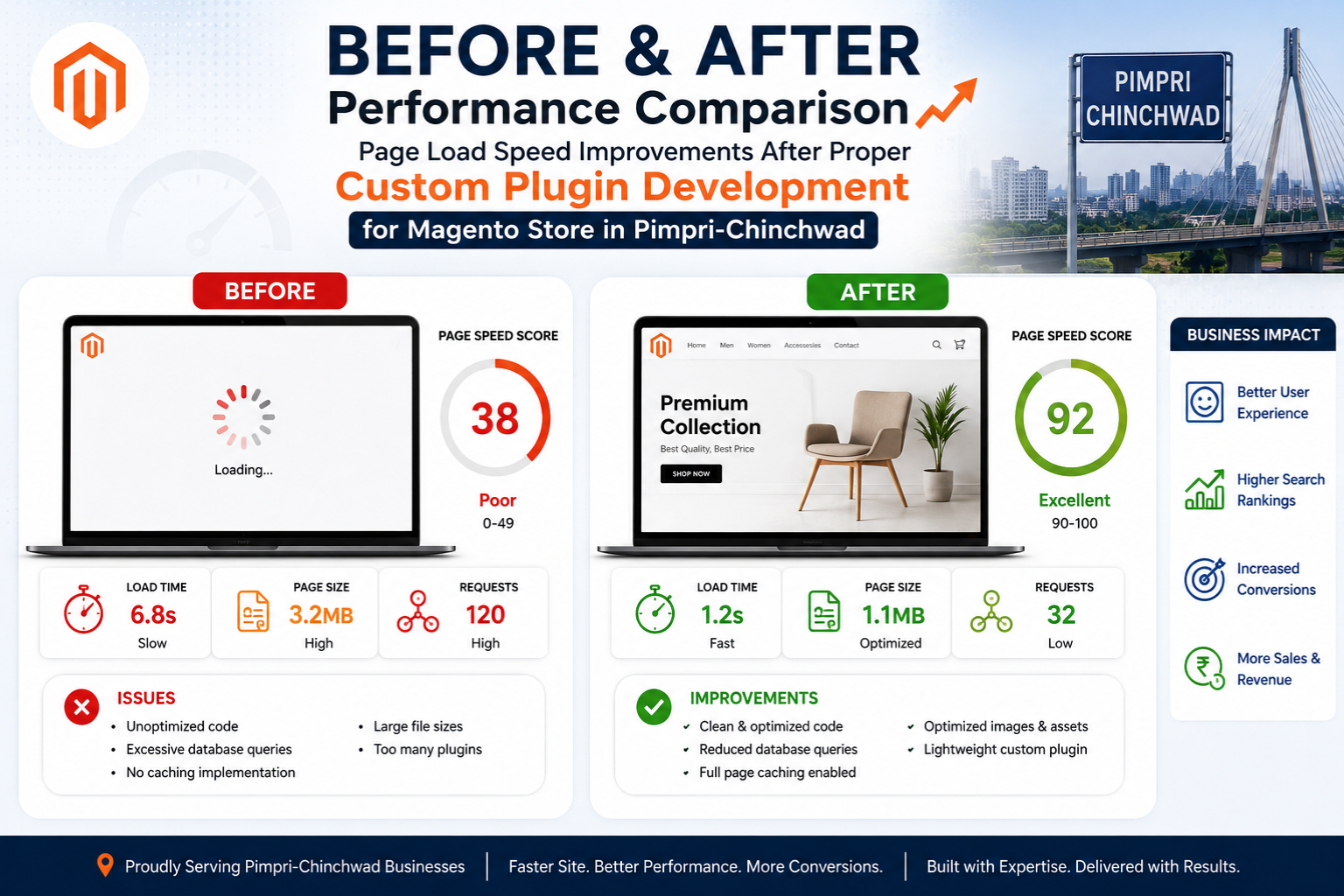
- Store speed: 8-12 second admin load, 4-6 second frontend
- Google Ads cost-per-conversion: ₹2,340
- After we rebuilt properly: 2-second admin, under 2-second frontend
- New cost-per-conversion: ₹980
- Monthly ad spend stayed the same (₹1.8 lakhs), conversions went from 77 to 184
Store #2 — Electronics Retailer (Pune)
- Six separate plugins, none integrated
- Order processing time: 12 minutes average
- Customer support handling: 35 tickets per day, average resolution 6 hours
- After consolidated custom plugin: 3-minute processing, 58 tickets per day (more customers), 1.5-hour resolution
- Support cost dropped by ₹42,000 monthly
Store #3 — Automotive Parts Supplier (Chakan)
- Cheap custom plugin broke during Magento update
- Three days of downtime
- Direct revenue loss: ₹12 lakhs
- Customer relationship damage: 8 dealers moved some business to competitors permanently
- Rebuild cost: ₹1.85 lakhs
- Total cost of “cheap” development: ₹13.85 lakhs
This is what I mean when I say custom plugin development isn’t just about the code.
Frequently Asked Questions
How much does custom plugin development for Magento typically cost in Pune?
Honestly, it varies wildly based on complexity. At Webcomp Digitex, we’ve done simple extensions for ₹25,000-40,000 (like custom product attributes with frontend display) and complex integrations for ₹3-5 lakhs (like multi-vendor marketplace functionality with custom commission logic).
Here’s what drives cost: database complexity, third-party integrations, admin interface requirements, frontend customization depth, and testing scope. A plugin that just adds a field to checkout? Maybe ₹30,000. A plugin that integrates with your ERP, handles complex approval workflows, and needs custom reporting? Could be ₹4+ lakhs.
Be skeptical of quotes that seem too cheap. We’ve rebuilt at least a dozen “cheap” plugins in the last two years because they broke stores or didn’t handle edge cases.
How long does it take to develop a custom Magento plugin?
For something straightforward — like adding custom checkout fields or modifying product display logic — we’re talking 2-4 weeks at Webcomp Digitex. That includes requirements gathering, development, testing, and deployment.
More complex work like B2B pricing engines, inventory integrations, or custom workflow management? Plan for 8-12 weeks. Maybe more if you need extensive testing with your actual data and business processes.
I’m not 100% sure anyone can give you an exact timeline without understanding your specific needs. But here’s a red flag: if someone quotes you “2-3 days” for anything beyond the simplest modification, they’re either not understanding the complexity or not planning to test properly.
Can custom plugins affect my Magento store’s performance?
Absolutely, yes. This is actually one of the biggest issues we fix. Badly written plugins can slow your store to a crawl.
Here’s what causes performance problems: database queries on every page load, poor caching implementation, loading unnecessary code globally instead of only where needed, not using Magento’s indexing properly, and blocking the checkout process with slow API calls.
When we build custom plugins at Webcomp Digitex, we profile everything with Magento’s built-in profiler and New Relic. We measure database query counts, memory usage, and page load impact. A well-built plugin should have zero noticeable impact on frontend performance for customers.
Use tools like GTmetrix, Google PageSpeed Insights, and Magento’s performance toolkit to check your store before and after adding any custom plugin.
Should I choose a custom web application development company or a Magento-specific agency?
This depends on what you’re actually building. If your need is purely e-commerce-related — checkout modifications, pricing engines, product display customization, cart functionality — you want a Magento-specific agency. They’ll understand Magento’s architecture deeply and build things the right way.
But if you’re adding complex business processes that aren’t really about selling products — manufacturing workflows, approval systems, reporting that spans multiple data sources, vendor management — you might need custom web application development services that integrate with Magento rather than extend it.
At Webcomp Digitex, we do both. We’ve worked with manufacturing units in Chakan who needed both Magento expertise and custom web application development. The key is proper integration through APIs so both systems work together without making Magento slow or unstable.
Think about it this way: if the feature is about how customers buy, it’s probably a Magento plugin. If it’s about how you run your business behind the scenes, it might be better as a separate application.
How do I maintain custom plugins after development?
Good question, because this is where a lot of businesses get stuck. Here’s what maintenance actually involves:
Compatibility updates — When Magento releases security patches or major updates, custom plugins often need adjustments. At Webcomp Digitex, we include three months of free compatibility support with custom development, then offer annual maintenance contracts.
Bug fixes — Real-world usage always reveals edge cases. You need someone available to fix issues when they come up.
Feature additions — Your business changes. You’ll want to modify or extend the plugin.
Make sure your development partner provides clean, documented code. Insist on documentation that explains how the plugin works and how to make basic changes. Get unit tests included (we use PHPUnit) so future developers can modify code without breaking things.
And honestly? Plan for ongoing relationship with whoever builds your custom plugins. One-and-done rarely works for complex Magento development.
Ready to Extend Your Magento Store the Right Way?
Look, I’ve seen too many Pune businesses waste money on custom plugin development that creates more problems than it solves. Slow stores. Broken integrations. Plugins that work until you need to upgrade Magento, then everything falls apart.
At Webcomp Digitex, we’ve spent twelve years building custom plugins for Magento stores across manufacturing, healthcare, real estate, and e-commerce. We know what works in real-world conditions, not just on a developer’s laptop.
Whether you’re in Hinjewadi dealing with complex B2B workflows, in Pimpri-Chinchwad managing industrial equipment sales, or in Baner running a growing e-commerce operation — we’ll tell you honestly if you even need custom plugin development. Sometimes you don’t. Sometimes you need better configuration, sometimes a marketplace extension, sometimes a custom web application that integrates with Magento.
We’re based in Pune. We understand local businesses. We work with your team on-site when needed. And we build things that keep working, not just at launch but six months and two Magento upgrades later.
Call us at +91-9960802498 or visit webcompdigitex.com. Let’s talk about what you’re actually trying to accomplish with your Magento store. No sales pressure. Just honest conversation about whether custom plugin development makes sense for your situation.
Because extending your store’s capabilities should make your business easier to run, not harder.


