How Much Does Web App Development Cost in India? What Pune Businesses Actually Pay
Last month, a healthcare clinic owner from Baner called me, frustrated. He’d been quoted ₹2.5 lakhs by one agency and ₹12 lakhs by another — for what looked like the same inventory management web app. “How is this even possible?” he asked. “What am I missing?”
Here’s the thing: web app development cost in India isn’t just all over the place because agencies randomly throw numbers at you. It’s because most quotes are comparing completely different things. It’s like asking “how much does a vehicle cost?” — well, are we talking about a scooter or a bus?
I’ve spent over a decade working with SMBs across Pune — from manufacturing units in Chakan to real estate developers in Kharadi — and I can tell you exactly what drives these wild price differences. More importantly, I’ll show you what you’re actually paying for so you can make a smart decision, not just pick the middle quote and hope for the best.

What You’re Actually Buying When You Pay for Web App Development
Most businesses think they’re just paying for code. That’s maybe 40% of what you’re getting.
A web app isn’t a website with a few extra pages. It’s software that runs in a browser — think of your CRM, your inventory system, your booking platform. It needs to handle data, manage users, stay secure, and actually work when ten people are using it at once.
When a web app development agency quotes you, here’s what’s buried in that number:
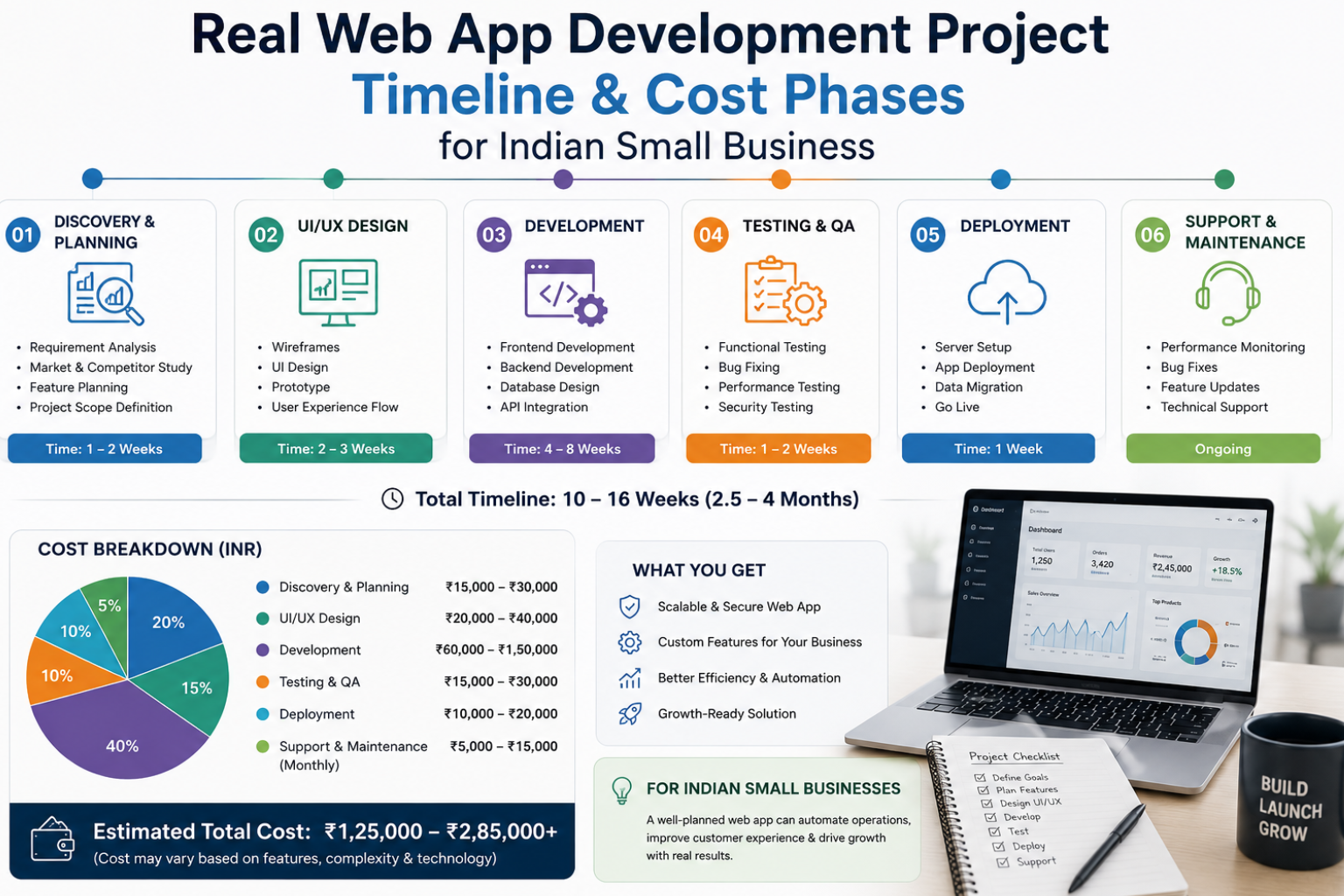
Discovery and planning — understanding your workflow, mapping out features, figuring out what the app actually needs to do. This takes 1-2 weeks for a simple project, 4-6 weeks for something complex. Skip this, and you’ll rebuild half the app later when you realize it doesn’t match how your team actually works.
Design work — not just making it look good, but creating an interface that your staff can use without constant training. We built a dispatch management system for a logistics company in Pimpri-Chinchwad, and we spent three weeks just on the driver’s mobile view because these guys needed to update deliveries while on the road, often in bright sunlight with gloves on.
Front-end development — what users see and interact with. This is your interface, your forms, your dashboards.
Back-end development — the engine. Database design, business logic, integrations with your existing tools. This is usually where 50-60% of development time goes.
Testing — not just “does it work” but “does it work when Kumar from accounts does that weird workaround he always does” and “what happens when the internet drops mid-transaction.”
Deployment and setup — getting it live, configuring servers, setting up SSL certificates, connecting domains.
Post-launch support — because something will definitely need tweaking in the first month.
Now let’s talk actual numbers.
The Real Cost Breakdown: What Indian SMBs Actually Pay
I’m going to give you real ranges based on what we’ve quoted and what I’ve seen in the Pune market. These aren’t theoretical — these are what businesses are actually spending.
Basic web app (₹80,000 – ₹2,50,000):
Simple internal tools, basic CRUD applications (Create, Read, Update, Delete), straightforward workflows. Think a leave management system, a basic inventory tracker, a simple booking calendar.
A manufacturing client in MIDC needed a quality inspection checklist app. Inspectors would fill digital forms on tablets instead of paper, data would go to a dashboard for the QA manager. No complex integrations, no payment processing, maybe 4-5 user roles. We built this for ₹1,85,000. Took 8 weeks start to finish.
This range usually means: pre-built templates with customization, standard frameworks, basic security, limited custom features.
Mid-range web app (₹2,50,000 – ₹6,00,000):
More users, more features, some integrations. Custom workflows, role-based access, maybe connection to your existing ERP or accounting software.
We worked with a real estate agency in Hinjewadi that needed a property management system. Clients could log in to see their property listings, schedule site visits, upload documents, track payment schedules. The sales team had a different view with lead management. The accounts team could generate invoices. It connected to their Tally system.
That project came in at ₹4,20,000 over 4 months. And honestly, that was the sweet spot for them — not the cheapest option, but not gold-plated either.
This range means: mostly custom development, proper database design, API integrations (usually 2-3 systems), mobile-responsive design, decent security practices, 3-4 months development time.
Complex web app (₹6,00,000 – ₹15,00,000+):
Multiple modules, advanced features, complex business logic. Think e-commerce platforms, CRM systems, healthcare management tools, fintech applications.
Here’s where the website and app development cost jumps because you’re dealing with things like payment gateway integrations, advanced security requirements, handling thousands of records, complex user permissions, scheduled tasks, email automation, reporting dashboards with real-time data.
A healthcare chain we worked with needed a patient management system across three clinics in Pune. Patient records, appointment scheduling, billing, lab report uploads, doctor availability, SMS notifications, insurance claim tracking. We used React for the frontend, Node.js for the backend, MongoDB for the database. That was a ₹11,50,000 project that took 7 months.
But here’s what most agencies won’t tell you upfront: this range is where scope creep kills budgets. Every “oh, can we also add…” conversation adds ₹50,000 to ₹1,50,000.
Why Two Quotes for the Same App Can Differ by ₹8 Lakhs
Remember that Baner clinic owner I mentioned? Here’s why his quotes were so different.
The ₹2.5 lakh quote was probably:
- Using a pre-built healthcare template
- Minimal customization
- Basic features only
- Limited post-launch support
- Shared hosting
- Maybe a junior developer doing most of the work
The ₹12 lakh quote might have included:
- Fully custom development
- Integration with diagnostic equipment
- HIPAA-level security (even though that’s US-specific, some agencies throw this in to justify cost)
- Native mobile apps for iOS and Android (not just a web app)
- Dedicated server setup
- One year of maintenance
- Training for all staff
Neither is necessarily wrong. But they’re not comparable.
Here’s my take after doing this for 12+ years: most Indian SMBs don’t need the ₹12 lakh option. But the ₹2.5 lakh option often leaves you needing a rebuild in 18 months.
The approach that actually works? Start with the core 20% of features that solve 80% of your problem. Build that well. Launch it. Then add features based on real usage, not imagined scenarios.
We did this with an e-commerce client in Wakad. Instead of building every feature in their wishlist, we launched with product catalog, cart, checkout, and basic admin panel. Cost: ₹3,80,000. Three months after launch, we added reviews, wishlists, and advanced filtering based on what customers actually asked for. That was another ₹1,40,000. Total: ₹5,20,000 spread over 8 months instead of ₹7,50,000 upfront for features they might never have needed.
The Hidden Costs Nobody Mentions in Initial Quotes
Look, I’m going to be straight with you because this is where businesses get burned.
That initial quote? It usually doesn’t include:
Hosting and infrastructure — ₹5,000 to ₹25,000 per year depending on traffic and features. A basic shared hosting plan won’t cut it for a web app. You’ll need a VPS at minimum, maybe AWS or Google Cloud if you’re handling sensitive data or expecting decent traffic.
Domain and SSL certificates — minor, but it’s ₹1,000-2,000 annually that nobody mentions.
Third-party services — payment gateway charges (usually 2-3% per transaction plus ₹3-5 per transaction), SMS gateway costs (₹0.20-0.50 per SMS), email service costs if you’re sending automated emails (₹2,000-10,000 monthly depending on volume).
Maintenance and updates — this is the big one. Your web app isn’t like a website that can sit unchanged for two years. Security patches, framework updates, browser compatibility fixes — you’ll need at least quarterly maintenance. Most agencies charge ₹15,000 to ₹50,000 annually, or 15-20% of the original development cost per year.
Training — your team needs to actually know how to use the thing. Budget ₹20,000-50,000 for proper training sessions and documentation.
Feature additions — you will want to add features. Budget for it. At Webcomp Digitex, we usually see clients spending another 30-40% of the original development cost over the next two years on feature additions and improvements.
A manufacturing unit in Chakan came to us after their previous agency disappeared. Their ₹4 lakh app hadn’t been updated in 18 months, was throwing errors, and didn’t work on the new Android version. We quoted ₹1,80,000 to fix, update, and add the features they’d been wanting. They were shocked — “but we already paid ₹4 lakhs!”
That’s the thing. App and website development cost isn’t just the upfront number. It’s the total cost of ownership over 3-5 years.

Small Budget vs Big Budget: What You Actually Get
Let’s get practical. You’re a Pune SMB. You’ve got maybe ₹3-4 lakhs to spend. What can you actually get?
The ₹3 lakh approach:
Use proven frameworks (Laravel, React, Node.js), don’t reinvent the wheel. Start with core features only. Use standard UI components instead of custom designs for everything. Deploy on reliable but affordable hosting (DigitalOcean, AWS Lightsail). Plan for a 3-4 month build time.
This works for: internal tools, basic automation, replacing spreadsheets and paper processes, simple customer-facing apps with straightforward logic.
This doesn’t work for: anything involving complex integrations, apps that need to handle thousands of concurrent users, anything in healthcare or finance where security requirements are intense, apps that need offline functionality.
The ₹8-10 lakh approach:
Custom everything. Scalable architecture from day one. Advanced security. Multiple integrations. Sophisticated user experience. Native mobile apps in addition to web. Comprehensive testing. 5-7 month timeline.
This works for: customer-facing products where UX is critical, apps handling sensitive data, platforms expecting significant user growth, businesses where this app is central to operations.
This doesn’t work for: testing an idea, replacing a simple manual process, anything where you’re not sure of requirements yet.
Here’s what I’ve seen work best: start with the ₹3-4 lakh approach, but work with a web app development agency that architects it properly. At Webcomp Digitex, we build even basic apps with clean code structure and modular design. Costs the same upfront, but when you want to add features later, you’re not rebuilding everything.
We did this for an e-commerce business in Kharadi. Built their initial admin panel for ₹2,80,000. When they wanted to add a vendor portal six months later, it was only ₹1,20,000 more because the foundation was solid. If we’d hacked it together cheaply the first time, that vendor portal would have been ₹3,50,000 because we’d have to refactor everything.
Freelancer vs Agency vs In-house: The Real Cost Comparison
Everyone asks this. “Should I just hire a freelancer? Why pay agency rates?”
Fair question. Here’s what each option actually costs, beyond just the money:
Freelancer (₹50,000 – ₹3,00,000):
Lower hourly rates, more flexible, direct communication. Good freelancers in Pune charge ₹800-2,500 per hour.
The upside: cheaper, often faster for small projects, you’re working directly with the person writing code.
The downside: if they disappear, you’re stuck. Most freelancers are good at either frontend or backend, rarely both. No formal testing process. If they’re busy with another project, your timeline slips. No team to handle design + development + DevOps.
I’ve seen this work beautifully for simple projects under ₹2 lakhs. I’ve also seen businesses spend ₹3 lakhs with a freelancer, get 70% of an app, then come to an agency to finish it — and we end up rewriting most of it because it wasn’t built to scale.
Agency (₹1,50,000 – ₹15,00,000+):
Higher cost, but you get a team. Designer, frontend developer, backend developer, QA tester, project manager.
The upside: proper process, code reviews, someone’s always available, clear contracts, usually better security practices, they’ve dealt with problems like yours before.
The downside: more expensive per hour, sometimes slower decision-making, you might be a small fish if you’re working with a big agency.
This makes sense for anything over ₹3 lakhs or anything business-critical. Yes, you’re paying more, but at Webcomp Digitex we’ve rescued enough half-finished freelancer projects to know that cheap often becomes expensive.
In-house developer (₹6,00,000 – ₹15,00,000 annually):
A decent full-stack developer in Pune costs ₹50,000-80,000 per month. Plus benefits, office space, equipment, software licenses.
The upside: dedicated resource, knows your business deeply, available for immediate fixes and changes.
The downside: expensive if you don’t have ongoing work, one person can’t do everything (design, frontend, backend, DevOps, security), gets sick or goes on vacation, might not have experience with specific technologies you need.
This makes sense only if you’re constantly building and updating applications. For most SMBs, it’s not worth it.
Here’s the comparison nobody talks about: opportunity cost. That freelancer might be ₹2 lakhs cheaper, but if your app launches 3 months late because they got busy, how much revenue did you miss? That in-house developer might seem like a good investment, but if they spend 60% of their time on minor fixes and could-be-automated tasks, you’re wasting money.
Technology Choices That Impact Web App Development Cost
This might sound technical, but it directly affects your bill.
The tech stack matters:
A simple PHP/MySQL app costs less to build than a React/Node.js/MongoDB app. Why? Developer availability and hourly rates. PHP developers in India are ₹500-1,200 per hour. React developers are ₹1,200-2,500 per hour.
But here’s the nuance: that cheaper PHP app might cost more to maintain and scale later. We rebuilt a property management app for a client who’d originally gone the cheap PHP route. The rebuild in a modern framework cost ₹4,80,000, but their hosting costs dropped from ₹18,000 monthly to ₹6,000 monthly, and page load times went from 4 seconds to under 1 second.
Pre-built vs custom:
Using existing libraries and frameworks is smart. It’s not “cutting corners” — it’s not reinventing the wheel. At Webcomp Digitex, we use proven tools: Laravel or Node.js for backend, React or Vue for frontend, PostgreSQL or MongoDB for databases.
Custom development from scratch? That’s for when you have truly unique requirements. Most businesses don’t.
Integrations add up fast:
Each third-party integration (payment gateway, SMS, email, ERP, CRM) adds ₹30,000 to ₹1,50,000 depending on complexity. APIs that are well-documented and have libraries are cheap to integrate. Proprietary systems with poor documentation? Expensive.
We integrated a custom ERP system for a manufacturing client in Chakan. The ERP vendor provided terrible documentation and a barely functional API. What should have been a ₹80,000 integration became ₹2,40,000 because we had to reverse-engineer their database structure.
Mobile responsiveness vs native apps:
A web app that works on mobile browsers is included in most quotes. Native iOS and Android apps are separate — add ₹2,50,000 to ₹8,00,000 for both platforms.
Most SMBs don’t need native apps. A well-built Progressive Web App (PWA) works on any device and costs maybe ₹50,000-1,50,000 more than a standard web app.
How to Get an Accurate Quote (Not a Random Number)
Here’s how to approach agencies so you get real numbers, not fantasy estimates.
Document your requirements — not a 50-page spec, but a clear list of:
- Who will use this (roles/user types)
- What they need to do (key actions)
- What data you’re managing
- What systems it needs to connect to
- Any special requirements (security, compliance, offline access)
Share your budget range honestly — I know, I know, you think if you say ₹5 lakhs they’ll magically quote ₹4.95 lakhs. But here’s the reality: if your budget is ₹3 lakhs and the project needs ₹7 lakhs, a good agency will tell you how to phase it or cut scope. We do this all the time at Webcomp Digitex. Saves everyone time.
Ask about what’s included — hosting, maintenance, training, post-launch support, source code ownership. Get this in writing.
Ask about the team — who’s actually building this? Junior developers? Seniors? Outsourced? Mixed team? This affects both quality and cost.
Get timeline expectations — vague “2-3 months” is useless. Ask for a milestone-based timeline: wireframes by week 2, design approval by week 4, first demo by week 8, etc.
Ask about their process — how do they handle changes? What if you realize halfway through that a feature needs to work differently? Change requests are normal, but agencies that don’t have a clear process for handling them will hit you with surprise bills.
Here’s a practitioner insight: if an agency gives you a quote within 2 hours of your inquiry, be skeptical. They haven’t understood your needs — they’re just throwing a number based on gut feel. A detailed quote takes 1-3 days to prepare properly.
Smart Ways to Reduce Your Web App Development Cost Without Killing Quality
You don’t want the cheapest app. You want the best value for your money. Here’s how to get it:
Start with an MVP — Minimum Viable Product. Build only the features you need to launch. Add the nice-to-haves later. A full-featured app might cost ₹8 lakhs, but an MVP with 40% of the features might cost ₹3.5 lakhs and solve 80% of your problems.
We built an MVP booking system for a healthcare client in Baner for ₹2,20,000. Basic appointment scheduling, patient records, payment tracking. That’s it. Six months later, when they’d actually used it and knew what else they needed, we added prescription management, lab integrations, and SMS reminders for ₹1,80,000. Total: ₹4 lakhs spread over time, much easier to budget than ₹5.5 lakhs upfront for features they weren’t even sure they needed.
Use existing design systems — custom design for every button and form costs money. Using Material Design, Bootstrap, or other established UI frameworks saves 30-40 hours of design time. That’s ₹40,000-80,000 right there.
Be decisive — every round of “let me think about this” or “can we see another option” adds time. Time is money. Agencies charge for designer hours spent creating options you’ll eventually reject.
Choose proven technologies — experimental or cutting-edge tech means fewer developers available, higher rates, and more debugging time. Boring, proven tech is cheaper and more reliable.
Handle your own content and data — if you need to migrate data from old systems or create user manuals, doing this yourself instead of paying agency rates saves money. Agency rates for content entry or data migration are ₹800-1,500 per hour. You can hire someone at ₹300-500 per hour or do it in-house.
Sign a maintenance contract upfront — most agencies offer 10-15% discount on annual maintenance if you commit during development. That ₹60,000 annual maintenance becomes ₹50,000.
But here’s where NOT to cut costs:
- Security testing and implementation
- Proper database design
- Code documentation
- Responsive design
- Basic testing
Skimping on these creates expensive problems later. We’ve rebuilt apps where clients tried to save ₹80,000 by skipping proper security implementation. Then they got hacked, lost customer data, and spent ₹4,50,000 on emergency fixes, security audit, and reputation management.
Frequently Asked Questions
How long does web app development take in India?
Simple apps take 6-10 weeks. Mid-complexity apps take 3-5 months. Complex applications take 6-12 months. But here’s what affects timeline more than complexity: how quickly you make decisions. We’ve had ₹2 lakh projects take 5 months because the client took weeks to approve each milestone. We’ve had ₹6 lakh projects finish in 3 months because decisions happened within 48 hours. Your involvement directly impacts timeline.
Should I choose a Pune-based web app development agency or go remote?
There’s something valuable about meeting face-to-face, especially during planning and training phases. At Webcomp Digitex, even though we can work entirely remote, our Pune clients appreciate being able to visit our office when there’s a complex discussion. That said, location matters less than capability and communication. A great remote agency beats a mediocre local one. But if costs and quality are equal, local wins for the relationship factor.
What’s the difference between web app and website development cost?
A website is mostly informational — pages of content, maybe a contact form, blog. Think ₹40,000 to ₹3,00,000. A web app is interactive software — it handles data, processes transactions, manages users, performs calculations. Think ₹80,000 to ₹15,00,000+. Your business app that tracks inventory? That’s a web app. Your company’s informational site with your services listed? That’s a website. The development approach, technology, and therefore cost are completely different.
Can I build a web app in phases to spread the cost?
Absolutely, and you should. We recommend it for any project over ₹4 lakhs. Phase 1 is your MVP — core features that make the app useful. Launch, use, learn. Phase 2 adds the next tier of features based on real usage patterns. This approach not only spreads cost over time but also ensures you’re building features you’ll actually use. We’ve had clients save ₹2-3 lakhs by realizing in Phase 1 that half their Phase 2 wishlist wasn’t actually necessary.
What ongoing costs should I budget for after development?
Plan for hosting (₹5,000-25,000 annually), maintenance and updates (15-20% of development cost annually), third-party service fees (payment gateways, SMS, email), and feature additions (budget at least 30% of original cost over 2 years). A ₹5 lakh app will likely cost another ₹1.5-2 lakhs over the next two years to keep running smoothly and add minor improvements. Budget for this from day one so you’re not surprised.
How do I know if a quote is reasonable or inflated?
Get at least 3 quotes from different types of providers (one freelancer, two agencies of different sizes). Compare what’s included, not just the bottom line number. Ask for detailed breakdowns. Check portfolios and references. A reasonable quote explains what you’re getting and roughly how much time each phase takes. An inflated quote is vague about deliverables and timelines. If one quote is 3x higher than others, ask why — sometimes it’s justified (they’re including things others aren’t), sometimes it’s not.
What happens if I want to switch developers mid-project?
This depends entirely on your contract and code ownership. Make sure your contract specifies that you own the source code and all project files. If you own the code, switching is possible but messy — the new developer needs time to understand what’s been built, which costs money. If you don’t own the code (some contracts are weird like this), you’re stuck. This is why choosing the right partner initially matters more than getting the absolute lowest price. At Webcomp Digitex, all client projects include full code ownership and documentation, specifically so you’re never trapped.
Is it better to use templates or build custom from scratch?
For most SMBs, starting with a framework or template and customizing it is smarter than building everything custom. You save 40-50% on development time and cost, and you’re using code that’s been tested by thousands of other users. Fully custom makes sense only when you have unique requirements that templates can’t handle. We use this hybrid approach often — start with proven frameworks (Laravel, React), customize heavily for your specific needs. You get the cost benefit of templates with the functionality of custom development.
Ready to Build Your Web App? Let’s Talk Real Numbers
Look, web app development cost in India ranges from ₹80,000 to ₹15,00,000+ depending on complexity, features, and how it’s built. But the number that matters for your business is specific to what you’re trying to solve.
At Webcomp Digitex, we’ve built web applications for manufacturing units in Chakan, real estate agencies in Hinjewadi, healthcare providers across Pune, and e-commerce businesses in Kharadi. We know what works for Indian SMBs because we work with them every day.
Here’s how we do things differently: we start with understanding your actual workflow, not just your feature wishlist. We propose a phased approach that gets you live faster and spreads cost over time. We architect even basic apps properly so they can grow with you. And we’re straight about what things cost and why — no vague estimates, no surprise bills halfway through.
We’re based in Pune, we understand the local business context, and we’ve been doing this for over 12 years. If you want an honest conversation about what your web app would actually cost and what approach makes sense for your budget, let’s talk.
Call us at +91-9960802498 or visit webcompdigitex.com. We’ll give you a detailed quote within 2-3 days after understanding your requirements — not a random number in 2 hours, but a real breakdown of what you’re getting and what it costs.
Your web app doesn’t have to cost ₹12 lakhs. But it shouldn’t be a ₹1.5 lakh mess that you’ll need to rebuild in a year either. Let’s find the right solution for your business.


