Why Your Web Design and Digital Marketing Agency Should Explain Design vs Development Before Quoting
Here’s a conversation I had last month with a real estate developer in Baner:
“We paid ₹85,000 for a website. It looks good, but we can’t update property listings without calling the developer. He quoted another ₹15,000 to add a filter. Is that normal?”
I pulled up his site. Beautiful hero images. Smooth animations. Completely static HTML. No content management system. No way to make basic changes without touching code.
That’s what happens when you don’t understand the difference between design and development. You pay for both but don’t know which one you actually need. Or worse—you pay for one thinking you’re getting the other.
I’ve been working with SMBs in Pune for over 12 years now, and this confusion shows up in almost every initial conversation at Webcomp Digitex. Not because business owners are clueless. Because most agencies don’t bother explaining it. They throw around terms like “responsive design” and “full-stack development” and hope you’ll just nod along.
Let me break down what actually matters. Not the textbook definitions—the real-world stuff that affects your budget, your timeline, and whether your website actually helps your business grow.

Myth #1: “Design and Development Are Basically the Same Thing”
I get why people think this. You hire someone to “make a website.” They do… stuff. The website appears. What’s the difference?
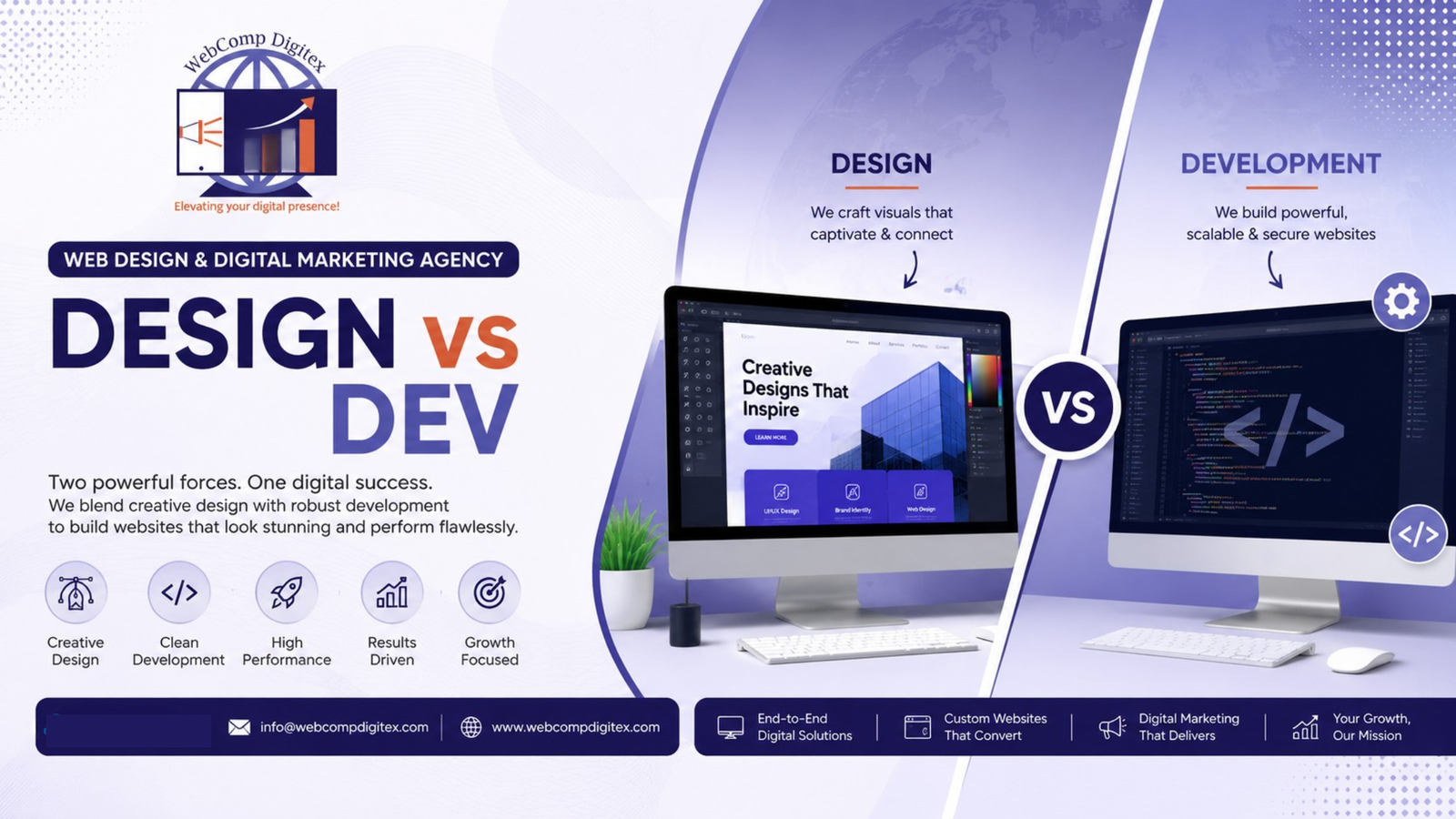
Here’s the thing: design is what you see. Development is what makes it work.
Design is your brand colors, the layout of your homepage, where the “Contact Us” button sits, how your product images are arranged. It’s visual. A designer works in tools like Figma or Adobe XD, creating mockups that show exactly what your site should look like.
Development is the code that brings that design to life. It’s what happens when someone clicks that “Contact Us” button. It’s the database that stores your product inventory. It’s the payment gateway that processes transactions. A developer works in languages like HTML, CSS, JavaScript, PHP, working in actual code editors.
But here’s where it gets tricky—and where this myth comes from. Some people can do both. They call themselves “full-stack” or “UI/UX developers.” And honestly? For small projects, that’s often fine.
The problem starts when businesses assume the person who made their site look good also built it to be functional, fast, and secure. Or when they hire a brilliant developer who creates a technically perfect site that looks like it’s from 2009.
I worked with a manufacturing client in Chakan last year. They’d hired a developer friend-of-a-friend who built them a portal where distributors could place orders. Functionally? Perfect. The logic was solid, the database structure was good, the security was tight. Visually? Absolutely terrible. Form fields that didn’t line up. Colors that clashed. Buttons that looked clickable but weren’t, and vice versa.
They came to Webcomp Digitex thinking they needed a complete rebuild. They didn’t. They needed a designer to rework the interface while keeping all that good development work intact. We redesigned the UI, and their distributor adoption went from 23% to 71% in two months. Same functionality. Different presentation.
Think about it this way: if you’re building a house, the architect designs it—the layout, the aesthetics, how rooms flow together. The construction team develops it—the foundation, electrical, plumbing, the stuff that makes the house actually work. You need both. And they need to talk to each other.
Myth #2: “Design Is Just Making Things Pretty—Development Is the Real Work”
This one bugs me, honestly. I’ve heard it from tech bros who think design is easy because it’s not “real coding.”
Look, I’m not going to pretend design and development require the same skill set. They don’t. But dismissing design as “just making things pretty” completely misses what good design actually does.
Good design converts. Bad design costs you money.
We ran an audit for a healthcare client in Kothrud—a diagnostic lab chain. Their website had been developed by a solid team. Fast loading times, secure booking system, clean code. But their appointment conversion rate was 2.1%. That’s terrible for local healthcare.
We tracked user behavior with Hotjar. People were bouncing from the test packages page. Not because it didn’t work—because they couldn’t figure out what to click. The page had eleven different CTAs, none of them visually prioritized. The package descriptions used internal medical codes instead of plain language. The price wasn’t visible without scrolling.
This wasn’t a development problem. The code was fine. This was a design problem—both visual design and user experience design.
We redesigned that page. One clear CTA above the fold. Prices visible immediately. Descriptions in language actual humans use. Same backend. Same development. Conversion rate jumped to 8.7% in six weeks. That’s over 4x more appointments from the same traffic.
Here’s what I mean: development makes things possible. Design makes things usable.
You can have the most sophisticated backend in the world—beautifully structured database, lightning-fast queries, clever algorithms. If users can’t figure out how to interact with it, it’s useless.
And it goes beyond just usability. Design communicates trust. When someone lands on your site, they make a snap judgment in about 0.05 seconds. That judgment is based almost entirely on design. Does this look professional? Does this look current? Does this look trustworthy?
A manufacturing company in Pimpri-Chinchwad came to us after their sales team complained that prospects were asking if they were “still in business.” The company was doing ₹40 crores annually. But their website looked like it was built in 2007—because it was. The development was actually holding up fine. But the design was killing their credibility.
We kept the same CMS, same structure, same basic functionality. Just redesigned the frontend. Sales team stopped getting that question. Lead quality went up because prospects stopped assuming they were some fly-by-night operation.
That’s not “just making things pretty.” That’s business-critical communication.

Myth #3: “I Can Redesign Later—Let’s Just Get Something Up Now”
I hear this all the time, especially from startups and small businesses watching their budget. “Let’s launch with something basic, then we’ll invest in design once we have revenue.”
Here’s my take, and this might just be my experience: that redesign almost never happens when you plan it. And even when it does, it costs way more than doing it right the first time.
Why? Because redesigning isn’t just changing colors and fonts. If your original site was built without thinking about design, the development probably wasn’t structured to support good design either.
Let me give you a real example. An e-commerce client in Hinjewadi selling industrial supplies came to Webcomp Digitex wanting a redesign. They’d launched two years earlier with a basic WooCommerce site, planning to “improve it later.” Later had arrived.
But here’s what they didn’t realize: their developer had hardcoded a bunch of layout elements directly into theme files. To redesign properly, we couldn’t just change the CSS—we had to refactor significant portions of the PHP templates. What should have been a ₹1.2 lakh design project became a ₹3.8 lakh design-plus-redevelopment project.
If they’d worked with a web design and marketing agency that understood both disciplines from the start, that structure would have been built to accommodate design changes.
Now, I’m not saying you need a ₹10 lakh custom site right out of the gate. That’s not realistic for most SMBs. But there’s a difference between “simple and strategic” and “quick and we’ll-deal-with-it-later.”
Simple and strategic means:
- Clean, professional design that matches your brand
- Development structure that can grow with you
- User experience that doesn’t frustrate people
- Mobile responsiveness that actually works
Quick and we’ll-deal-with-it-later means:
- Template that kind of fits
- Plugins stacked on plugins
- “Good enough” mentality that shows
- Technical debt that compounds
At Webcomp Digitex, we’ve seen both approaches age. The first one scales. The second one collapses under its own weight around month 18, requiring a complete rebuild.
There’s also a psychological thing that happens. Once a site is live, even a mediocre site, there’s organizational resistance to changing it. “It works fine.” “People know where things are.” “Let’s focus on marketing instead.” The momentum to improve just… disappears.
And here’s the thing about that “let’s focus on marketing” line—your website IS marketing. If I’m running Meta Ads or Google Ads for you, I’m driving traffic to your site. If your site doesn’t convert because the design is confusing or looks sketchy, I’m wasting your ad budget. Good digital design companies understand this connection. Your ads, your SEO, your social—all of it eventually points back to your website.
Myth #4: “Developers Should Know Design, and Designers Should Know Code”
This is the myth that sounds reasonable but causes real problems.
Yes, there’s value in designers understanding basic HTML/CSS. Yes, there’s value in developers understanding basic design principles. A little crossover knowledge helps both sides communicate better.
But expecting your developer to be a great designer, or your designer to code complex functionality, is like expecting your chef to also be a great server. Related skills? Sure. Same skillset? Not really.
I’ve seen this play out badly in both directions.
Direction one: The developer-designed site. I worked with a logistics company in MIDC Bhosari whose owner’s nephew “knew computers.” He built them a functional tracking system—impressive, actually, for someone self-taught. But the interface was brutal. Couriers had to click through seven screens to update a delivery status. The color scheme was… let’s call it “bold.” Buttons were different sizes for no reason.
They came to us after their courier team literally refused to use it. We brought in a UX designer who mapped out the actual workflow, reduced it to two screens, and created visual consistency. Same backend code. Completely different user experience.
Direction two: The designer-coded site. A real estate agency in Wakad hired a graphics designer who’d taken a WordPress course. She created something visually stunning. Seriously beautiful. But it loaded in 8.4 seconds. The contact form didn’t validate inputs. The search function broke if you used certain characters. There was no backup system. The site crashed twice in the first month.
We had to essentially rebuild it from scratch while keeping her design vision. Could’ve been avoided if they’d hired both a designer and developer from the start—or worked with a web design and digital marketing agency that had both on staff.
Here’s what actually works: collaborative teams where people do what they’re good at.
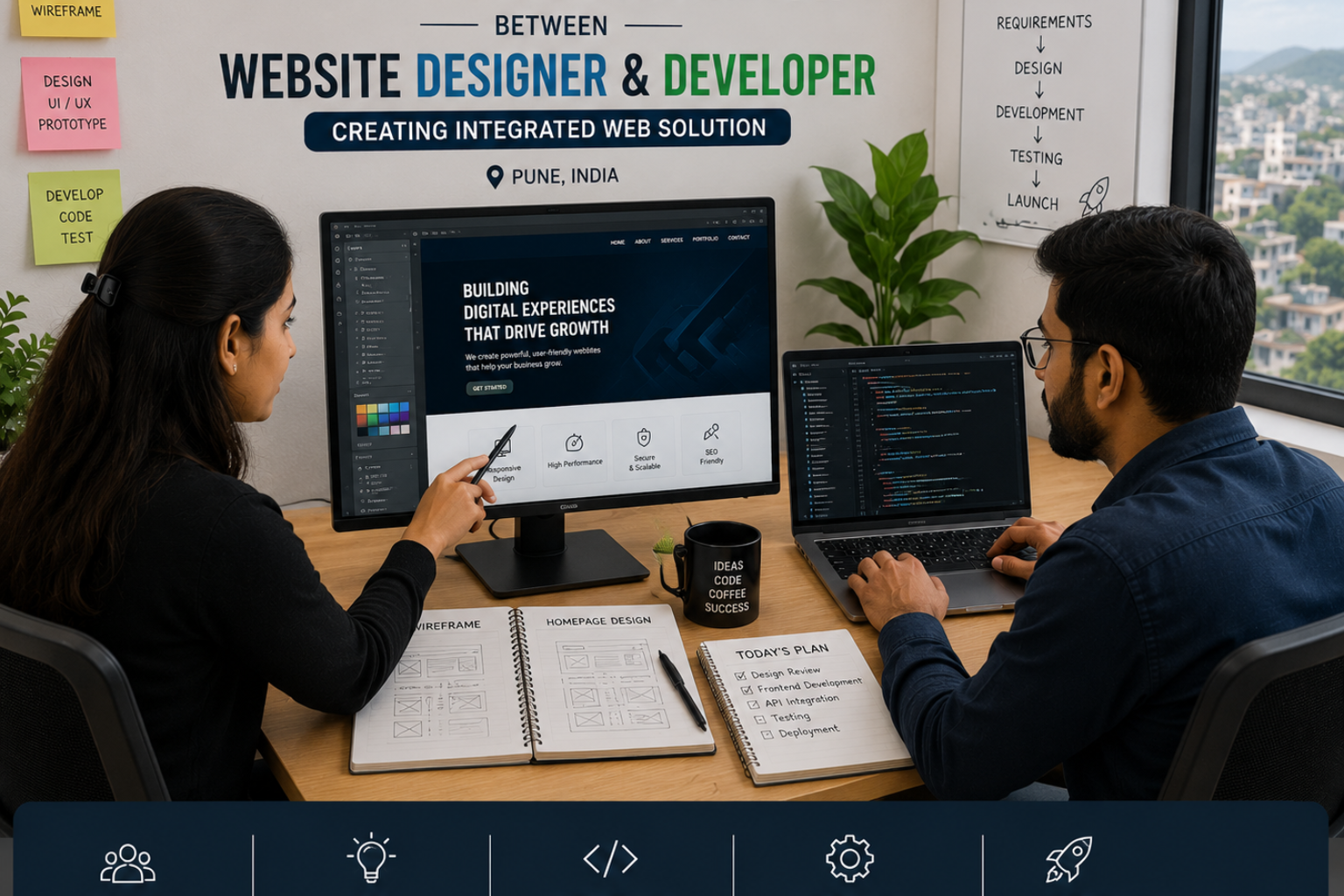
At Webcomp Digitex, our designers create mockups in Figma. Our developers review them to flag anything that’s technically problematic or will hurt performance. Designers adjust. Developers build it out. Designers QA the visual implementation. Developers QA the functionality. It’s back and forth, but each person stays in their lane.
That’s how you get sites that look great AND work great.
The “one person does everything” approach can work for very simple sites. A basic five-page company profile? Sure, a good designer with template-level development skills can probably handle it. But anything with custom functionality, anything with user interactions, anything you need to scale—you want specialists.
What Actually Matters for Your Business
Okay, enough myth-busting. Here’s what you should actually care about when hiring someone to build your website:
First, understand what you need.
Are you building a simple informational site? A designer who knows WordPress can probably handle it.
Are you building something with custom features—booking systems, calculators, portals, integrations with your existing software? You need a developer, probably multiple developers with different specializations.
Are you building something people need to use regularly—a tool, a dashboard, an app? You need both, and the design might actually be more critical than the development.
Second, ask about the team.
When you talk to an agency, ask who’s actually doing the work. Is it one person wearing multiple hats? Is it a team of specialists? There’s no inherently wrong answer, but you should know what you’re getting.
At Webcomp Digitex, we’re transparent about this. You’ll meet your designer and your developer. You’ll know who to talk to about what. If you want to change a color, that’s design. If you want to add a feature, that’s development. Different conversations, different timelines, different pricing.
Third, look at their past work through both lenses.
Don’t just look at whether their portfolio sites look good. Open them on your phone. Try to complete an action—sign up for something, filter products, submit a form. Click around. Does it feel intuitive? Is it fast? Does anything break?
If an agency shows you beautiful sites that don’t actually work well, they’re design-heavy. If they show you functional sites that look outdated, they’re development-heavy. You want both.
Fourth, understand the ongoing relationship.
Design and development don’t end at launch. Your site will need updates, changes, improvements. Who handles what?
We’ve taken over sites from clients who had separate designers and developers who didn’t talk to each other. Every change became a mess of miscommunication. “The designer sent me a mockup I can’t build.” “The developer changed my layout.” Neither side taking ownership.
When you work with a proper web design and marketing agency, there’s one point of contact, one project manager coordinating both sides. Makes life so much easier.
A Real-World Example: When Both Matter Equally
Let me tell you about a project that really drove this home for me.
We worked with an industrial pump manufacturer in Chakan—₹15 crore annual revenue, mostly B2B. They wanted a site where engineers at client companies could select pumps based on technical specifications, get instant quotes, and download CAD files.
The functionality requirements were intense. Dynamic filtering across eight parameters. Real-time pricing calculations based on specifications and quantity. Integration with their ERP system. Automated CAD file generation. This was serious development work.
But here’s the thing: their buyers were mechanical engineers, not IT people. They were used to calling a sales rep and having someone walk them through selection. They were skeptical of self-service tools.
If we’d just built the functionality without thinking about the experience, it would have failed. We needed to design an interface that felt guided, almost hand-holding, even though it was automated.
Our designer and developer sat together for the initial planning. Designer mapped out the user flow—how questions would be asked, how options would be presented, how confidence would be built at each step. Developer figured out how to make that flow technically possible without sacrificing performance.
The result was something that worked beautifully (development) and felt intuitive even to people who’d never done it before (design).
Within four months, 67% of their regular clients were using the tool instead of calling sales. Sales team shifted from taking specs to handling complex custom projects. Revenue per sales rep went up 34% because they were spending time on higher-value activities.
That doesn’t happen with good development alone. That doesn’t happen with good design alone. That happens when both work together toward the same business goal.
The Marketing Connection You Can’t Ignore
Here’s one more thing that most digital design companies miss: your website exists within a larger marketing ecosystem.
We’re a web design and digital marketing agency specifically because these things are connected. Your website isn’t a standalone asset. It’s where your SEO efforts are supposed to convert. It’s where your paid ads send traffic. It’s where your social media followers go to take action. It’s where your email campaigns link.
If your website isn’t designed and developed with marketing in mind, all those other efforts suffer.
Marketing-focused design means:
- CTAs that stand out and create urgency
- Layout that guides people toward conversion actions
- Trust signals placed strategically
- Forms that balance information gathering with conversion rate
Marketing-focused development means:
- Fast loading times (affects your Google Ads Quality Score)
- Proper schema markup (helps your SEO)
- Tracking code implemented correctly (so you actually know what’s working)
- Integration with your CRM, email platform, analytics tools
A manufacturing client came to us after spending ₹4.8 lakhs on Google Ads over six months with minimal results. We looked at their campaigns—actually well set up. Targeting was good. Ad copy was decent. The problem was the landing page.
Their developer had built a generic inquiry form with twelve fields. No headline specific to the ad. No social proof. No clear value proposition. The design didn’t match the ad creative at all—people clicked an ad with blue branding and landed on a page with red branding. Confusing.
We redesigned the landing page to match the ad journey, reduced the form to four fields, added testimonials from similar clients, created specific headlines for each ad group. Same development backend—the form still went to the same place. Just better design that understood the marketing context.
Cost per qualified lead dropped from ₹6,400 to ₹1,900 in four months. Same ad budget, same traffic volume, just better conversion through design that understood marketing.
Frequently Asked Questions
How much should I budget separately for design vs development?
This depends entirely on what you’re building, but here’s a rough framework from what we see in Pune: For a basic informational website (5-10 pages, standard functionality), you’re looking at roughly 40% design and 60% development. For something with custom features or complex user interactions, it might flip to 30% design and 70% development. For something where UX is critical—dashboards, tools, apps—it could be 50-50 or even 60% design and 40% development. Don’t let anyone tell you there’s a universal ratio. At Webcomp Digitex, we quote based on the specific requirements after understanding what you actually need.
Can’t I just use a template and skip the custom design?
You can, and honestly, for some businesses it makes sense. A good premium template with light customization can work great for straightforward sites. But here’s what templates can’t do: match your exact brand, address your specific user needs, stand out from competitors (who might be using similar templates), or accommodate unique features without breaking. I’m not anti-template—we’ve implemented them when it’s the right fit. Just understand the tradeoffs. You’re choosing “good enough” over “exactly right.” Sometimes that’s a smart business decision. Sometimes it’s penny-wise and pound-foolish.
How do I know if my current site’s problems are design or development?
Here’s a quick test: If your problem is about how things look, how things are organized, or whether users can figure out what to do—that’s design. If your problem is about things not working, being slow, breaking, or not doing what they’re supposed to—that’s development. If it’s both, or you’re not sure, use Google Analytics and Hotjar to see where people are actually struggling. Track where they drop off. Record sessions. At Webcomp Digitex, we always do this audit before recommending solutions because fixing the wrong thing wastes everyone’s time and money.
Do I need a full-service agency or can I hire designers and developers separately?
You can absolutely hire separately—lots of businesses do. The advantage is you can pick the best specialist for each role. The disadvantage is coordination becomes your job. You’re the project manager, mediator, and decision-maker when design and development conflict. If you have the time and knowledge to manage that, fine. Most SMB owners don’t. That’s why agencies like Webcomp Digitex exist—we handle that coordination so you can focus on running your actual business. Also, when things go wrong (they always do at some point), you have one throat to choke instead of two parties blaming each other.
How long does proper design and development take?
Stop believing anyone who promises a custom site in two weeks. That’s template deployment, not custom work. For a properly designed and developed business website with standard features, expect 8-12 weeks minimum. Custom functionality adds time—sometimes a lot of time. A realistic timeline at Webcomp Digitex: 1-2 weeks discovery and planning, 2-3 weeks design and revisions, 3-4 weeks development, 1-2 weeks testing and refinement. Rush it, and you’ll either get something half-baked or pay rush fees that’ll make you cry. Plan ahead.
What should I ask an agency before hiring them?
Ask to talk to both a designer and a developer—if they can’t produce both, that tells you something. Ask how they handle the handoff between design and development. Ask what tools they use (you want to hear things like Figma, Adobe XD for design; Git, VS Code for development; GA4 and Google Search Console for tracking). Ask about their revision process for both. Ask for examples where they solved problems similar to yours—specific examples, not vague portfolio pieces. And honestly? Ask what happens when things go wrong. Everyone promises smooth sailing. You want to work with people who have a plan for storms.
Let’s Talk About Your Project
Look, I’ve thrown a lot at you in this article. Here’s the summary: design and development are different skills that need to work together. You need both. How much of each depends on what you’re building. Don’t cheap out on either one. Don’t assume they’re the same thing. Don’t hire people who can’t explain the difference.
At Webcomp Digitex, we’ve spent 12+ years building websites for manufacturing companies, real estate developers, healthcare providers, and e-commerce businesses all across Pune—from Hinjewadi to MIDC to Baner to Kharadi. We’ve seen what works and what doesn’t. We’ve fixed what others broke. We’ve learned expensive lessons so you don’t have to.
We’re a web design and digital marketing agency specifically because these elements don’t exist in isolation. Your website needs to look good (design), work reliably (development), and actually help you grow your business (marketing). That’s the whole point.
If you’re building something new, redesigning something old, or just trying to figure out why your current site isn’t delivering results, let’s talk. No sales pitch on the first call—just a real conversation about what you need and whether we’re the right fit.
Call us at +91-9960802498 or visit webcompdigitex.com. We’re based in Pune, we work with businesses like yours, and we’ll give you straight answers about what your project actually needs.
Because at the end of the day, it’s not about design versus development. It’s about building something that actually works for your business.


