
How a Web App Development Agency Builds Applications That Actually Scale
You’ve probably been there. Your web application worked fine with 500 users. Then you hit 5,000 and things started breaking. Pages load slower. Forms time out. Your developer says you need to “rebuild from scratch” and that’ll cost another ₹15 lakhs.
Here’s what nobody tells you upfront: scalability isn’t something you bolt on later. It’s baked in from day one, or you pay for it later. Much more expensively.
I’ve spent the last 12 years working with businesses in Pune — manufacturers in Chakan who need dealer portals, real estate developers in Baner building property management systems, healthcare clinics in Kharadi wanting patient booking platforms. And I can tell you this: most web app projects fail not because of bad code, but because nobody planned for what happens when things actually work.
At Webcomp Digitex, we’ve built web applications that started with 200 users and now handle 50,000+ without breaking a sweat. Let me show you exactly how we do it, and more importantly, why most web app development services get this wrong.

Why Most Web Apps Can’t Scale (And How We Think Differently)
Look, I’m going to be blunt here. Most custom web application development company teams build for today. They ask “what features do you need?” and start coding. Three months later, you have a working application. Six months after launch, when your user base doubles, everything falls apart.
We start every project with a different question: “What happens when this works really well?”
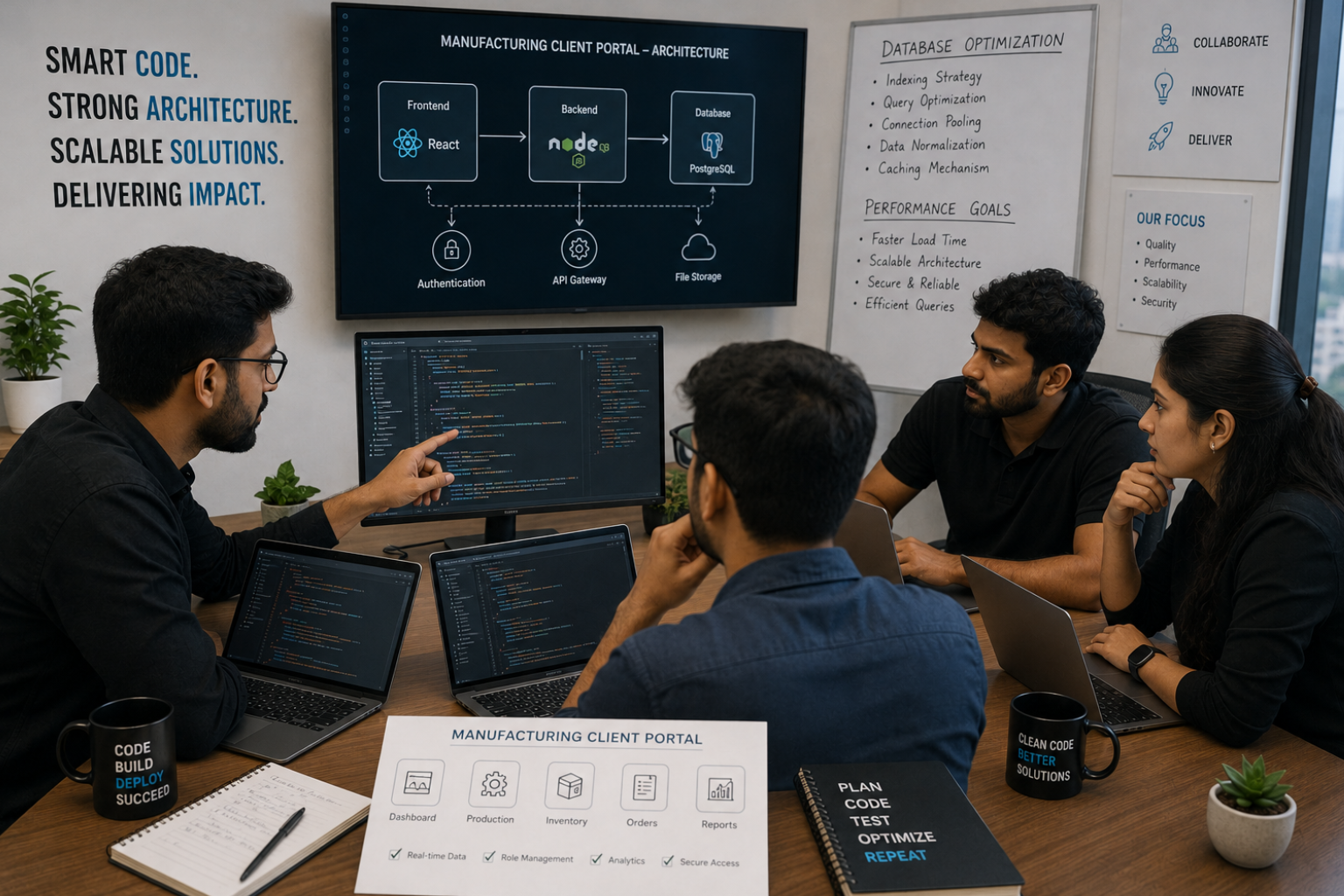
Think about it this way. A manufacturing client came to us last year from Pimpri-Chinchwad. They needed a dealer management system for 45 dealers. Simple enough, right? But we asked: what if you get that funding round you’re planning for? What if you expand to 200 dealers next year? What if each dealer starts placing 10 orders a day instead of 2?
Those questions changed everything about how we built their system.
Here’s what I mean by scalability in practical terms:
- Your database can handle 10x more records without slowing down
- Your server can process more requests by simply adding resources
- Your code doesn’t need a complete rewrite when features expand
- Your hosting costs grow linearly, not exponentially, with users
Most developers don’t think this way because honestly, it’s easier to build for right now. Planning for scale takes more upfront work. It means making architecture decisions that might seem like overkill for your current 500 users.
But here’s the thing: rebuilding later costs 3-4 times more than building it right the first time.
The Architecture Decisions That Actually Matter
I’m going to get a bit technical here, but stay with me. These decisions make or break scalability.
Modular architecture isn’t buzzword stuff. It means we break your application into independent pieces. Your user authentication system sits separate from your inventory management, which sits separate from your reporting engine. Why does this matter? Because when 10,000 users hit your login page simultaneously, it doesn’t bring down your entire application.
We built a healthcare platform for a Hinjewadi clinic chain last year. Patient bookings, doctor schedules, medical records, billing — all separate modules. When they ran a Facebook campaign and got 3,000 booking requests in one day, only the booking module felt the load. Everything else ran normally.
Database architecture is where most applications die slowly. Here’s something only someone who’s actually done this work would tell you: it’s not about choosing MySQL vs PostgreSQL vs MongoDB. It’s about how you structure your data relationships and queries.
We worked with an e-commerce client who had a product database that took 8 seconds to load search results. Eight seconds. Know what the problem was? Every search query was checking stock levels across 6 warehouse tables in real-time. We restructured it so stock levels update every 5 minutes instead of real-time (which they didn’t actually need), and search dropped to 0.4 seconds.
Nobody needs real-time data for everything. But most developers build like everything needs to update instantly.
API-first development means your web application can grow into a mobile app, integrate with other systems, connect to third-party tools — all without rebuilding core functionality. We use this approach for every project at Webcomp Digitex because we’ve seen too many businesses held hostage by rigid systems.
A real estate client in Wakad needed their property listings to appear on their website, their mobile app, and automatically sync to 99acres and MagicBricks. Because we’d built their system API-first, adding those integrations took 3 weeks instead of 3 months.
How We Handle Growth Without Breaking Things
Scalability isn’t just about architecture. It’s about what happens in production when real humans use your application in ways you never expected.
Caching strategies save your bacon. Look, database queries are expensive. If 5,000 users request the same product catalog page, why hit the database 5,000 times? We implement multiple caching layers — Redis for session data, CDN for static assets, application-level caching for frequent queries.
That manufacturing client I mentioned earlier from Pimpri-Chinchwad? Their dealer dashboard loads in 1.2 seconds even during peak order-placing hours (8-10 AM apparently, when dealers are most active). Without caching, it’d be 6-7 seconds. Dealers would’ve hated it.
Load balancing isn’t something you add later. We set up applications so traffic distributes across multiple servers from day one. Yeah, you might run just one server initially, but the architecture allows you to spin up server 2, 3, 4 when needed. No code changes required.
One of our e-commerce clients went from 200 daily orders to 2,000 during a Diwali sale. We added two servers the day before, and their checkout process didn’t miss a beat. Cost them ₹12,000 extra for those 10 days, but they processed ₹40+ lakhs in additional sales.
Database optimization is ongoing work. We monitor query performance using tools like New Relic and PostgreSQL’s native analytics. Slow queries get identified and fixed before they become problems. Indexes get added where needed. Tables get partitioned when they grow too large.
This might sound boring, but here’s a real number: we reduced a client’s database server costs from ₹28,000/month to ₹11,000/month by optimizing 23 slow queries. Same performance, less than half the cost.

The Tech Stack Choices That Enable Scale
People obsess over tech stack like it’s the secret sauce. It’s not. But it matters.
We’re framework-agnostic, but opinionated. For most business applications, we lean toward:
- Backend: Node.js or Python (Django/FastAPI) depending on requirements
- Frontend: React or Vue.js for dynamic interfaces
- Database: PostgreSQL for structured data, MongoDB when we need flexibility
- Cloud: AWS or Google Cloud, almost never shared hosting
Why these choices? Because they’re battle-tested at scale. Millions of applications run on these stacks. When you hit a weird scaling issue, someone else has solved it already.
But here’s what matters more than the framework: how we use it.
Containerization with Docker means your application runs identically in development, testing, and production. No more “but it worked on my machine” nonsense. And it makes scaling horizontal (adding more servers) dead simple.
CI/CD pipelines let us deploy updates without downtime. We push code changes, automated tests run, and if everything passes, it deploys automatically. Your users never know an update happened.
A healthcare client needed to add a new feature to their patient portal. Using our CI/CD setup, we deployed it on a Tuesday afternoon. Zero downtime. Patients booking appointments didn’t notice a thing.
Real Performance Under Real Load
Here’s something you won’t hear from most web app development agency pitches: we load test everything before launch.
Using tools like Apache JMeter and k6, we simulate thousands of concurrent users hitting your application. We find the breaking points in a controlled environment, not when your business depends on it.
That e-commerce client I mentioned? Before their Diwali sale, we simulated 3,000 concurrent users completing checkouts. The application handled it fine. We simulated 5,000. A database bottleneck appeared. We fixed it. On actual sale day, their peak was 2,200 concurrent users and everything ran smoothly.
We monitor everything in production. GA4 for user behavior, obviously. But also:
- Server performance metrics (CPU, memory, disk I/O)
- Application performance monitoring with tools like New Relic
- Error tracking with Sentry
- Uptime monitoring with Pingdom
When something starts degrading, we usually know before you do. And we can often fix it before it impacts users.
A real example: we noticed increased database query times for one client at 2 AM on a Wednesday. Turned out their automated backup process was running during peak international user hours (they had customers in the US). We shifted the backup window, problem solved.
Security That Scales With Your Application
Scalability without security is just building a bigger target.
We implement security at every layer:
- Input validation on the frontend and backend
- SQL injection prevention through parameterized queries
- XSS protection with content security policies
- Rate limiting to prevent abuse
- SSL/TLS for all data transmission
- Regular dependency updates to patch vulnerabilities
One of our real estate clients in Baner had their old website (built by someone else) get hit with a credential stuffing attack. Attackers tried 50,000 login attempts in 3 hours. Their server crashed.
When we rebuilt their property management system, we implemented rate limiting (10 login attempts per IP per hour), CAPTCHA after 3 failed attempts, and IP blocking for suspicious patterns. Last month, they got hit with a similar attack. The system automatically blocked the attackers, notified us, and normal users experienced zero disruption.
Data backup and disaster recovery are non-negotiable. Automated daily backups with 30-day retention. Database transaction logs for point-in-time recovery. We can restore your application to its state 5 minutes before something went wrong.
This saved a healthcare client when a staff member accidentally deleted 200 patient records. We restored from backup, and only 15 minutes of data entry was lost.
Cost vs Scale: The Real Numbers
Let’s talk money because that’s what actually matters.
Building a scalable web application costs 20-30% more upfront than building a “just make it work” version. For a typical business application, we’re talking ₹6-8 lakhs instead of ₹4-5 lakhs.
But here’s the math that matters: rebuilding later costs ₹12-18 lakhs. Plus the cost of downtime, lost users, and business disruption.
Our hosting and maintenance approach: We don’t lock you into expensive managed services. We set up your application on cloud infrastructure that scales with usage. A typical starting point:
- Month 1-6: ₹8,000-12,000/month (small server, low traffic)
- Growth phase: ₹15,000-25,000/month (medium load)
- Scale phase: ₹30,000-50,000/month (high traffic, multiple servers)
That manufacturing client in Chakan I mentioned? They started at ₹9,500/month. They’re now at ₹23,000/month supporting 180 dealers and 45,000 transactions per month. Their revenue grew 4x. Their tech costs grew 2.5x. That’s healthy scaling.
Compare that to another business we consulted with (but didn’t build for). They went cheap initially, paid ₹3.5 lakhs for a basic system. Within 18 months, they needed to rebuild. Total cost: ₹14 lakhs. Plus 4 months of development time when they should’ve been growing.
Frequently Asked Questions
What makes a web application scalable vs non-scalable?
A scalable application can handle increased load (more users, more data, more transactions) without significant performance degradation or complete rewrites. The key factors are modular architecture, efficient database design, proper caching, and infrastructure that allows horizontal scaling. Non-scalable apps are usually monolithic, have poorly optimized databases, and can only run on a single server. Basically, scalable systems let you add resources to handle growth; non-scalable ones hit hard limits.
How long does it take to build a scalable web application?
Honestly, it depends on complexity, but for most business applications, expect 3-6 months. A basic dealer management system might take 3-4 months. A full-featured e-commerce platform with inventory, payments, and logistics integration might take 6-8 months. We don’t rush this at Webcomp Digitex because scalability requires proper planning and testing upfront. Quick 6-week projects usually mean you’ll be rebuilding within a year.
Can you make my existing application scalable?
Sometimes yes, sometimes no. If your application is reasonably well-structured, we can often re-architect parts of it — optimize the database, add caching layers, move to better hosting, break out heavy features into separate services. But if it’s built on a fundamentally flawed architecture or very old technology, rebuilding is often faster and cheaper than trying to retrofit scalability. We typically do a 2-3 day technical audit to give you an honest answer.
What’s the difference between vertical and horizontal scaling?
Vertical scaling means making your server bigger — more CPU, more RAM, faster disk. It’s simple but has limits and gets expensive fast. Horizontal scaling means adding more servers and distributing the load. It’s harder to set up initially but scales infinitely and costs less at scale. We design applications for horizontal scaling because that’s how you handle real growth. You can’t buy a single server big enough for 100,000 concurrent users, but you can run 20 medium servers.
How do you test if an application can actually handle growth?
We use load testing tools like Apache JMeter and k6 to simulate thousands of users hitting your application simultaneously. We test different scenarios — 1,000 users browsing, 500 users checking out, 100 users uploading files — whatever matches your business model. We gradually increase load until we find breaking points, then fix those weak spots. We also use monitoring tools in production (New Relic, Datadog) to track real performance under real usage patterns.
What happens if traffic suddenly spikes beyond expectations?
If we’ve built the infrastructure properly, we can scale up quickly — sometimes within minutes by adding servers or increasing resources. We set up auto-scaling for clients who expect unpredictable traffic (like e-commerce during sales). For others, we monitor actively and can scale manually when needed. The key is having architecture that allows rapid scaling without code changes. And honestly, we usually over-provision slightly for important events rather than risk downtime.
Let’s Build Your Web Application the Right Way
Look, you’ve got two paths here. Build cheap and fast now, then rebuild expensively later. Or invest in proper scalable architecture upfront and grow smoothly.
We’ve been down both roads with clients. The second one is always less painful and less expensive in the long run.
At Webcomp Digitex, we’ve built scalable web applications for over 50 businesses across Pune — from small startups to established companies doing ₹50+ crore annual revenue. We know what works in real production environments, not just in theory.
Our web app development services cover the full lifecycle — architecture planning, development, testing, deployment, monitoring, and ongoing optimization. We’re not the cheapest custom web application development company in Pune, but we’re probably the most honest about what it actually takes to build systems that scale.
Want to talk about your specific project? We’ll give you a straight answer about whether you actually need heavy-duty scalability or if you’re fine with a simpler approach. Not every application needs to handle a million users, and we won’t oversell you.
Call us at +91-9960802498 or check out our work at webcompdigitex.com. We’re based in Pune and work primarily with businesses in Hinjewadi, Baner, Kharadi, Wakad, and across Pimpri-Chinchwad and the MIDC areas.
We’ll start with understanding your business, your growth plans, and what “scale” actually means for you. Then we’ll build something that works today and grows with you tomorrow.
Because that’s what a proper web app development agency should do.


