
How a Facebook Advertising Agency Near Me Helped Scale Ads Without Burning Cash
You’re spending ₹40,000 a month on Meta ads. It’s working okay — decent leads, some conversions. Your agency or internal person says “let’s scale this up to ₹1.5 lakh and get more results.”
So you do. And suddenly everything breaks.
Cost per lead shoots up 3x. Quality tanks. You’re getting tire-kickers instead of serious buyers. The campaigns that were humming along at ₹40k are now gasping for air at ₹1.5 lakh. You’ve just learned the expensive way that scaling Meta ads isn’t about spending more money.
I’ve seen this exact scenario play out with at least 15 businesses in Pune over the past three years. A real estate developer in Baner, a manufacturing unit in Chakan, an e-commerce brand in Kharadi — same story, different industry.
Here’s what actually works when you want to scale Meta ads without lighting your budget on fire.

Stop Scaling Like It’s 2019
Most facebook marketing companies still tell you to “just increase the budget by 20% every few days.” That’s outdated advice that’ll wreck your campaigns.
Meta’s algorithm has changed. The auction dynamics are different. Competition in Pune alone has tripled since 2020. When you dump more money into a campaign too fast, you force Meta to find new audiences quickly — and it’ll grab anyone remotely matching your targeting, even if they’re terrible fits.
We worked with a healthcare clinic in Pimpri-Chinchwad last year. They were getting quality appointment bookings at ₹890 per lead with a ₹30,000 monthly budget. They wanted to scale to ₹1 lakh to open a second location.
Their previous paid advertising agency just cranked up the spend. Within two weeks, cost per lead hit ₹2,100 and appointment no-shows doubled. Why? Meta was scraping the bottom of the barrel for audiences.
Here’s what we did instead: we kept the winning campaign at ₹30k and built three new campaigns with fresh creatives, different angles, and slightly different audiences. Each started at ₹15k. Total spend went to ₹75k, but we weren’t forcing one tired campaign to do all the heavy lifting.
Result? Cost per lead dropped to ₹740 within six weeks because we gave Meta’s algorithm room to explore and optimize properly across multiple campaigns.
Think about it this way: you don’t ask one sales guy to handle 10x more leads. You hire more salespeople. Same with campaigns.
The Creative Problem Nobody Talks About
You can’t scale on one creative. Period.
This is something you only learn after managing a few hundred thousand rupees in Meta ad spend. The platform will burn out your creative way before you hit your budget ceiling.
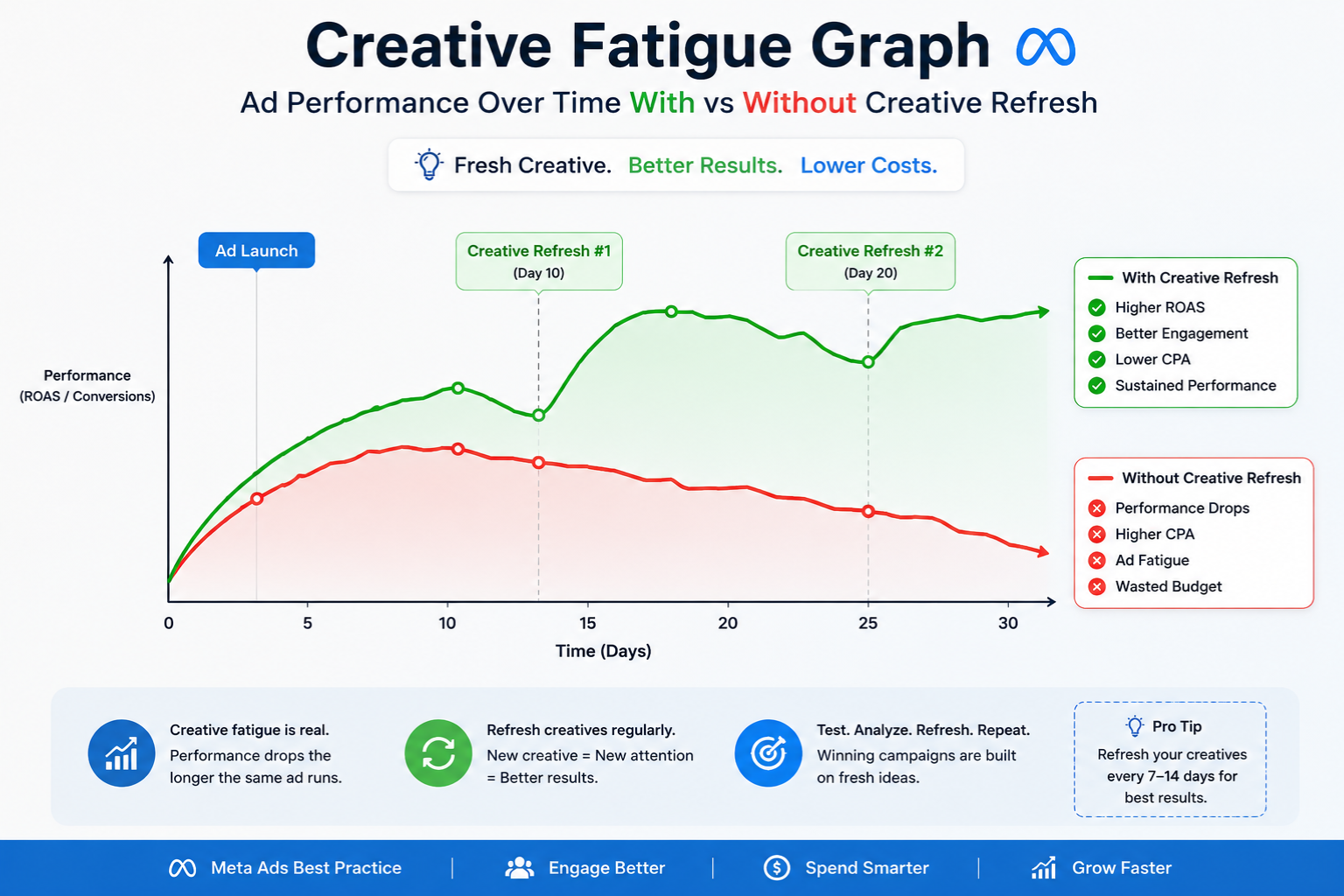
A single ad creative — no matter how good — has a shelf life. In Pune’s competitive markets (real estate, education, healthcare), that shelf life is getting shorter. We’re seeing creative fatigue set in at around 15-20 days now. Sometimes faster.
When you scale spend but keep the same creative, you’re essentially showing the same ad to more people more often. Frequency shoots up. People get blind to your ad. CTR drops. CPM increases. Everything gets expensive.
We run a simple rule at Webcomp Digitex: for every ₹50k you want to scale, you need at least 3-5 new creative variations ready to test. Not minor tweaks — actually different hooks, angles, formats.
I’m talking about:
- A carousel instead of a single image
- A testimonial video instead of a features list
- A problem-focused hook instead of a solution-focused one
- UGC-style content instead of polished brand content
One manufacturing client in MIDC Bhosari wanted to scale their lead gen campaigns from ₹45k to ₹1.8 lakh. Ambitious, but they had the sales team to handle it.
We created 12 different creative concepts. Not 12 versions of the same ad — 12 actually different approaches. We tested them in smaller batches, killed the losers fast, and scaled the winners.
Within three months, we were spending ₹1.6 lakh monthly (close to target) and their cost per qualified lead had actually dropped from ₹3,200 to ₹2,400. The key was creative diversity. We always had fresh ads in rotation.
Audience Layering Beats Broad Targeting
Here’s a practitioner insight: broad targeting works brilliantly for scaling… until it doesn’t.
Meta’s “Advantage+ audience” (they love renaming things) is powerful because it lets the algorithm find your buyers beyond your manual targeting. But if you only run broad, you lose control. And when you’re spending serious money, you need some guardrails.
The smart play is audience layering:
Base layer: Keep one campaign broad with minimal targeting. Let Meta explore. This is your discovery engine. Budget: 30-40% of total spend.
Interest layer: Run campaigns targeting specific interests relevant to your product. These convert better but have less scale. Budget: 30-40%.
Retargeting layer: Always, always, always run retargeting. Website visitors, video viewers, engaged users. These are your highest-intent audiences. Budget: 20-30%.
Most paid social agency setups ignore this balance. They go all-in on one approach. That’s fine at ₹30-40k monthly spend. It’s a disaster at ₹1.5 lakh+.
A real estate client in Wakad came to Webcomp Digitex after burning through ₹2.8 lakh in two months with barely any site visits that converted. Their previous agency was running everything broad.
We restructured: 40% broad (for reach and discovery), 35% interest-based (targeting people interested in property investment, home loans, interior design), and 25% retargeting (people who’d visited their site or engaged with ads).
Same budget, different structure. Within 45 days, their cost per site visit dropped by 60%, and actual conversions from ads went from 2-3 monthly to 18.
Budget Increase Patterns That Actually Work
If you’re going to scale spend, here’s the framework we use:
Don’t increase any single campaign budget by more than 20-25% every 3-4 days. Yes, it’s slow. Yes, it’s annoying. But it works.
Meta’s algorithm needs time to adjust. When you shock the system with a sudden 100% budget increase, you reset the learning phase. Your campaign goes back to square one, testing randomly until it figures out what works again. You’ll burn money during that relearning period.
Better approach: vertical and horizontal scaling together.
Vertical scaling: Gradually increase budget on winning campaigns (20-25% every 3-4 days max).
Horizontal scaling: Launch new campaigns/ad sets with fresh creatives and audiences rather than just pumping more money into existing ones.
We manage a healthcare client’s campaigns in Hinjewadi. They wanted to go from ₹60k to ₹2 lakh monthly. Here’s exactly how we did it:
Month 1: Kept existing campaigns at ₹60k. Launched two new campaigns at ₹20k each. Total: ₹1 lakh.
Month 2: Increased best-performing original campaign to ₹75k. Kept one new campaign at ₹20k (it was underperforming), scaled the other to ₹35k. Launched one more at ₹20k. Total: ₹1.5 lakh.
Month 3: Killed the underperformer. Scaled two winning campaigns to ₹50k and ₹45k each. Kept testing campaign at ₹25k. Launched another at ₹20k. Total: ₹1.9 lakh.
Slow? Yes. Effective? Their cost per acquisition stayed within 15% of the original baseline while spending 3x more. That’s a win.
The Quality Check That Saves Your Scale
Here’s something most facebook marketing companies won’t tell you: more leads doesn’t mean more revenue.
When you scale, you need to obsessively track lead quality, not just lead volume. I’ve seen businesses scale to 5x more leads and actually make less money because the lead quality tanked.
Set up a proper tracking system before you scale. You need to know:
- Which campaigns generate leads that convert to sales
- What’s the actual customer acquisition cost (CAC) including your sales team’s time
- How long your sales cycle is
- Which audience segments close fastest
Use Meta’s Conversions API alongside the pixel. Check Google Analytics 4 (GA4) to see what people do after they click your ad. Are they browsing one page and leaving? Are they checking pricing? Reading multiple blogs?
We use Hotjar for some clients to literally watch session recordings of people who came from Meta ads. You’d be surprised what you learn. Sometimes the ad is perfect but the landing page is garbage. You’ll scale spend, get more clicks, but conversions stay flat because your landing experience isn’t built to handle the traffic.
One e-commerce client in Baner scaled from ₹80k to ₹2.2 lakh in ad spend. Leads went from 180 to 520 monthly. Sounds great, right?
Except actual purchases only went from 22 to 31. The extra 340 leads were low-quality — people clicking out of curiosity, not buying intent.
We dug into GA4 and Meta Ads Manager data. The scaled campaigns were targeting broader, colder audiences. These people needed more nurturing. We added a retargeting sequence (email + Meta ads) for non-purchasers and adjusted our targeting to focus on higher-intent signals (people who’d searched for specific product types, engaged with competitor pages, etc.).
Two months later, at the same ₹2.2 lakh spend, monthly purchases hit 54. Same ad budget, better quality control.

When to Actually Hit the Brakes
Look, sometimes scaling isn’t the right move. And a good facebook advertising agency near me should tell you that, even if it means less billings for them.
If your funnel can’t handle the volume, don’t scale. If your sales team is already overwhelmed, don’t scale. If your product/service has delivery constraints, don’t scale.
We had a conversation with a manufacturing client in Chakan last quarter. They wanted to 3x their Meta ads budget. When we looked at their operations, they were already struggling to fulfill orders on time. Their Google reviews were starting to slip because of delivery delays.
We told them: don’t scale ads yet. Fix operations first. Scaling marketing when your backend is broken just speeds up your path to angry customers and bad reviews.
They weren’t thrilled to hear it, but they respected the honesty. They spent two months sorting their fulfillment. Then we scaled ads. Much better outcome.
The Testing Budget You Can’t Skip
Here’s the unsexy truth about scaling: you need to allocate 15-20% of your budget purely for testing.
Testing new audiences. Testing new creatives. Testing new placements (Stories vs Feed vs Reels). Testing different offers. Testing landing page variations.
This testing budget feels like “wasted” money because most tests will fail. But it’s not wasted — it’s the R&D that lets you scale profitably later.
At Webcomp Digitex, we run at least 3-4 new tests every month for clients, even ones with established, profitable campaigns. Markets change. Audiences evolve. Creative trends shift. What worked six months ago might be stale now.
A real estate developer in Kharadi has been our client for two years. Their campaigns are profitable and consistent. But we still test new stuff monthly. Last quarter, we tested Reels ads (they’d been running Feed and Stories only). Reels outperformed by 35% on cost per lead.
If we’d just stuck with “what works,” we’d have missed that opportunity. Testing budgets aren’t optional when you’re serious about scaling.
Frequency Caps and Impression Limits Matter
This is technical but important: watch your frequency metric in Meta Ads Manager.
Frequency is how many times, on average, each person sees your ad. When frequency creeps above 3-4, you’re usually in trouble. People have seen your ad multiple times and aren’t biting. You’re wasting impressions.
High frequency + scaling spend = disaster. You’re just annoying the same people over and over while Meta charges you more for each impression because your CTR is dropping.
If you see frequency climbing past 4 on a campaign, you have a few options:
- Refresh the creative immediately
- Expand the audience (carefully)
- Reduce budget on that campaign
- Kill it and start fresh
Don’t just let it ride. High-frequency campaigns burn money fast.
We monitor this weekly for all clients. It’s one of those things that only someone actually managing campaigns daily would catch. A lot of facebook advertising agency near me setups check in monthly. That’s too slow. By the time you spot the problem, you’ve wasted weeks of budget.
Scaling Across Placements (Not Just Feed)
Most businesses still default to Facebook Feed and Instagram Feed. That’s leaving money on the table.
Stories, Reels, Audience Network, Messenger — these placements can be goldmines for scaling because they’re less saturated (for now).
Here’s what works: run Advantage+ placements initially to see where Meta naturally puts your budget. Then, check the breakdown in Ads Manager. If certain placements are performing way better, create dedicated campaigns for those.
We did this for a healthcare client in Pimpri-Chinchwad. Their Advantage+ campaigns were getting 60% of conversions from Reels, but Reels was only getting 30% of the budget.
We created a Reels-only campaign with creatives specifically designed for that format (vertical, hook in first 2 seconds, text overlay because people watch without sound). Scaled that campaign separately.
Cost per conversion dropped 40% on the Reels-specific campaign compared to their mixed-placement campaigns.
The CBO vs ABO Scaling Debate
Campaign Budget Optimization (CBO) vs Ad Set Budget Optimization (ABO) — this used to be a huge debate. Meta’s pushed everyone toward CBO, but here’s my take after managing both extensively:
Use CBO when you’re testing and want Meta to figure out what works. Use ABO when you’ve found winners and want control over exactly how much each ad set spends.
For scaling, I prefer a hybrid: CBO for your testing campaigns (that 15-20% testing budget), ABO for your proven winners where you want to control spend distribution.
A paid advertising agency that only uses one approach is either inexperienced or lazy. You need both tools in your kit.
At Webcomp Digitex, about 60% of our client campaigns run on CBO, 40% on ABO. It varies by client, by goal, by stage of the campaign.
Common Scaling Mistakes We See Repeatedly
Let me just rapid-fire these because I see them constantly:
Scaling too fast: Going from ₹50k to ₹3 lakh in two weeks. Don’t. You’ll tank your campaigns.
Ignoring creative fatigue: Running the same ad for three months while scaling spend. It’ll stop working.
No retargeting layer: Scaling only cold traffic campaigns. You’re making Meta work way harder (and more expensively) than necessary.
Forgetting about landing pages: Scaling ad spend but sending traffic to a slow, ugly, confusing landing page. Fix the page first.
Not tracking beyond Meta: Trusting only Meta’s reporting. Use GA4, use your CRM data, track the full funnel.
Scaling losing campaigns: Thinking “maybe it just needs more budget to work.” No. Fix it or kill it, then scale.
Ignoring iOS 14+ tracking issues: Not setting up Conversions API, not using proper UTM parameters, losing data and making bad decisions as a result.
A manufacturing client came to us after spending ₹4.8 lakh over four months with another agency, getting almost nothing. When we audited the account, they’d made literally all seven mistakes above. All of them.
Frequently Asked Questions
How much should I increase my Meta ads budget when scaling?
Don’t increase any single campaign budget by more than 20-25% every 3-4 days. Larger increases reset Meta’s learning phase and you’ll waste money while the algorithm relearns your audience. Better to launch new campaigns alongside existing ones (horizontal scaling) rather than just pumping more money into one campaign. This gives you more control and usually better results.
What’s the biggest mistake businesses make when scaling Meta ads?
Keeping the same creative while dramatically increasing spend. One ad creative has a limited effective reach — scale spend without fresh creatives and you’ll just show the same ad to the same people more often, driving up frequency and costs. You need 3-5 new creative variations for every ₹50k you want to add to your budget.
How do I know if my scaled campaigns are actually profitable?
Track beyond Meta’s dashboard. Check your actual customer acquisition cost in your CRM, not just cost per lead in Ads Manager. Set up GA4 properly to see what people do after clicking. Monitor lead quality and sales team feedback. We’ve seen campaigns with “great” Meta metrics that produced zero actual revenue because the leads were terrible quality.
Should I use Advantage+ audience or detailed targeting when scaling?
Use both. Run 30-40% of your budget on Advantage+ (broad) for discovery and reach, 30-40% on interest-based targeting for better conversion rates, and 20-30% on retargeting for your highest-intent audiences. Going all-in on one approach limits your scale potential. Different audience types serve different purposes in your funnel.
How long does it take to scale Meta ads properly?
Plan for 2-4 months to double or triple your spend while maintaining performance. Yes, that’s slower than you want. But rushing it means burning cash on bad data while Meta’s algorithm relearns. We typically increase spend by about 50-75% monthly for clients, with constant testing and creative refresh. Faster than that and you’re gambling.
Ready to Scale Your Meta Ads the Right Way?
Look, scaling Meta ads isn’t rocket science, but it’s not simple either. It requires constant monitoring, testing, creative refresh, and most importantly — patience.
If you’re in Pune and looking for a facebook advertising agency near me that actually understands how to scale campaigns without burning your budget, we should talk.
At Webcomp Digitex, we’ve scaled campaigns for manufacturing units in Chakan, real estate developers in Baner and Wakad, healthcare providers in Pimpri-Chinchwad, and e-commerce brands in Kharadi and Hinjewadi. We’ve managed everything from ₹30k monthly budgets to ₹5+ lakh, and we know exactly where the landmines are.
We don’t just “run your ads.” We build proper scaling frameworks, we refresh creative constantly, we track what actually matters (revenue, not just leads), and we tell you when scaling isn’t the right move yet.
Want to talk about scaling your Meta ads without the budget bonfire? Call us at +91-9960802498 or visit webcompdigitex.com.
We’re based in Pune, we work with businesses across Pune, and we know this market inside out. Let’s see if we can help you scale profitably.


