Performance Marketing Services That Actually Get Clicks: How to Write Ad Copy That Converts in 2026
You’re staring at your Meta Ads Manager dashboard again. ₹45,000 spent this month. Click-through rate hovering at 0.4%. Cost per lead climbing to ₹8,200.
And your ad copy? It’s basically the same thing your competitors in Hinjewadi are running: “Best Quality. Trusted Since 2010. Call Now.”
Here’s the thing — almost everything you’ve been told about writing ad copy is either outdated or just plain wrong. And I know this because we’ve managed over 200 campaigns at Webcomp Digitex, and I’ve seen the same myths kill budgets again and again.
Let me walk you through what’s actually happening in 2026, and why the old playbook doesn’t work anymore.
Myth #1: “Features Sell Products”
This one’s everywhere. Business owners genuinely believe that if they just list enough features — “ISO certified”, “24/7 support”, “20 years experience” — people will click.
I get where it comes from. When you’re a manufacturer in Chakan or a healthcare provider in Kharadi, you’ve worked hard for those certifications. Those features matter to you.
But here’s what we found: nobody cares. Not because your features aren’t good. Because your prospect is scrolling through their phone at 11 PM, half-paying attention, and features don’t trigger an emotional response.
Think about it this way. When was the last time you clicked an ad because it said “premium quality”? You didn’t. You clicked because something made you feel understood, curious, or slightly anxious about missing out.
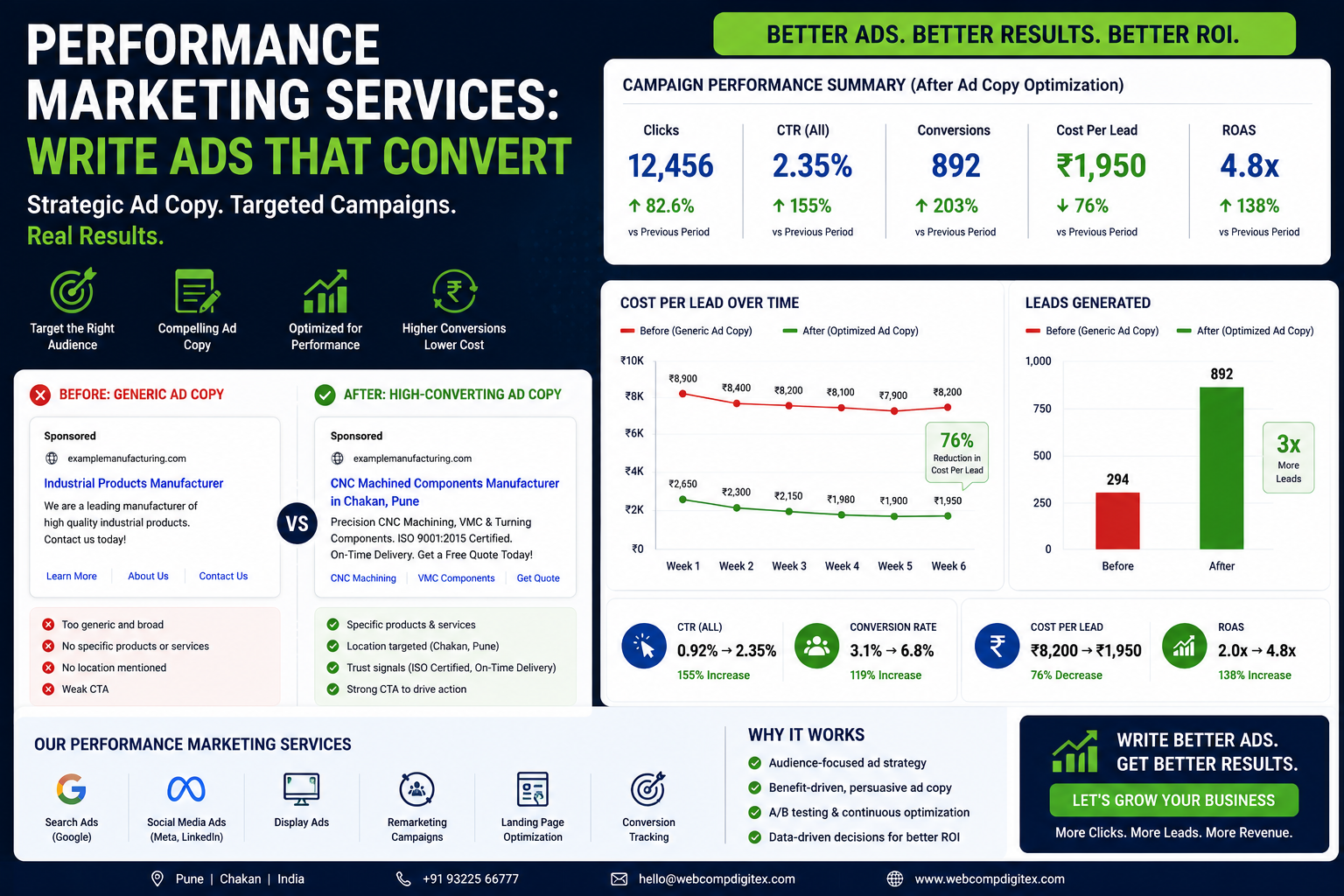
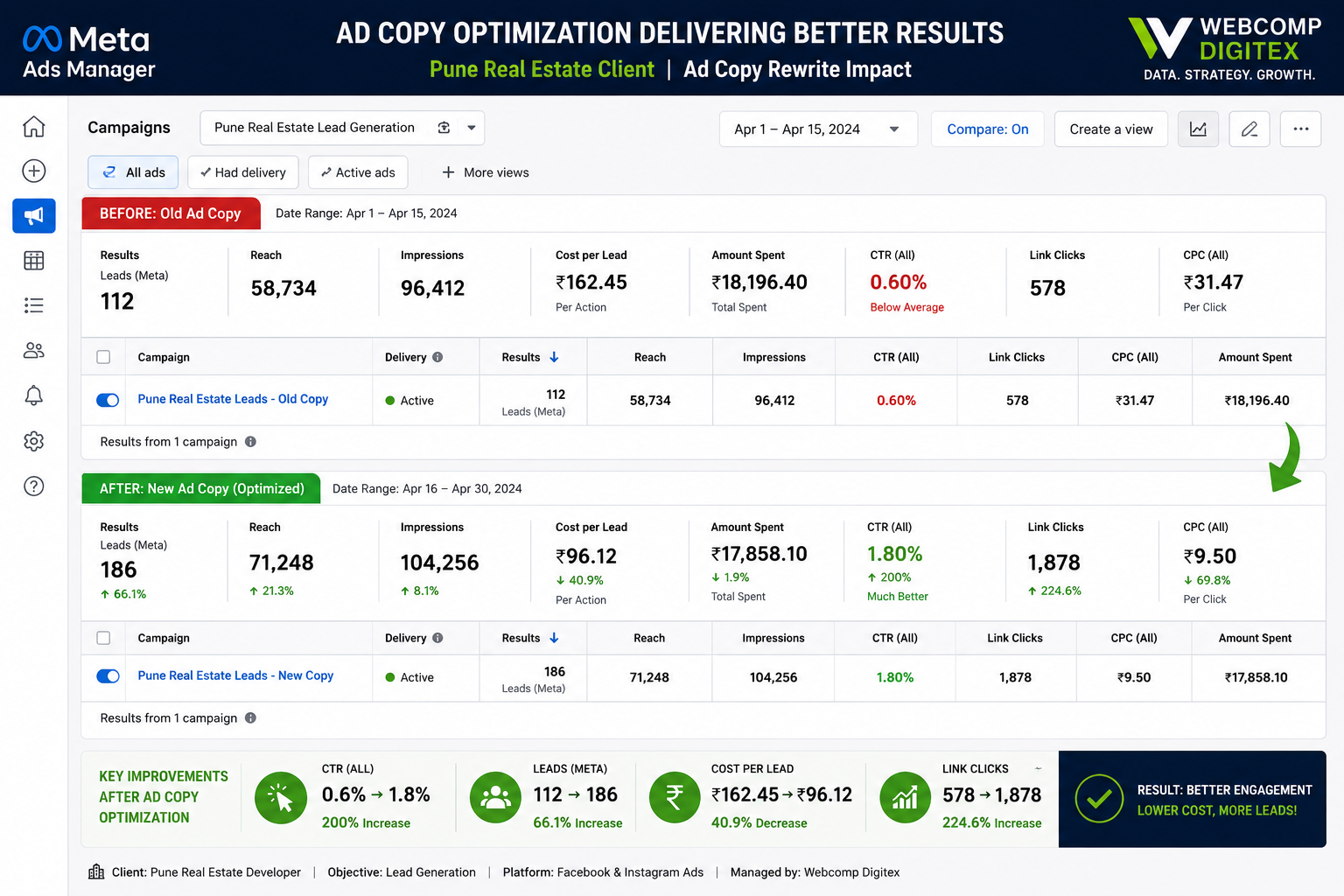
We ran a test for a real estate client in Wakad last year. Their original ad copy was all features:
“3 BHK flats, vastu compliant, premium amenities, near schools”
CTR: 0.6%. Cost per lead: ₹4,800.
We rewrote it to lead with the actual problem their buyers had:
“Tired of compromising? 3 BHK that doesn’t eat your entire savings (and your kids can actually walk to school)”
Same targeting. Same budget. CTR jumped to 1.8%. Cost per lead dropped to ₹1,950.
What actually works instead: Start with the specific problem or desire. Make it concrete. Not “looking for a home” — that’s too vague. But “you’re sick of paying ₹35,000 rent and having nothing to show for it” or “you want your parents close by but not in the same building.” That specificity makes people stop scrolling.
Here’s something only people who actually manage campaigns know: the first three words matter more than anything else. Because that’s what shows up in the preview. We’ve tested this in Google PPC management campaigns repeatedly. An ad that starts with “Struggling with…” outperforms “We provide excellent…” by 3x on average.
The formula we use at Webcomp Digitex for performance marketing services: Problem + Specific Solution + Why Now.
Not: “Quality manufacturing solutions for automotive parts.”
But: “Your supplier missed another deadline? Get automotive parts in 48 hours (minimum order: just 100 units).”
Myth #2: “Make It Sound Professional”
I can’t tell you how many times clients have asked us to make their ad copy “sound more professional.” They want words like “comprehensive”, “state-of-the-art”, “world-class.”
And honestly? That’s the kiss of death for conversion rates.
Professional-sounding copy is corporate-sounding copy. It’s stiff. It’s forgettable. And worse, it sounds like every other paid advertising agency trying too hard to impress.
Real people don’t talk like that. When someone in Pimpri-Chinchwad is searching for a solution at midnight, they’re not thinking “I need a comprehensive digital transformation partner.” They’re thinking “why is my website not getting any damn leads?”
Your ad copy needs to match that energy.
We worked with a healthcare diagnostics center in Baner. Their ads sounded like a medical textbook: “Comprehensive diagnostic services utilizing advanced technology and certified professionals.”
Nobody clicked. CTR was 0.3%.
Here’s what we changed it to:
“That nagging health worry keeping you up? Get answers tomorrow, not next week. Reports in 24 hours.”
CTR went to 1.4%. More importantly, conversion rate from click to booking doubled.
What actually works instead: Write like you talk. Use contractions. Ask questions. Be direct.
One trick we use when writing ad copy for performance marketing agencies: read it out loud. If it sounds like a robot or a corporate brochure, rewrite it. If it sounds like something you’d actually say to a friend who asked for a recommendation, you’re close.
And here’s the thing about “unprofessional” language — using words like “damn” or “sick of” or “honestly” doesn’t make you look bad. It makes you look human. Which is what you need when you’re competing with 6 other ads in the same auction.
The best-performing ad we’ve ever written for a manufacturing client started with: “Look, you don’t need another supplier who overpromises.” That word “look” — clients hated it initially. Thought it was too casual. But it got a 2.1% CTR in an industry where 0.7% is normal.
Myth #3: “Longer Copy Performs Better”
This myth comes from the old direct response days. The idea that you need to write mini-essays in your ad copy to “pre-qualify” prospects and build desire.
And sure, in some contexts — like landing pages — longer copy can work. But in actual ad copy? In 2026? You’ve got about 2 seconds before someone swipes past.
I think this myth persists because it feels more thorough. Business owners feel like they’re giving people enough information. But performance marketing services aren’t about giving information in the ad — they’re about getting the click.
We tested this extensively for an e-commerce client selling industrial supplies. Their original ad was 3 paragraphs explaining their product range, quality standards, and delivery promise.
CTR: 0.5%.
We cut it down to two sentences:
“Your tools supplier just raised prices again? Same industrial supplies, 15% less, delivered to Chakan by tomorrow.”
CTR: 1.7%.
But here’s where it gets interesting. Some people said, “Well, shorter ads get more clicks but lower quality leads.” So we tracked it. Conversion rate from click to purchase actually went up. Because the people who clicked were specifically interested in price-conscious, fast delivery. We weren’t attracting tire-kickers — we were attracting our exact customer.
What actually works instead: Ruthlessly cut everything that doesn’t directly drive the click. Every word needs to earn its place.
When we audit campaigns at Webcomp Digitex, one of the first things we check is word count in ad copy. If it’s over 50 words for a search ad or 40 words for a social ad, it’s probably too long.
The structure that consistently works:
- One sentence about the problem or desire (10-15 words)
- One sentence about your specific solution (10-15 words)
- One call-to-action (5-8 words)
That’s it. That’s the entire ad.
Example for a paid advertising agency in Pune:
“Spending ₹50k monthly on ads with nothing to show? We cut wasted spend and get you actual leads. See how we did it for 47 Pune businesses.”
Total: 31 words. Gets the point across. Creates curiosity. Drives the click.
Here’s something you learn after running hundreds of campaigns: people don’t need all the details in the ad. They just need enough to decide whether to click. Everything else can live on your landing page.
Myth #4: “Always Include a Discount or Offer”
“Get 20% off today!” “Limited time offer!” “Free consultation!”
Every performance marketing agency tells you this, right? Your ad needs a compelling offer or nobody clicks.
Except… that’s not quite true.
Yes, offers can boost CTR. But they also attract a specific type of customer — the discount-hunter. And if you’re not careful, you end up with a pipeline full of people who only buy when things are on sale.
We saw this clearly with a B2B manufacturing client in MIDC. They ran ads with “Get 15% off your first order” for three months. Good CTR. Terrible customer quality. Almost everyone who converted bought once and never came back.
When we removed the discount and focused the ad on speed of delivery and consistent quality instead, CTR dropped slightly (from 1.2% to 0.9%). But customer lifetime value tripled. Because we were attracting people who cared about reliability, not just price.
What actually works instead: Match your offer to your business model.
If you’re e-commerce selling commodity products, yes, discounts work. But if you’re selling something where quality, trust, or expertise matters — Google PPC management, healthcare, professional services — leading with a discount can actually hurt you.
Better offers for service businesses:
- A specific, useful piece of information (“See the 3 mistakes killing your ad budget”)
- A relevant case study (“How we helped a Hinjewadi manufacturer cut lead costs by 64%”)
- A low-commitment first step (“Get your free ad account audit”)
We’ve tested this across dozens of campaigns at Webcomp Digitex. For performance marketing services specifically, “Free audit” outperforms “10% discount” by about 40% in terms of qualified lead quality.
And here’s something I’m not 100% sure everyone agrees with, but I’ve seen it play out: overly aggressive discounts make people suspicious. “50% off” makes people wonder what’s wrong. “Limited slots available” makes them think you’re desperate.
The sweet spot is an offer that feels valuable but not too good to be true. For our real estate clients, “Book a site visit and get the actual unit price list (most sites hide this)” works better than “Get ₹2 lakh off.”
What Actually Drives Conversions in 2026: Specificity Wins
If I had to boil down everything we’ve learned from managing performance marketing campaigns for Pune businesses, it’s this: specificity beats everything.
Vague promises don’t work anymore. Not because people are smarter (though they might be), but because they’re overwhelmed. Your prospect sees 50+ ads a day. The only ones that break through are the ones that feel like they were written specifically for them.
Not “grow your business with digital marketing” — everyone says that.
But “get more walk-ins to your Kothrud showroom without spending on billboards” — that’s specific. That makes someone think, “wait, how did they know that’s exactly my problem?”
Here’s a real example. We manage Google PPC management campaigns for a diagnostic lab. Their original ad copy was generic:
“Full body checkup packages. Accurate results. Book now.”
We made it hyperspecific to their actual customer:
“30+ and haven’t done a health checkup since college? Full body scan in Baner, reports tomorrow, ₹2,499.”
Same service. Same price. But CTR went from 0.7% to 1.9%. Why? Because suddenly it felt personal.
The formula we use across all our performance marketing agencies work:
- Specific problem (not “health concerns” but “haven’t done a checkup since college”)
- Specific solution (not “diagnostic services” but “full body scan”)
- Specific location (not “Pune” but “Baner”)
- Specific price or timeframe (not “affordable” but “₹2,499”)
Look, I get that this feels risky. You’re narrowing your message. You’re worried you’ll exclude people. But here’s what actually happens: you attract fewer but better-qualified leads. Your cost per acquisition drops because you’re not paying for useless clicks.
One of our manufacturing clients was skeptical about this. They wanted their ads to appeal to “anyone who needs precision parts.” We convinced them to test hyperspecific copy aimed at automotive suppliers who needed quick turnaround.
Original ad: “Precision manufacturing for all industries”
New ad: “Your automotive supplier can’t deliver in 3 days? We can (minimum 100 units, ±0.01mm tolerance)”
The new ad got 40% fewer clicks. But conversion rate was 3x higher. Cost per actual customer dropped from ₹11,400 to ₹3,800.
The Stuff Nobody Tells You About Ad Copy
After 12+ years doing this, there are things you learn that don’t make it into the blog posts or courses. Here are a few:
Negative qualifiers actually improve performance. Saying “minimum order 100 units” or “only for Pune businesses” sounds like you’re limiting yourself. But it filters out bad-fit clicks and increases conversion rate. We saw this across multiple campaigns — adding a clear qualifier cut CTR by 10-20% but improved conversion rate by 40-60%.
Questions outperform statements, but only specific questions. “Looking for digital marketing?” is useless. “Spending ₹40k monthly on ads and seeing zero ROI?” — that’s a question that makes someone stop and think “yes, exactly.”
Numbers are magic. Any time we replace a vague claim with a specific number, performance improves. Not “fast delivery” but “48-hour delivery.” Not “affordable” but “₹2,499.” Not “many happy clients” but “47 Pune businesses.” The number doesn’t even have to be huge — it just needs to be real.
Your worst-performing keywords can write your best ads. Look at the search terms that get impressions but no clicks in Google Search Console. Those are often super-specific problems people have. Turn them into ad copy. We did this for a client and found someone searching “why is my ad spend so high but no leads” — we literally used that as headline copy. It became their best-performing ad.
And here’s something that might just be my experience, but I’ve seen it enough to believe it: ad copy that would make your English teacher cringe often performs best. Sentence fragments. Starting with “And” or “But”. Casual language. The stuff that feels slightly wrong to write is often exactly right for the audience.

Frequently Asked Questions
What’s the ideal length for ad copy in 2026?
For search ads, stick to 30-40 words maximum. For social media ads, 25-35 words. You need just enough to communicate the problem, your specific solution, and a reason to click right now. Anything longer and you’re losing people. We’ve tested this across 200+ campaigns at Webcomp Digitex — longer copy consistently gets lower CTR without improving lead quality.
Should I use emojis in my ad copy?
It depends on your industry and platform. For B2C and e-commerce on Facebook/Instagram, selective emoji use can boost CTR by 10-15%. For B2B and Google search ads, skip them. They look unprofessional and can actually hurt performance. We tested this for manufacturing clients in Pimpri-Chinchwad — emojis tanked CTR by 30%.
How often should I update my ad copy?
When performance drops, not on a schedule. If your CTR is above 1.5% for search or 1% for social, and your cost per lead is in your target range, leave it alone. We’ve had ads running for 8+ months without changes because they still work. But if you see CTR declining month-over-month or your audience is seeing the same ad 4+ times (check frequency in Meta Ads Manager), then refresh.
Does AI-written ad copy work as well as human-written?
Honestly? Not yet. We’ve tested ChatGPT and other tools for our performance marketing services. The copy is grammatically perfect and hits the technical requirements. But it lacks specificity and sounds generic. It can’t write “Your supplier in Chakan missed another deadline?” because it doesn’t know that’s a real frustration. Use AI for first drafts or variations, but a human who understands your customer needs to refine it.
What’s more important — the headline or the body copy?
The headline by far. About 80% of people who see your ad only read the headline. In Google PPC management campaigns, we’ve seen the same body copy perform completely differently just by changing the headline. Spend 80% of your time on the headline. Make it specific, clear, and focused on one problem or desire.
Ready to Write Ad Copy That Actually Converts?
Look, you can keep running ads that sound professional and safe and generic. You’ll get some clicks. You’ll spend your budget. You’ll wonder why it’s not working better.
Or you can try what actually works in 2026: specific, conversational copy that talks to one person about one problem.
At Webcomp Digitex, we’ve spent the last 12+ years figuring this out through trial and error, managing performance marketing campaigns for over 200 Pune businesses. We’ve seen what works for manufacturers in Chakan, real estate developers in Wakad, healthcare providers in Kharadi, and everything in between.
If you’re spending ₹30,000+ monthly on paid advertising and not seeing the returns you expected, we should talk. We’ll audit your current campaigns, show you exactly where the budget is leaking, and give you specific recommendations — whether that’s rewriting your ad copy, adjusting your targeting, or completely restructuring your paid advertising agency approach.
No vague promises. No corporate buzzwords. Just practical performance marketing services from people who’ve actually done this hundreds of times.
Call us at +91-9960802498 or visit webcompdigitex.com. We’re based in Pune and work with businesses across Hinjewadi, Baner, Pimpri-Chinchwad, and the broader Maharashtra region.
Let’s write some ad copy that actually gets you customers, not just clicks.


