
Why Your Website Isn’t Ranking on Google (And How to Fix It)
I got a call last Tuesday from a manufacturer in Chakan. Been online for two years. Beautiful website. Not a single lead from Google.
“We’re just… invisible,” he said. “I type in exactly what we make, and we’re nowhere. My competitor with that terrible website? He’s on page one.”
If you’ve ever searched for an SEO Agency Near Me, chances are you’re facing the same challenge. Businesses often assume that simply having a website is enough, but ranking on Google requires a clear SEO strategy.
Here’s what I told him: if your website isn’t ranking on Google, it’s not bad luck. It’s not some mysterious algorithm you’ll never understand. It’s usually one of seven specific problems. And honestly? Most of them you can start fixing this week.
Let me show you exactly what’s going wrong and how to fix it. These aren’t theories—this is what we do at Webcomp Digitex every single day with businesses across Pune, from Hinjewadi IT firms to Pimpri-Chinchwad factories.

Your Website Is Too New (Or Google Doesn’t Trust It Yet)
Look, I know this isn’t what you want to hear. But if your website went live three months ago and you’re not ranking, part of it is just time.
Google doesn’t trust new websites immediately. Think about it this way: would you trust a restaurant that opened last week as much as one that’s been around for five years? Same principle.
But here’s the thing most people miss — you’re not helpless while you wait. There’s a specific window where you can either earn trust faster or completely waste those crucial early months.
What to do right now:
First, check when Google actually discovered your site. Go to Google Search Console (if you haven’t set this up, do it today — it’s free and takes 10 minutes). Look at your coverage report. If Google indexed your site last month but you launched six months ago, that’s a problem. You weren’t even in the race.
Submit your sitemap if you haven’t. In Search Console, go to Sitemaps and add yourwebsite.com/sitemap.xml. Most websites on WordPress or Shopify generate this automatically.
Second, focus on building domain authority while you’re in this early phase. Get listed in legitimate business directories: Google Business Profile (absolutely critical), JustDial, Sulekha, IndiaMART if you’re in manufacturing. Get your industry associations to link to you. That manufacturer I mentioned? We got him listed on the Chakan Industrial Area directory and three vendor portals his customers actually use.
Third, publish consistently. Not randomly. We had a healthcare client in Baner who published one detailed article every Tuesday for four months. Nothing fancy. Just answering actual patient questions. By month five, organic traffic started climbing. By month eight, they were getting 3-4 consultation bookings per week from Google.
What trips people up: They launch, see no results in 30 days, panic, and either give up or completely redesign everything. Don’t. Give it four to six months of consistent effort before you judge whether something’s working.
Your Technical SEO Is Broken
This is the unsexy stuff. But I’ve seen technically broken websites that would never rank no matter how good their content was.
A real estate developer in Wakad came to us last year. Great projects. Website looked professional. Completely broken from a technical standpoint. Their site took 12 seconds to load on mobile. Half their pages returned 404 errors. Google could barely crawl the site.
We fixed the technical issues first. Before we touched content. Before we looked at keywords. Within two months, they jumped from page 7 to page 2 for “flats in Wakad.” Same content. Just technically functional.
Here’s your technical checklist:
Run your site through Google’s PageSpeed Insights right now. Just google “PageSpeed Insights” and enter your URL. If your mobile score is under 50, you’ve got problems. Under 30? That’s an emergency.
The most common culprits: images that are way too large (we’re talking 3MB hero images when they should be 150KB), no browser caching, cheap hosting that can’t handle traffic. That Wakad developer? His images alone were the issue. We compressed them, set up a CDN, and his load time dropped from 12 seconds to 3.
Check your site on your phone. Not just “does it look okay” but actually use it. Can you tap buttons easily? Is text readable without zooming? Does anything break? About 70% of traffic for most Indian businesses comes from mobile. If your mobile experience is bad, your ranking will be too.
Use Screaming Frog (free version works for sites under 500 pages) to crawl your site. Install it, enter your URL, let it run. Look for 404 errors (broken pages), redirect chains (page A redirects to B redirects to C — Google hates this), and pages with missing title tags or meta descriptions.
Check if your site is actually mobile-friendly in Google’s eyes: search “mobile friendly test Google” and run your URL through it. We’ve seen sites that look fine but fail Google’s test because of tiny tap targets or text that’s too small.
What trips people up: They try to fix everything at once, get overwhelmed, and do nothing. Pick the worst thing first. If your site is slow, fix speed before anything else. If you have 50 broken links, fix those this week. One thing at a time.
You’re Targeting the Wrong Keywords
This is probably the most common mistake I see. Business owners guess at what people search for instead of actually checking.
We worked with an e-commerce client selling traditional Maharashtrian jewelry. They optimized everything for “authentic Indian jewelry” and “traditional gold jewelry.” Competitive terms. They were fighting with huge brands.
We did actual keyword research. Found that “Kolhapuri saaj price” and “Maharashtrian nath designs” had decent search volume, way less competition, and people searching these were ready to buy. We shifted their focus. Three months later, they were ranking on page one for twelve specific product terms. Sales tripled.
How to find the right keywords:
Open an incognito window. Start typing what you think people search for. Look at what Google suggests. Those autocomplete suggestions? That’s real search data. Screenshot them.
Go to AnswerThePublic.com (free with limitations). Type your main product or service. It’ll show you questions people actually ask. A manufacturing client in MIDC made industrial pumps. AnswerThePublic showed us people searched “how to select industrial water pump” and “centrifugal pump vs submersible pump.” He ranked for these within two months because barely anyone else targeted them.
Look at what’s already ranking. Search your main keyword. Look at the page one results. What are they actually about? If you’re trying to rank for “best accounting software” but all the results are comparison articles and you’re selling accounting software, you’ve misunderstood search intent. You won’t rank.
Use Ahrefs or SEMrush if you have budget (₹8,000-12,000 per month). If not, use Google’s free Keyword Planner in Google Ads. It’ll show you search volume and competition. Look for keywords with 100-1000 monthly searches and low to medium competition. Those are your opportunities.
The thing nobody tells you: Search volume doesn’t matter as much as you think. We have clients ranking for terms with only 50 searches per month that generate ₹2-3 lakhs in revenue because those 50 people are exactly the right buyers. Don’t ignore low-volume, high-intent keywords.
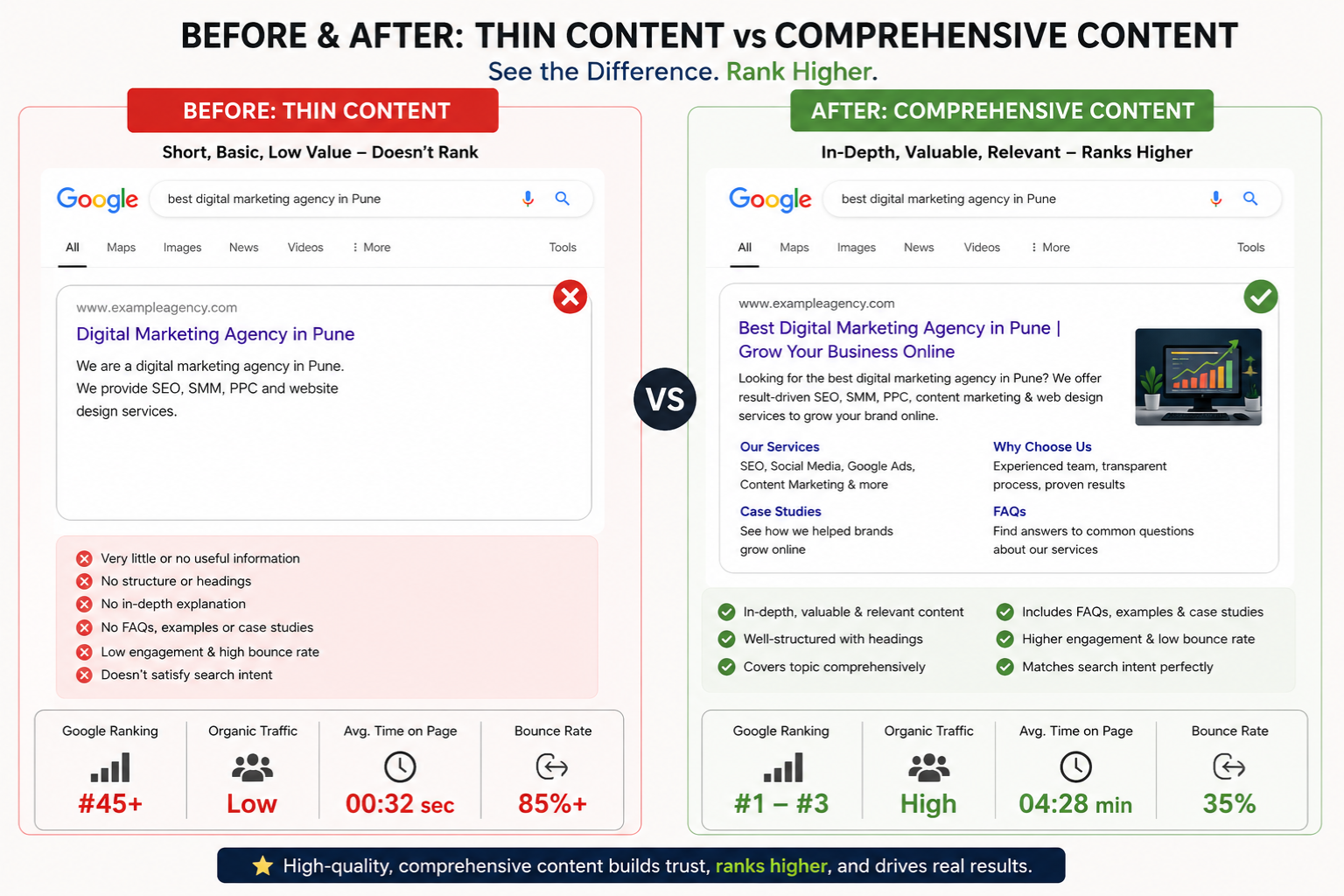
Your Content Is Thin or Outdated
Google ranks content that answers questions completely. Not content that exists just to exist.
I see this constantly: a services page with 150 words that just lists what you do. A blog post from 2019 that hasn’t been touched since. Product pages with two sentences and a price.
Here’s what I mean by thin content. A healthcare diagnostics center in Kharadi had a page for “blood tests.” That was the title. The page had maybe 200 words describing that they offer blood tests, they’re accurate, they’re fast. That’s it.
We rewrote it. Explained what’s included in a complete blood count. When you should get tested. How to prepare. What the results mean. Added pricing clearly. Added FAQs. The page went from 200 words to 1,800 words. It started ranking for “CBC test Kharadi,” “blood test price Pune,” and six other variations. Bookings from that one page went from maybe one per month to three per week.
How to fix thin content:
Audit your existing pages. Open Google Analytics (or GA4 if you’ve switched). Look at your landing pages. Find pages getting impressions in Google but no clicks, or clicks but no conversions. Those are your candidates for improvement.
For each important page, ask: does this completely answer what someone searching this keyword wants to know? If you’re ranking for “commercial property in Hinjewadi,” does your page explain sizes available, price ranges, amenities, connectivity, how to schedule a visit? Or does it just say “we have commercial property, contact us”?
Add depth where it matters. This doesn’t mean rambling. We’re not trying to hit word counts. We’re trying to be genuinely helpful. Include specifics: timelines, prices (even ranges help), processes, what to expect, common concerns.
Update old content. Anything older than two years should be reviewed. Stats outdated? Information changed? Add a “Last updated: [date]” at the top. Google notices when you refresh content and often rewards it with better rankings.
What trips people up: They think more content automatically means better rankings. It doesn’t. We’ve seen 500-word pages outrank 5,000-word pages because the shorter one directly answered what people wanted and the longer one rambled. Quality beats length every time.
You Have Zero Backlinks
Backlinks are still huge. They’re basically votes of confidence. If ten reputable websites link to you, Google thinks “okay, this site must be legitimate.”
If nobody links to you, Google sees you as an island. Isolated. Possibly not trustworthy.
That Chakan manufacturer I mentioned earlier? When we started, he had zero backlinks. Literally zero. He’d been online 18 months. We built 23 quality backlinks over four months. Not spammy directory submissions. Real links from industry sites, vendor portals, a local news mention about a community initiative they sponsored, a guest article on a manufacturing blog.
His domain authority went from 1 to 14. His main keywords moved from page 6 to page 1. Cost-per-lead dropped from ₹6,400 to ₹1,900 because organic traffic replaced expensive ads.
How to build backlinks without being spammy:
Start with the easy ones. Get listed on your Google Business Profile, industry-specific directories (IndiaMART, TradeIndia for B2B, Zomato if you’re in food, Practo if you’re in healthcare), local business directories for Pune. These aren’t powerful links, but they’re legitimate and easy to get.
Look for unlinked mentions. Google your business name in quotes: “Your Business Name Pune”. Sometimes people mention you without linking. Reach out politely: “Hey, saw you mentioned us in your article about [topic]. Would you mind linking to our website so readers can learn more?” Half will say yes.
Create something link-worthy. This is harder but more valuable. A manufacturer could create a detailed guide: “Complete Buyer’s Guide to Industrial Pumps in India.” An accounting firm could publish “GST Compliance Checklist for Pune Startups.” Then reach out to people who’ve linked to similar resources: “Saw you linked to [competing resource] in your article. We just published an updated guide with 2024 information, thought it might be useful for your readers.”
Get involved locally. Sponsor a local event. Volunteer. These often come with website links from legitimate local sites. A client in Baner sponsored a coding workshop at a local school. Got a link from the school website, local news coverage (with a link), and the event organizer’s site. Three quality local links.
What trips people up: They buy backlink packages from Fiverr. “500 backlinks for $5!” Those are garbage. They’ll hurt you, not help you. Google isn’t stupid. Focus on getting 5-10 legitimate links over six months rather than 500 spam links overnight.
Your Google Business Profile Is Neglected
If you’re a local business in Pune — and by local I mean you serve customers in Pune even if you ship nationwide — your Google Business Profile matters enormously.
It’s often the first thing people see when they search for what you do. And most businesses completely neglect it.
We had a physiotherapy clinic in Pimple Saudagar. Good reputation. Zero Google reviews. Incomplete Google Business Profile. Photos were terrible. They wondered why a newer clinic down the road got more walk-ins.
We optimized their profile completely. Got them to 35 reviews in three months (from existing happy patients, not fake ones). Added professional photos of the clinic, the equipment, the team. Posted updates weekly. They started showing up in the Google Maps pack for “physiotherapist near me” and similar searches. Walk-ins increased 40%.
How to optimize your Google Business Profile:
Claim it if you haven’t (google “Google Business Profile” and follow the verification process). Complete every single field. Not just the basics. Add services, products, attributes (wheelchair accessible, women-led, parking available), FAQs, appointment booking links.
Add photos. At least 10. Exterior, interior, products, team, work in progress. Update them every few months. Businesses with photos get 42% more requests for directions and 35% more clicks to their websites according to Google’s own data.
Get reviews systematically. Not by begging, by asking at the right moment. When a customer says they’re happy, that’s when you ask. “Would you mind sharing that on Google? It really helps us.” Make it easy — send them a direct link to your review page. We help clients at Webcomp Digitex set up simple follow-up systems for this. Even 10-15 genuine reviews make a massive difference.
Post weekly updates. Google Posts are like mini social media updates on your profile. Share a new product, a client success story (with permission), a tip related to your industry, an upcoming offer. Takes five minutes. Shows Google you’re active.
What trips people up: They set it up once and forget it exists. Your Google Business Profile isn’t a one-time thing. It’s an ongoing asset that directly impacts local search rankings.

You’re Ignoring Search Intent
This is more subtle, but it’s huge. Search intent means: what is the person actually trying to do when they search this term?
Someone searching “best CRM software” is comparing options, not ready to buy. Someone searching “Zoho CRM pricing India” is much closer to a purchase decision. Different intent. You need different content for each.
We worked with a B2B SaaS company in Hinjewadi. They had one page targeting “project management software.” It was a sales page: features, benefits, “sign up now.” They weren’t ranking.
Why? Because people searching “project management software” are at the research stage. They want comparisons, pros and cons, what to look for. The pages ranking were comparison articles and guides, not product pages.
We created a comprehensive guide: “How to Choose Project Management Software for Indian Teams.” Included comparisons, factors to consider, pricing models explained. That ranked. Then from that guide, we linked to their product pages for people ready to sign up.
How to match search intent:
Search your target keyword. Look at what’s ranking on page one. Are they blog posts or product pages? Guides or services pages? Videos or text articles? That tells you what Google thinks people want for that search.
Identify the intent category:
- Informational (how to do something, what is something)
- Commercial (best options, comparisons, reviews)
- Transactional (buy, price, near me)
- Navigational (specific brand or website)
Create content that matches. If the intent is informational, write a guide or tutorial. If it’s commercial, create a comparison or review. If it’s transactional, make sure your product or service page is detailed with clear pricing and CTAs.
Don’t force it. If you sell accounting software and want to rank for “how to file GST returns,” you can create that content. But it should genuinely teach people how to file GST returns, not just be a thinly veiled sales pitch. Be helpful first. The business will follow.
What trips people up: They create the content they want to create, not the content searchers actually want. Your service page won’t rank for “how to” questions. Your blog post won’t rank for “buy now” terms. Match the format to the intent.
Frequently Asked Questions
How long does it take to rank on Google?
Honestly? It depends. New websites usually take 4-6 months to start seeing meaningful movement. Established sites with good authority can rank for new content in 4-8 weeks. Competitive keywords take longer than niche ones.
But here’s what I tell people: you should see some kind of progress within three months. Maybe not page one rankings, but movement from page 10 to page 5. Increasing impressions in Search Console even if clicks haven’t jumped yet. If you see zero movement after three months of proper SEO work, something’s wrong.
Can I do SEO myself or do I need an SEO agency near me?
You can absolutely do basic SEO yourself. The stuff I’ve outlined here — fixing technical issues, targeting better keywords, improving content — any business owner with time and patience can learn this.
When you might need an agency like us at Webcomp Digitex: if you don’t have 10-15 hours per week to dedicate to this, if your competition is fierce and you need sophisticated strategy, if you’ve tried for six months and aren’t seeing results, or if you just want experts handling it while you focus on running your business.
We work with clients who range from “we need you to do everything” to “we’ll do the content, you handle the technical stuff and strategy.” There’s no one right answer. It depends on your time, budget, and skill level.
Why is my website ranking in other cities but not Pune?
This happens a lot. Usually it means your local SEO is weak. Google doesn’t clearly understand you’re a Pune business, or you haven’t optimized for Pune-specific keywords.
Fix this by: making sure your Google Business Profile lists Pune as your location, adding Pune (or specific areas like Kharadi, Hinjewadi, Baner) naturally in your content, getting backlinks from Pune-based websites, ensuring your NAP (Name, Address, Phone) is consistent across all directories with your Pune address.
What’s the fastest way to improve my Google ranking?
There’s no magic overnight solution. But if I had to pick the fastest impact areas: fix major technical issues first (if your site is slow or broken, nothing else matters), optimize your Google Business Profile completely (can impact local rankings within 2-4 weeks), and improve your best existing content rather than creating new content (updating a page already on page 2 is faster than ranking a new page from scratch).
How do I know if my SEO is working?
Check Google Search Console monthly. Look at total impressions (how often you appear in search results) and total clicks (how often people click through). Both should trend upward over 3-6 months.
Track your rankings for 5-10 important keywords. Use a simple spreadsheet or a tool like SEMrush. You should see gradual improvement, though rankings do fluctuate week to week.
Most importantly: track business results. Are you getting more contact form submissions? More phone calls? More sales? Rankings matter, but business results matter more.
Ready to Fix Your Google Ranking Problem?
Look, I get it. This is a lot. And maybe you’re thinking “I don’t have time for all this” or “I’ll mess something up.”
That’s fair.
At Webcomp Digitex, we’ve spent 12+ years helping Pune businesses climb Google rankings. Manufacturing units in MIDC, healthcare providers in Kharadi, real estate developers in Baner, e-commerce stores shipping nationwide. We’ve seen every version of “website not ranking” there is.
We start every client relationship with a detailed SEO audit — where you actually are, what’s broken, what opportunities you’re missing, and a realistic timeline for improvement. No fluff. No vague promises about “page one in 30 days.”
If your website isn’t ranking and you want to fix it properly, let’s talk. Call us at +91-9960802498 or visit webcompdigitex.com. We’re based in Pune, we work with Pune businesses, and we understand the market you’re trying to reach.
Even if you don’t work with us, start with one thing from this article this week. One thing. Fix your slowest loading page. Update your thinnest content. Set up Google Search Console. Progress beats perfection.
Your competitors aren’t doing all of this. Most aren’t doing any of it. That’s your opportunity.


