
Why App Development Studios Need to Stop Building Everything at Once
Here’s what happens way too often in Pune.
A business owner walks into an app development studio with an idea. The studio gets excited. They show you apps like Swiggy and Zomato. They say, “We can build this.” They quote you ₹25 lakhs and a 9-month timeline. You agree because you don’t want to launch something that looks “incomplete.”
The problem? That’s exactly why an MVP Strategy for Apps exists. Instead of investing heavily in a full-featured product, an MVP lets you validate your idea, gather real user feedback, and launch faster with significantly lower risk and cost.
Twelve months later (always longer than quoted), you’ve spent ₹32 lakhs. The app has 47 features. It looks beautiful. And almost nobody uses it.
I’ve seen this exact story play out at least 15 times with clients who eventually came to Webcomp Digitex after their first app failed. The problem isn’t the quality of development. It’s that they built the wrong thing.
This is where MVP strategy actually matters. Not as a buzzword that mobile app developer agencies throw around in proposals. But as a real discipline that can save you 60-70% of your initial budget and actually get you to product-market fit.
What an MVP Actually Is (And What It Isn’t)
Let me clear something up first.
An MVP isn’t a crappy version of your app. It’s not about cutting corners or launching something embarrassing. That’s what most custom mobile app development companies get wrong when they pitch “MVP development” as a cheaper package.
Here’s what an MVP really is: the smallest version of your app that lets you test your core assumption about user behavior.
That’s it.
Think about it this way. You believe people will pay for X. An MVP is whatever you need to build to find out if you’re right or wrong. Nothing more.
I worked with a healthcare client in Kharadi last year who wanted to build a “comprehensive patient management system” as a mobile app. Their first spec had appointment booking, medicine reminders, health records, doctor chat, video consultations, payment gateway, insurance integration, and a symptom checker.
We asked one question: “What’s the one thing that, if patients don’t do it, nothing else matters?”
Answer: booking appointments.
We built just that. One feature. Book an appointment with your doctor through the app instead of calling the clinic. Took 6 weeks and ₹4.8 lakhs instead of the quoted ₹28 lakhs for the full version.
Within 3 months, we learned something critical. Patients weren’t abandoning the app because it lacked features. They were abandoning it because doctors weren’t confirming appointments fast enough. The problem wasn’t the app. It was the clinic’s workflow.
If they’d built the full version first, they’d have wasted ₹23 lakhs before learning that basic fact.

The Real MVP Strategy for Apps Development Studios Should Follow
Most mobile application development agencies approach MVP backwards. They take your full feature list and just… build less of it. That’s not strategy. That’s just building slowly.
Here’s the approach that actually works.
Step 1: Identify Your Riskiest Assumption
Every app idea has one assumption that, if wrong, kills the entire business. Find it.
Not “will users like this?” That’s too vague. Something concrete like:
- Will restaurant owners pay ₹5,000/month for this?
- Will users open the app at least 3 times per week?
- Will corporate HR departments integrate this into their workflow?
For a manufacturing client in Chakan, the risky assumption was: “Will plant supervisors actually log quality issues on a mobile app instead of the paper system they’ve used for 8 years?”
That’s what the MVP had to test. Nothing else mattered until we knew the answer to that.
Step 2: Build Only What Tests That Assumption
This is where you get ruthless.
What’s the absolute minimum functionality needed to test whether your risky assumption is true or false? I’m talking bare minimum. If you can test it without building a feature, don’t build the feature.
For the manufacturing client, we built:
- Login (because we needed to know who was logging what)
- A form to report quality issues with photo upload
- A basic dashboard for managers to see reports
That’s it. No analytics. No export to Excel. No integration with their ERP. No push notifications. No offline mode (even though the plant had spotty wifi — we tested during breaks when wifi worked).
Cost: ₹6.2 lakhs. Timeline: 7 weeks.
Within 2 months, we had our answer. Supervisors logged 340 issues. The paper logbook recorded 89 issues in the same period. The assumption was correct — they would use it if it was easier than paper.
Now we knew it was worth building the rest.
Step 3: Define Your Success Metric Before You Build
Here’s something only people who’ve actually done this work know: if you don’t define success before you launch, you’ll move the goalposts after.
You’ll say things like “well, the engagement isn’t great, but users really like the design” or “downloads are low, but the people who use it love it.” These are the lies we tell ourselves when we don’t want to admit we built the wrong thing.
Before you write a single line of code, write down: “This MVP succeeds if [specific number] of users do [specific action] within [specific timeframe].”
For a real estate client in Hinjewadi, it was: “This MVP succeeds if 40 buyers schedule site visits through the app within 60 days of launch.”
Not downloads. Not registrations. Not “engagement.” Scheduled site visits. That was the behavior that mattered for their business.
They hit 43 visits in 52 days. MVP succeeded. We built the next version.
If they’d hit 8 visits, the MVP would have failed. We’d have learned the problem wasn’t solved by an app, and they’d have saved the ₹18 lakhs they almost spent on the full version.
Common MVP Mistakes App Development Studios Make
I’ve reviewed probably 30+ MVP proposals from other agencies over the years when clients ask us for a second opinion. Here are the mistakes I see constantly.
Mistake 1: Including features “because users expect them”
No. Users expect apps that solve their problem. They don’t care if you have a sophisticated user profile system. They care if you help them do the thing they opened the app to do.
A mobile app developer agency in Baner pitched an e-commerce client a “minimum” version that included user reviews, wishlists, social sharing, and a referral program. None of that tests whether people will buy the product. It’s all stuff you add after you know people want to buy.
Mistake 2: Building for scale you don’t have
Your MVP doesn’t need to handle 100,000 concurrent users. Because you don’t have 100,000 users. You’ll have 50.
I’ve seen custom mobile app development companies over-engineer the backend “so it’s ready to scale” and add 40% to the cost. Guess what happens to most MVPs? They pivot. You rebuild parts of it anyway. That beautiful scalable architecture you paid extra for? Wasted money.
Build for 100 users. If you get to 1,000, you’ll have revenue to rebuild it properly.
Mistake 3: Spending 60% of budget on polish
That smooth animation when you pull to refresh? Cut it.
That custom illustration on your empty state screens? Cut it.
That beautiful onboarding tutorial? Cut it.
Your MVP should work reliably and look professional. It shouldn’t look like it cost ₹25 lakhs. Because it didn’t.
At Webcomp Digitex, we literally have a rule: MVP designs get maximum 2 revision rounds. Not because we’re lazy. Because perfectionism kills MVPs. Ship it. Learn from it. Improve it.
Mistake 4: Forgetting the “viable” part
Here’s the flip side. Some app development studios go too far the other way.
They build something so bare-bones it’s actually not viable. Nobody will use something that feels broken or frustrating, even if it’s “just an MVP.”
The question isn’t “what’s the least we can build?” It’s “what’s the least we can build that someone would actually choose to use?”
There’s a difference. One gets you real feedback. The other gets you polite excuses about why people didn’t try it.
How to Choose App Development Studios That Get MVP Strategy
If you’re shopping for a mobile application development agency, here’s how to tell if they actually understand MVP thinking or if they’re just using the term to sound modern.
Ask them: “What would you cut from this feature list?”
Good agencies will push back on your scope. They’ll ask uncomfortable questions about what you’re really testing. They’ll suggest cutting features you think are essential.
Bad agencies will say “yes, we can build all of that” and just give you a longer timeline for the MVP version.
Ask them: “How will we know if this MVP succeeds or fails?”
Good agencies will want to define success metrics with you before quoting the project. They’ll ask about your business model and what user behavior actually drives revenue.
Bad agencies will talk about “user satisfaction” and “engagement” without defining what those words mean in numbers.
Ask them: “What have you built that failed?”
Good agencies will tell you about MVPs that didn’t work and what they learned. They understand that some assumptions are wrong and that’s the whole point of building an MVP.
Bad agencies will show you a portfolio of beautiful apps and talk about how successful everything was. Nobody bats 1.000 in product development. If they claim they do, they’re lying.
The MVP Feature Priority Framework We Use
At Webcomp Digitex, we use a simple framework to decide what goes in an MVP and what doesn’t. It’s not fancy, but it works.
We put every proposed feature into one of four buckets:
Bucket 1: Core — Can’t test assumption without it
These features get built. Non-negotiable. Usually 1-3 features.
Bucket 2: Enablers — Makes core features usable
Things like login, basic profile, settings. Not exciting, but necessary. Keep them as simple as possible.
Bucket 3: Enhancements — Makes the experience better
Notifications, advanced filters, social features, animations. All good ideas. None go in the MVP. Build them after you validate the core assumption.
Bucket 4: Future — Interesting but not relevant yet
Integration with other tools, admin dashboards, analytics, premium features. Put these in a backlog. Most will never get built because you’ll learn your users don’t actually need them.
For most MVPs, you’re building 5-8 features max. Everything else waits.
I know this feels uncomfortable. You’re worried users will think the app is incomplete. Here’s the thing though: 50 users who love a simple app that solves their problem will tell their friends. 5,000 users who download a complex app that kind of solves their problem will delete it and never think about it again.
Simple and useful beats complex and impressive. Every time.
What an MVP Timeline Should Actually Look Like
Another way app development studios mess this up is timeline.
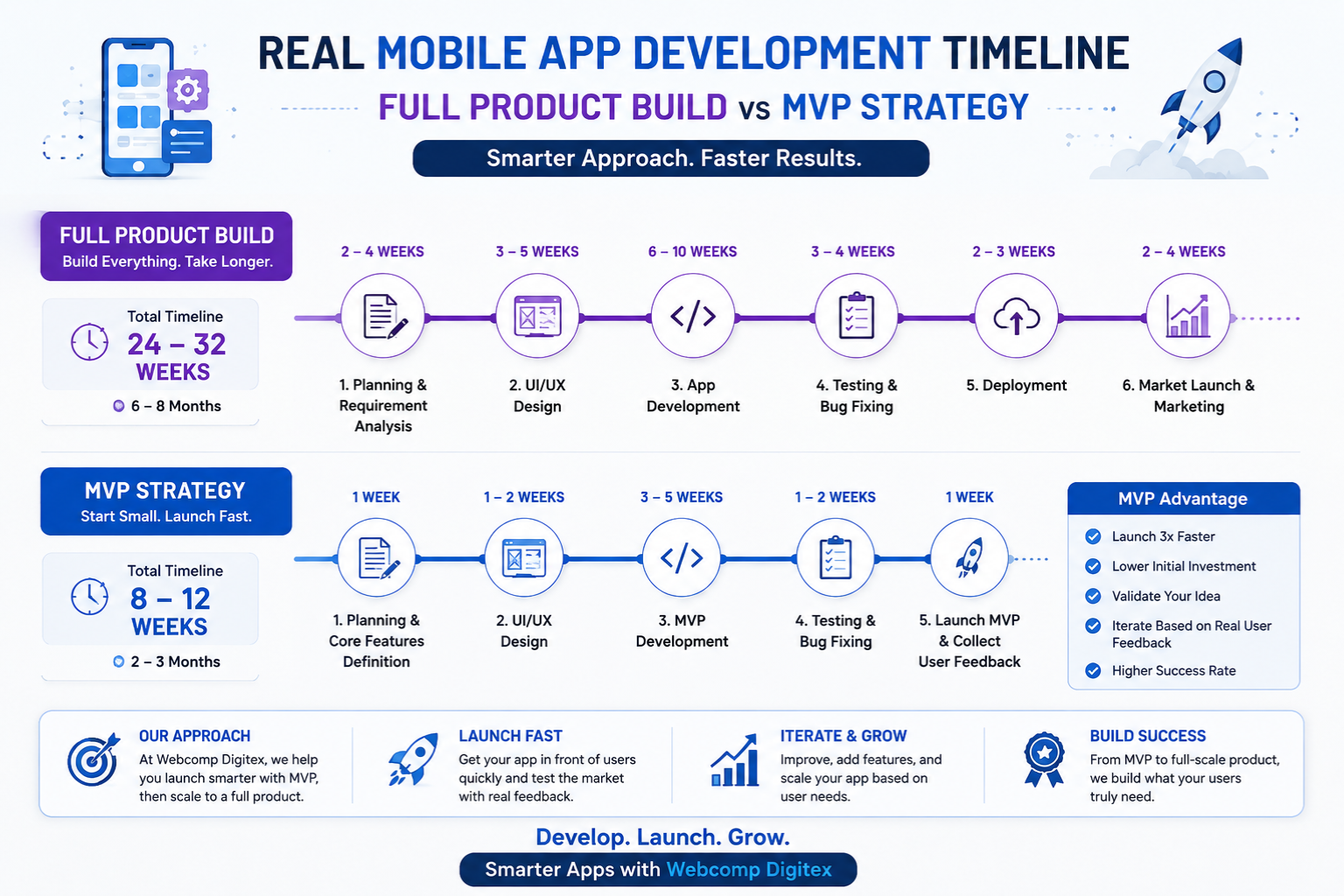
A proper MVP shouldn’t take 6-9 months. If it does, you’re not building an MVP. You’re building a full product slowly.
Here’s what realistic MVP timelines look like for different types of apps:
Simple utility app (booking, forms, calculators): 6-8 weeks
Marketplace/platform (connecting two user types): 10-14 weeks
Content/social app (feeds, profiles, interactions): 12-16 weeks
Notice none of these say “6 months.” If a custom mobile app development company quotes you 6 months for an MVP, they’re either including way too many features or they’re not prioritizing your project.
At Webcomp Digitex, our average MVP timeline is 8-10 weeks from kickoff to launch. That includes:
- 1 week: Discovery and scope finalization
- 1 week: Design (wireframes and basic UI)
- 4-5 weeks: Development
- 1-2 weeks: Testing and fixes
- Launch
Could we do it faster? Sometimes. Should we? Usually not. Rushing development creates bugs. But 8-10 weeks is the sweet spot where you move fast without breaking things.
The Post-Launch MVP Strategy Nobody Talks About
Here’s what most mobile app developer agencies don’t tell you: launching the MVP is maybe 40% of the work.
The other 60% is what you do after launch. This is where you actually learn whether your assumption was right.
You need to:
Track the right things: Not total downloads. Not daily active users (yet). Track the specific behavior that tests your risky assumption. For our real estate client, we literally had a spreadsheet with every user who scheduled a site visit. We called some of them. We asked why they used the app. We asked what almost stopped them.
Talk to users who quit: The people who downloaded your app and never came back? Those people have the most valuable feedback. Most companies ignore them because it’s uncomfortable. But they’ll tell you exactly why your assumption was wrong.
Set a decision date: Before you launch, decide: “On [specific date], we’ll look at the data and decide if we continue, pivot, or kill this.” Otherwise you’ll keep moving the goalposts. We usually set this at 60-90 days post-launch.
Budget for iteration: Your MVP budget should include at least 2-3 rounds of changes based on what you learn. If you spend 100% of budget on the initial build, you can’t act on the feedback. That’s pointless.
A healthcare tech client in Pimpri-Chinchwad learned this the hard way. They built an MVP for ₹8 lakhs with another agency. It launched. They got feedback. They had no budget left to implement changes. The app sat there for 6 months while they tried to raise more money. By the time they had budget, the market had moved on.
When they came to us for version 2, we structured it differently: ₹6 lakhs for initial MVP, ₹3 lakhs reserved for post-launch iterations. Worked way better.
When NOT to Build an MVP
Look, I’m supposed to sell you on app development. That’s literally what we do at Webcomp Digitex. But honestly? Sometimes an MVP is the wrong move.
Don’t build an MVP if:
You haven’t talked to 20+ potential users: If you’re building based on a hunch without talking to real people who have the problem you think you’re solving, you’re not ready for an MVP. You’re ready for customer interviews. Do those first. They cost zero rupees.
You can test your assumption without building anything: Can you test it with a landing page and a Google Form? A WhatsApp group? A manual service? Do that first. A manufacturing client in MIDC wanted to build an app for spare parts ordering. We said “just make an Excel sheet and share it on WhatsApp for a month.” They did. Nobody used it. Saved them ₹12 lakhs.
You’re in a market where users expect feature parity: If you’re building a direct competitor to an established app in a mature market, MVP strategy is hard. Users will compare you to the full-featured incumbent. You might need to build more upfront. This isn’t common, but it happens.
You don’t have budget for iteration: If your total budget is ₹6 lakhs and that’s it, I’d rather see you spend ₹4 lakhs on the MVP and keep ₹2 lakhs for changes. If you spend all ₹6 lakhs on the initial build, you’re stuck.
The Real Cost of MVP Development
Let’s talk numbers because this is what everyone wants to know.
What should an MVP actually cost with a decent mobile application development agency in Pune?
Based on our projects and what I see in the market:
Simple MVP (single-sided, 5-7 features): ₹4-7 lakhs
Medium MVP (marketplace/two-sided, 8-12 features): ₹7-12 lakhs
Complex MVP (multiple user types, some integrations): ₹12-18 lakhs
Anything below ₹4 lakhs, you’re probably getting freelancers or very junior developers. Could work, but higher risk. Anything above ₹18 lakhs, you’re not building an MVP anymore.
If app development studios are quoting you ₹25-30 lakhs for an “MVP,” ask them to show you exactly what features that includes. Then use the framework I gave you earlier. I bet you can cut it in half.

Frequently Asked Questions
How long should we test an MVP before deciding to continue or pivot?
60-90 days is the sweet spot for most apps. Less than that, you don’t have enough data. More than that, you’re probably overthinking it. Set a specific date before you launch and stick to it. At Webcomp Digitex, we usually plan a “decision meeting” 75 days after launch where we look at the metrics we defined upfront and make a call: continue, pivot, or kill.
Can we add features to an MVP after launch or do we need to rebuild?
You can definitely add features. That’s the whole point. Your MVP should be built in a way that lets you add to it. Good app development studios will architect it for growth even if they’re not building for scale. Just don’t add features randomly. Add the ones that your user feedback says you need. We had an e-commerce client add 3 features over 4 months based on what users kept asking for. That’s how it should work.
What’s the difference between an MVP and a prototype?
A prototype is something you show to people. An MVP is something people actually use. Prototypes are usually not fully functional — they might be clickable designs or limited functionality just to demonstrate the idea. MVPs are real apps that work, just with limited features. You can’t really test user behavior with a prototype. You can with an MVP.
Should we build for iOS, Android, or both for an MVP?
Pick one. Whichever platform your target users actually use. In India, for most consumer apps, that’s Android. For B2B or premium products, might be iOS. Don’t build both for an MVP unless you have strong data that your users are split 50/50. Building for both adds 40-50% to your cost and timeline. Launch on one platform, validate your assumption, then expand. A real estate client in Wakad launched Android-only, got traction, added iOS 5 months later. Smart move.
How do we know if our MVP failed or if we just need more time?
This is why you define success metrics before you build. If you said “success is 50 users completing X action in 90 days” and you got 12, your MVP failed. That’s not a bad thing — you learned your assumption was wrong, and you didn’t waste ₹20 lakhs. If you hit 45, you’re close but not quite there. That might mean you need to tweak something, not rebuild. If you hit 8, something fundamental is wrong. Time won’t fix it. This is uncomfortable but necessary clarity.
Can app development studios really build a useful MVP in 8-10 weeks?
Yes, if they’re good and if you’re disciplined about scope. We do it regularly at Webcomp Digitex. The key is ruthless prioritization and not changing requirements mid-project. Where timelines blow up is when clients keep adding “just one more small feature” every week. Or when the initial scope was too big to begin with. If a mobile app developer agency says they need 6 months for an MVP, they’re either padding the timeline or building too much.
Ready to Build an MVP That Actually Tests Your Idea?
Look, most app ideas don’t work. That’s not pessimism. It’s statistics.
But the ones that do work? They usually start with a smart MVP that tests one core assumption before spending a fortune on features users don’t need.
At Webcomp Digitex, we’ve built 40+ MVPs for businesses across Pune — from manufacturing companies in Chakan to real estate developers in Hinjewadi to healthcare startups in Kharadi. About 60% of them validated their core assumption and moved forward to build the full product. About 40% learned their idea needed a pivot or wasn’t viable.
Both outcomes saved our clients money and time. That’s what good MVP strategy does.
If you’re thinking about building a mobile app and you don’t want to waste ₹15-20 lakhs on features nobody uses, let’s talk. We’ll be honest with you about what needs to be in version 1 and what can wait. We’ll help you define success before you write any code. And we’ll build something in 8-10 weeks that actually tests whether your idea works.
Call us at +91-9960802498 or visit webcompdigitex.com. Let’s figure out what your MVP really needs to be.


