
Best Social Media Platforms for Your Business Type: What Actually Works in Pune
A real estate developer in Wakad spent ₹85,000 on Instagram ads last year and got exactly three enquiries. None converted.
Same budget, different platform — LinkedIn — and they closed two deals worth ₹4.2 crores in six months.
Here’s the thing: the best social media for business isn’t Instagram or Facebook or LinkedIn. It’s the one where your actual customers spend time and are ready to hear from you. And that changes completely based on what you sell.
I’ve spent 12 years helping Pune businesses figure this out — manufacturers in Chakan, clinics in Kharadi, e-commerce brands shipping from Pimpri-Chinchwad. The pattern is clear once you know where to look.
Let me show you exactly which platform makes sense for your business type. No theory. Just what we’ve seen work (and waste money) across hundreds of campaigns at Webcomp Digitex.

If You’re in Manufacturing or B2B: LinkedIn Wins, Period
I’ll be direct: if you’re selling to other businesses, Instagram is mostly a waste of your time.
Your procurement manager isn’t scrolling reels looking for sheet metal suppliers. They’re on LinkedIn.
We worked with a precision parts manufacturer in Chakan. They were doing Facebook posts about their CNC machines — pretty pictures, some engagement from relatives and competitors. Zero enquiries.
We shifted everything to LinkedIn. Posted case studies. Shared technical insights about tolerance levels in automotive parts. Participated in industry group discussions.
Cost-per-lead dropped from ₹6,400 to ₹1,900 in four months. More importantly, lead quality jumped. These weren’t tyre-kickers. They were actual decision-makers from OEMs.
Here’s what works on LinkedIn for B2B:
Post consistently but don’t overthink it. Two to three times a week is plenty. Share actual project photos. Write about problems you solved — “How we reduced rejection rates for a Pimpri automotive client from 8% to 1.2%”. People remember specifics.
Use LinkedIn’s targeting in ads. You can reach exactly who you need: job titles, company size, industries. A campaign we ran for an industrial automation company targeted “Production Managers” and “Plant Heads” in Maharashtra. That precision doesn’t exist on Facebook.
And here’s something only people actually running these campaigns know: LinkedIn leads are slower but stickier. Your sales cycle might be three months, not three days. That’s fine. B2B deals don’t happen because someone saw a carousel post and impulse-bought a ₹15 lakh machine.
What about Facebook for B2B?
Not completely useless, but secondary. We use it mainly for retargeting — someone visited your website, now they see your ad on Facebook. It keeps you visible. But for cold outreach to new prospects? LinkedIn every time.
Real Estate: Facebook Still Dominates (But You’re Probably Using It Wrong)
Every real estate developer in Baner is on Facebook. Most are doing it badly.
They post property photos with “Possession soon!” and wonder why leads don’t come. Here’s what they’re missing: people don’t buy apartments because of a nice photo. They buy because you solved their specific worry.
The best social media to promote business in real estate is still Facebook, but you need to understand what works in 2025.
Target by life stage, not just location.
We run campaigns for a mid-sized developer in Hinjewadi. Instead of targeting “everyone in Pune aged 25-45”, we targeted:
- Newly married couples (relationship status: married, changed in last 2 years)
- People who recently moved to Pune (tagged in posts at Pune locations, living elsewhere before)
- Parents with young kids (interests in parenting groups, preschools)
Each segment got different messaging. Young couples saw 2BHK options with home loan guidance. Families got 3BHK with school proximity highlighted.
Cost-per-lead went from ₹420 to ₹180. Site visits increased 60%.
Video tours beat photos every single time.
Not fancy 4K drone shots (though those are nice). I mean simple walk-through videos. Show the view from the balcony. Open the kitchen cabinets. Stand in the bedroom and pan around.
People watch these videos for 2-3 minutes. That’s massive engagement. Facebook’s algorithm loves it, shows your content to more people.
One practitioner insight: post these videos natively on Facebook, don’t just share YouTube links. Native videos get 3x more reach in our experience. Facebook wants to keep people on Facebook.
Instagram for real estate? Maybe.
If you’re selling premium properties — ₹1.5 crore+ — Instagram makes sense as a secondary platform. The audience skews younger and higher income. But it’s not your primary channel. Facebook has the volume.
Healthcare and Clinics: Google My Business First, Then Facebook
Look, I know this is about social media. But if you run a clinic in Kharadi and you’re not obsessing over your Google My Business profile before touching Facebook, you’re doing it backwards.
People search “orthopedic doctor near me” — they don’t scroll Instagram hoping to find one.
That said, the best social media for small business in healthcare is Facebook, used very specifically.
Build trust through education, not promotion.
We work with a multispecialty clinic in Pimpri-Chinchwad. Their Facebook strategy is simple: answer common health questions. “When should knee pain worry you?” “Five signs your child needs an eye checkup.”
Short posts, clear language, no medical jargon. Once a week, a doctor records a 90-second video answering a question.
They’re not selling. They’re helping. But when someone in that audience needs an orthopedic consultation, guess who they remember?
Hyper-local targeting is everything.
Don’t target all of Pune. Target 5km around your clinic. Maybe stretch to 10km if you’re a specialty clinic.
Use Facebook’s radius targeting in Ads Manager. Pin your exact location, draw the circle. Someone in Hinjewadi isn’t coming to your Hadapsar clinic no matter how good your ad is.
What about Instagram for doctors?
Works for dentists and cosmetic specialists. Before-after photos perform well (with proper consent, obviously). For general physicians or specialists? Not really worth it. Your patients are on Facebook.
WhatsApp is actually more valuable. Get people onto a broadcast list with health tips. Just make sure you have permission — nobody likes spam.
E-Commerce: It Depends Entirely on What You Sell
This is where everyone wants a simple answer and I can’t give you one.
The best social media advertising for e-commerce changes based on your product, price point, and audience age.
Selling to women aged 25-40? Instagram and Facebook.
Fashion, home decor, kids’ products, beauty — Instagram works beautifully. We manage campaigns for an organic skincare brand shipping from Pune. Instagram Shopping posts, Reels showing how to use products, Stories with customer reviews.
Revenue from Instagram is 40% of their total online sales. Facebook is another 35%.
Here’s the thing though: you need good content. Not just product photos on white backgrounds. Lifestyle shots. Someone actually using the thing. User-generated content works best — repost customer photos (with permission).
Selling electronics, gadgets, or anything tech? Facebook ads, maybe YouTube.
Instagram doesn’t convert as well. People want specs, comparisons, reviews. Facebook lets you put more information in the ad. YouTube reviews build credibility.
We tried Instagram for a client selling phone accessories. Engagement was good, sales were terrible. Moved budget to Facebook with carousel ads showing features — conversions doubled.
Selling high-ticket items? Multi-platform retargeting.
Nobody buys a ₹40,000 coffee machine from a single Instagram ad. They research. They think about it. They come back.
Your strategy: use Facebook and Instagram to build awareness. When someone visits your product page, retarget them across both platforms. Show reviews. Show the product being used. Offer a limited-time discount.
Use Meta Pixel to track this properly. Set up custom audiences in Meta Ads Manager based on behaviour — people who viewed product but didn’t add to cart, people who added to cart but didn’t buy.
One thing people mess up: they retarget forever. Someone bought from you, they keep seeing ads. Use exclusion audiences. If someone purchased, stop showing them the same product ad.
Professional Services (CA, Lawyers, Consultants): LinkedIn + Organic Facebook
You’re selling expertise. Social media for you is about visibility and credibility, not direct sales.
LinkedIn for authority building.
Write about regulatory changes. Share case studies (anonymized). Comment on industry news. You’re not selling your CA services in a post — you’re demonstrating you know what you’re talking about.
When someone in your network needs a CA, they’ll remember the person who explained GST changes in simple language.
Facebook for local visibility.
Join local business groups. Answer questions. If someone asks “Can anyone recommend a good corporate lawyer in Baner?”, that’s your moment. But you need to have been present in that group, helping people, before that question comes up.
Don’t just show up to sell.
Instagram? Skip it.
Unless you’re a career counselor or life coach targeting younger people. For traditional professional services, Instagram doesn’t deliver.
The Platforms Most Pune Businesses Waste Money On
Let me save you some cash.
Twitter (X): Unless you’re in media, politics, or tech startups, don’t bother. Your customers aren’t there.
Pinterest: Works for some e-commerce (home decor, fashion, food). For everything else? No. We tested it for three clients. Total waste.
Snapchat: Only if you’re targeting college students specifically. Even then, Instagram Reels probably works better.
YouTube: Not a waste, but it’s a long game. Great for building authority and SEO. Terrible if you need leads next month. Video production takes time and money.
At Webcomp Digitex, we usually tell clients: master one or two platforms before spreading yourself thin. I’ve seen too many businesses post inconsistently across five platforms and wonder why nothing works.
How to Actually Choose (The Framework We Use)
Stop guessing. Answer these questions:
Where do your existing customers spend time?
Ask them. Literally. “How did you hear about us? What social media do you use daily?” If eight out of ten customers say Facebook, there’s your answer.
What’s your product consideration time?
Impulse buy under ₹500? Instagram can work. Complex B2B solution with six-month sales cycle? LinkedIn.
Can you create content consistently?
Instagram needs visuals — photos, videos, graphics. If you can’t produce that regularly, you’ll fail. Facebook is more forgiving. LinkedIn values written insights.
Pick the platform that matches your content creation ability.
What’s your budget?
Organic reach is dead everywhere. You’ll need to pay for ads. Facebook and Instagram ads start small — ₹500/day can work. LinkedIn is expensive — minimum ₹1,500/day to see anything meaningful.
If you’ve got ₹15,000/month total, Facebook makes more sense than spreading it across three platforms.
The Biggest Mistake: Treating Every Platform the Same
I see this constantly in Pune businesses.
They create one post and share it everywhere. Same image, same caption, LinkedIn to Instagram to Facebook.
It doesn’t work because people use these platforms differently.
LinkedIn: Professional. People are in work mode. They want insights, data, case studies. A casual meme that works on Instagram looks stupid here.
Instagram: Visual and aspirational. People want to see beautiful things, entertaining things, inspiring things. A text-heavy infographic that works on LinkedIn gets scrolled past here.
Facebook: Mix of personal and practical. People want community, relatability, useful information. Overly corporate content feels off.
We create different content for each platform at Webcomp Digitex. It’s more work, yes. It also actually performs.
One tactic that works: repurpose smartly. Take one core idea — say, “Five ways to reduce energy costs in manufacturing.” On LinkedIn, it’s a detailed post with data. On Facebook, it’s a simple tips list. On Instagram, it’s a carousel with one tip per slide and better visuals.
Same insight, different packaging.
Tracking What Actually Matters
Pretty follower counts mean nothing if they don’t translate to business.
Here’s what to track based on your goal:
If you want leads: Cost per lead, lead quality (how many convert to customers), conversion rate from social to website.
Use UTM parameters in every link you share. Set them up in Google Analytics 4. You’ll see exactly which social post or ad brought traffic that converted.
If you want sales: Revenue attributed to social, return on ad spend (ROAS), customer acquisition cost from each platform.
Meta Ads Manager and LinkedIn Campaign Manager both show this data. Actually look at it weekly.
If you want brand awareness: Reach, engagement rate, video view duration, share rate.
But honestly, if you’re a small business in Pune, awareness doesn’t pay bills. Focus on leads and sales first.
One thing we check that most businesses ignore: negative feedback on ads. If your ad is getting lots of “hide ad” clicks or negative reactions, Facebook shows it to fewer people and charges you more. Check your Relevance Score (Facebook) or Quality Ranking (Meta Ads Manager). If it’s low, your ad creative or targeting is off.
What We’re Seeing Work Right Now in 2025
Some current patterns from campaigns we’re running:
Short-form video dominates everywhere. Instagram Reels, Facebook Reels, even LinkedIn is pushing video hard. If you’re not doing video, you’re fighting with one hand tied.
Don’t overthink production quality. We’ve seen ₹500 smartphone videos outperform ₹25,000 professional shoots. Authenticity beats polish.
Conversational messaging ads work. Instead of “Click here to buy”, try “Want help choosing the right option for your space? Message us.” Opens a Messenger or WhatsApp chat. More personal, higher conversion.
Works especially well for real estate and healthcare.
Carousel ads still outperform single images. On both Facebook and Instagram. People swipe through, you get more time to tell your story. Use the first card to hook attention, next cards to build interest, last card for the offer.
Stop Doing What Everyone Else Is Doing
Every manufacturing company in MIDC posts the same content — factory photos, “We are hiring” posts, festival greetings.
It’s noise.
You know what got massive engagement for one of our manufacturing clients? They posted about their lunch dabba delivery system for workers. Showed the kitchen, talked about the meals, introduced the cook.
Humanized the business. People remembered them.
The best social media for business isn’t about following a template. It’s about showing up as real people solving real problems.
Your competitors are boring. You don’t have to be.

Frequently Asked Questions
Which social media platform is best for small business in Pune?
Facebook, hands down, for most small businesses. It has the largest active user base in Pune across age groups and income levels. You can target hyper-locally — down to specific areas like Kothrud or Aundh. Ad costs are reasonable. And people actually discover local businesses there. Instagram works as a secondary platform if your product is visual. LinkedIn only if you’re B2B.
How much should I spend on social media advertising?
Start with whatever you can sustain every month for at least three months. If that’s ₹10,000, fine. Consistency matters more than amount initially. We’ve seen businesses get decent results starting at ₹15,000-20,000/month on Facebook. LinkedIn needs minimum ₹25,000-30,000/month to gather enough data. Don’t spread a small budget across multiple platforms — pick one and test properly.
Can I manage social media myself or do I need an agency?
You can absolutely start yourself, especially organic posting. But paid advertising gets complex fast — audience setup, conversion tracking, A/B testing, retargeting. Most business owners we meet at Webcomp Digitex tried it themselves for 3-6 months, wasted ₹30,000-50,000, then called us. If you’re doing under ₹20,000/month in ads, learn it yourself. Above that, the cost of mistakes exceeds agency fees.
How long does it take to see results from social media marketing?
Organic: 3-6 months minimum before you see meaningful traction. Paid ads: you’ll see data within days, but give it 4-6 weeks to optimize and see consistent results. B2B on LinkedIn takes longer — 2-3 months. If an agency promises immediate results, they’re lying. We tell clients at Webcomp Digitex to commit to at least 90 days before evaluating properly.
Should I focus on followers or engagement?
Neither, honestly. Focus on conversions — enquiries, calls, sales, whatever your business goal is. We’ve seen accounts with 800 followers generate more leads than accounts with 8,000. Engagement matters only if it’s from your target audience and it leads somewhere. Vanity metrics feel good but don’t pay salaries.
Is it worth posting daily on social media?
Quality over frequency. Three valuable posts a week beat seven mediocre ones. Daily posting only makes sense if you have good content and bandwidth to engage with comments. We usually recommend 3-4 times per week for most businesses. Instagram might need more if you’re e-commerce. LinkedIn works fine with 2-3 times per week.
Let’s Find What Actually Works for Your Business
Here’s the truth: you don’t need to be on every platform. You need to be on the right one, doing it properly.
We’ve spent 12 years figuring out what works for Pune businesses — manufacturers, real estate developers, clinics, retailers, everyone in between. The patterns are clear once you look at actual data instead of guessing.
At Webcomp Digitex, we don’t sell you a standard package. We look at your business type, your customers, your budget, and build a plan that makes sense. Sometimes that’s just Facebook. Sometimes it’s LinkedIn + retargeting. Sometimes it’s fixing your Google presence before touching social media.
Want to stop wasting money on platforms that don’t work for you? Let’s talk.
Call us at +91-9960802498 or visit webcompdigitex.com.
We’re based in Pune, we work with Pune businesses, and we’ll tell you straight up what’ll work and what won’t. No long-term contracts. No vague promises. Just real strategy based on what we’ve seen actually deliver results.
The best social media for business is the one that brings you customers. Let’s find yours.
4. Image Alt Texts
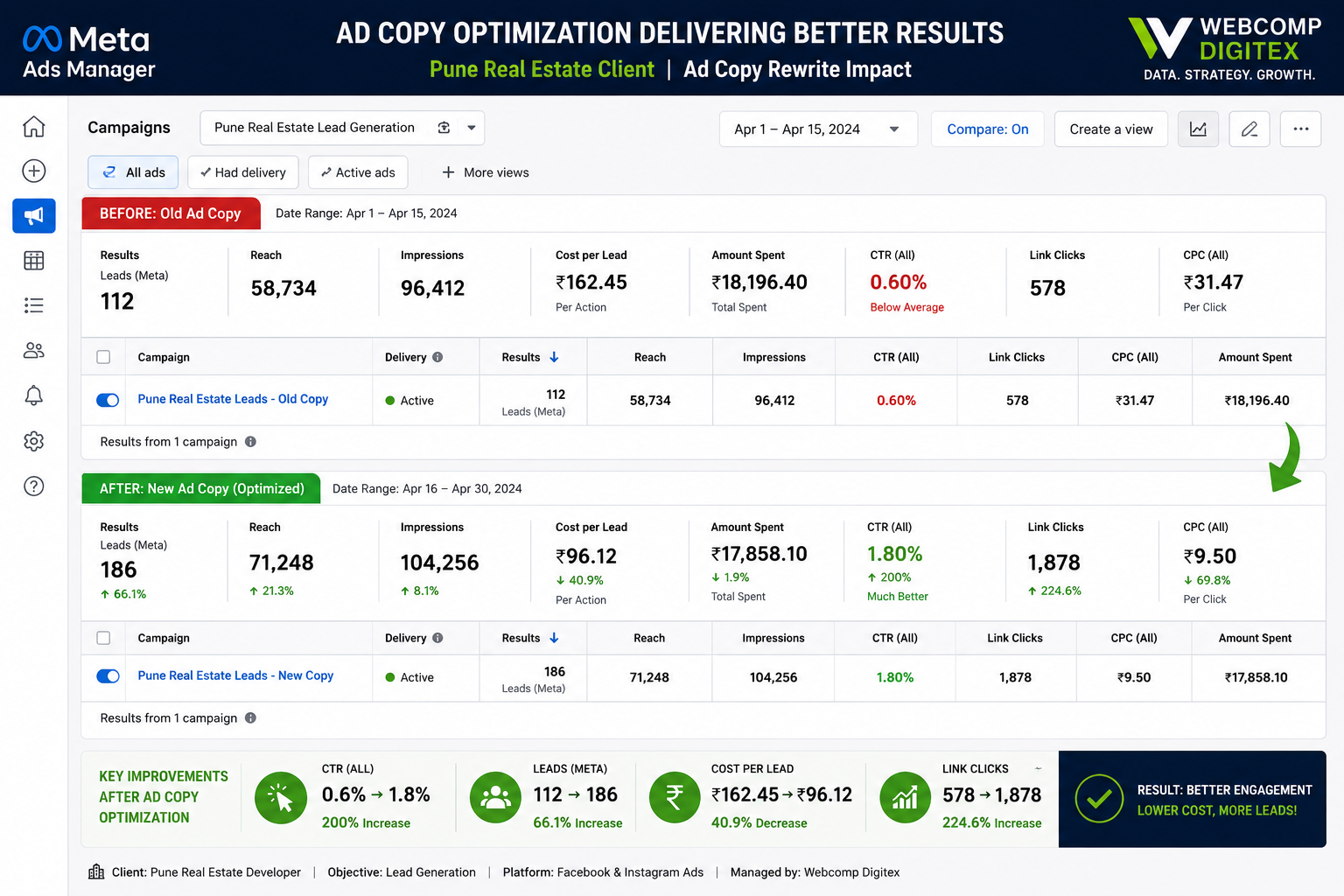
- “Facebook Ads Manager dashboard showing campaign results for Pune real estate client with cost-per-lead metrics”
- “LinkedIn feed on desktop showing B2B manufacturing company posts with engagement from procurement managers and industry professionals”
- “Comparison chart of social media platforms for different business types – manufacturing, real estate, healthcare, and e-commerce with performance indicators”


