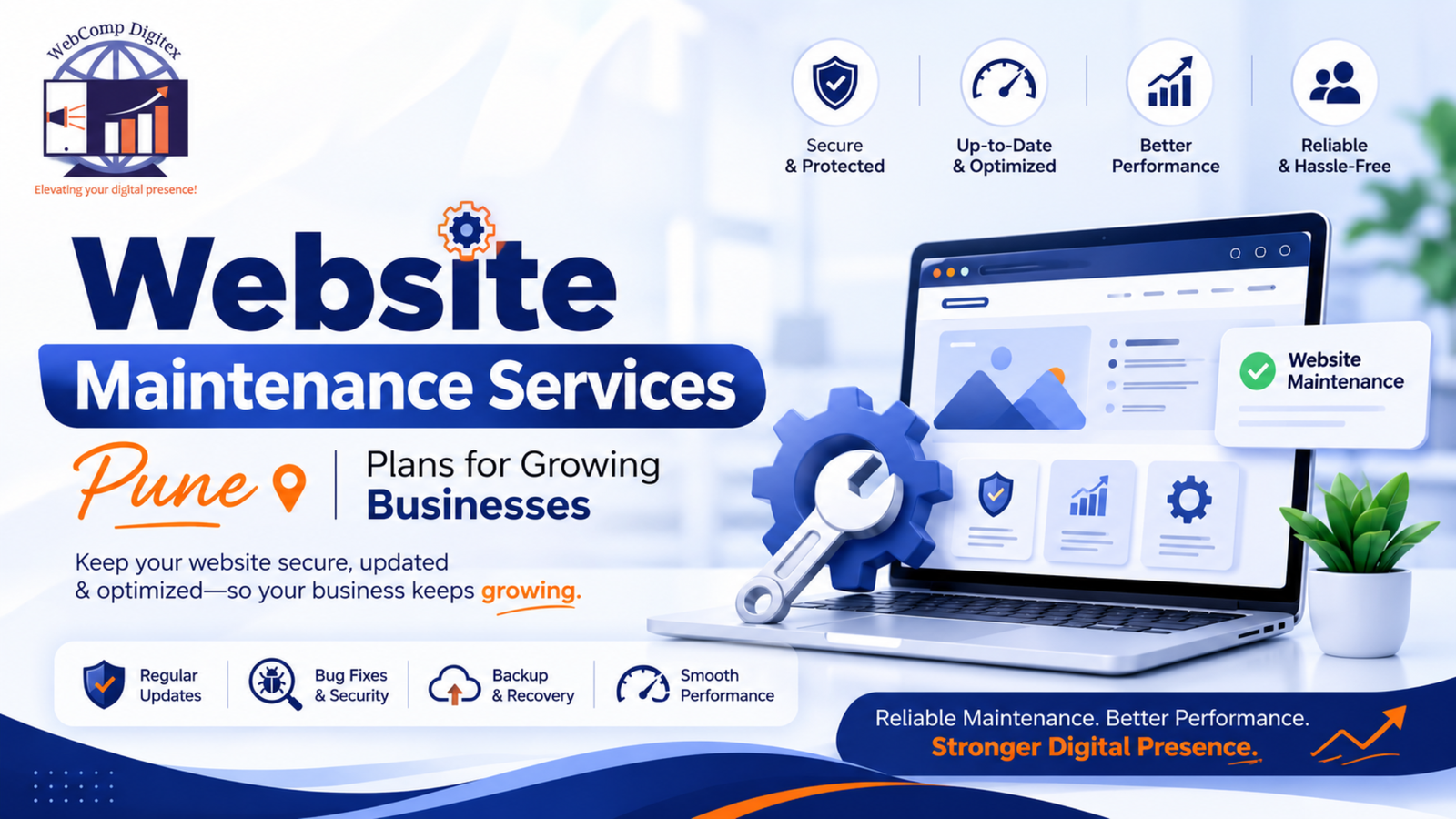
Your website launched six months ago. Looked great. Worked perfectly. Now? Forms break randomly. Page speed dropped 40%. Security plugins haven’t been updated since February. And you’re finding out about problems from customers, not monitoring systems.
That’s not a technology problem. That’s a maintenance problem. Most growing businesses in Pune treat their website like a vending machine – install it once, expect it to work forever. It doesn’t. Websites degrade. Plugins conflict. Security vulnerabilities emerge weekly. Without structured website maintenance services Pune businesses actually need, your digital storefront becomes a liability.
Here’s what most agencies won’t tell you upfront: maintenance isn’t glamorous, but it’s where ROI lives. A well-maintained website converts 23% better than one running on outdated code and hope. We’ve seen manufacturing clients lose enterprise deals because their contact form silently failed for three weeks. Real estate developers miss lead gen peaks because Core Web Vitals tanked and Google buried their project pages.
Business website upkeep isn’t about perfection. It’s about preventing expensive disasters and keeping conversion systems running when traffic arrives. Let’s talk about what actually matters.
What Website Maintenance Actually Covers
Not every web maintenance package looks the same. Some agencies count “maintenance” as logging in twice a month to update WordPress. That’s not maintenance – that’s bare minimum survival mode.
Real ongoing web management includes security monitoring, not just security updates. There’s a difference. One catches threats before they execute. The other patches holes after everyone’s already using them. For a business in Pimple Saudagar handling customer data through forms, that gap matters legally and financially.
Performance optimization isn’t a one-time setup either. Your website slows down as content grows, third-party scripts multiply, and hosting resources get shared differently. We’ve watched client sites drop from 1.8-second load times to 4.7 seconds over eight months – not because anything broke, but because nothing was maintained. That’s a 34% conversion rate drop you won’t see in Google Analytics as a red alert.
Backup systems sound boring until you need them. A plotting project client got hacked on a Saturday morning. Their hosting provider’s “daily backups” were corrupted. Our independent backup system restored everything in 47 minutes. Without that? Three weeks of leads, inquiry data, and brochure downloads – gone.
Then there’s the stuff nobody thinks about until it fails. SSL certificate renewals. Database optimization. Broken link monitoring. Image compression as libraries expand. Plugin compatibility testing before updates go live. Someone has to own that checklist, or your website becomes a ticking maintenance debt bomb.

Why Growing Businesses Can’t Skip Ongoing Support
Scale changes everything. A 15-page website rarely breaks. A 200-page website with integrated CRM, payment gateways, lead capture forms, live chat, and custom calculators? That’s a different animal. Every integration point is a failure point without website support plans that actually monitor them.
We worked with an industrial equipment manufacturer in Pune expanding into export markets. Website traffic jumped 280% after they ranked for key product terms. Great news. Except their hosting plan couldn’t handle the load. The site went down during peak U.S. business hours – repeatedly. They lost seven qualified B2B leads worth ₹1.8 crore before we migrated hosting and implemented uptime monitoring.
That’s not a hosting problem. That’s a maintenance problem. Nobody was watching performance under load. Nobody had contingency infrastructure ready. Growth without web maintenance packages becomes growth that punishes you.
Here’s the pattern: businesses invest heavily in website development and SEO, then treat maintenance as an afterthought. The website ranks. Traffic comes. Then conversion architecture fails because forms timeout, pages load slowly on mobile, or checkout flows break on specific browsers. All preventable. All invisible without active monitoring.
Software ages badly. What worked in early 2024 might conflict with PHP 8.2 updates in 2026. WordPress releases 3-4 major updates annually. Plugins update even faster. Skip those updates? Your site becomes a security target. Apply them blindly without staging environment testing? Your site breaks in production. Both scenarios kill revenue.
Most businesses realize they need website maintenance services Pune agencies offer only after something expensive breaks. That’s the wrong time to start looking. By then you’re in crisis mode, paying emergency rates, and losing money while waiting for fixes.
Core Components of Effective Website Support Plans
Security monitoring comes first. Not negotiable. WordPress sites face an average of 94 attack attempts per day according to Wordfence data. Most fail. Some don’t. A real security plan includes firewall configuration, malware scanning, brute force protection, and vulnerability patching – not just installing a security plugin and hoping.
We’ve caught intrusions at 3 AM that would have destroyed client databases by 9 AM. Automated monitoring flagged suspicious admin login patterns. We locked the site, killed the attack vector, and restored from clean backup before the business owner even knew something was wrong. That’s what business website upkeep looks like when it’s done right.
Performance optimization isn’t a set-and-forget task. It’s continuous improvement based on actual user behavior. We track Core Web Vitals weekly. When LCP creeps above 2.5 seconds, we investigate. Usually it’s uncompressed images, render-blocking JavaScript, or server response time degradation. Fix those, and bounce rate drops immediately.
A real estate client’s project page was loading in 6.2 seconds on mobile. They blamed their photographer’s image sizes. Partially true. The real issue? Fourteen tracking scripts loading synchronously, blocking page render. We moved eleven to async loading, deferred three others, and load time dropped to 2.1 seconds. Inquiry form submissions jumped 28% in the next two weeks.
Content updates matter more than people think. Your “Latest Projects” section showing work from 2023? That signals abandonment to visitors. Outdated pricing information? That creates sales friction. Broken blog images? That kills trust. Someone needs ownership of keeping your website current, not just functional.
Backup frequency depends on how often your site changes. An e-commerce site processing daily transactions needs daily backups, minimum. A corporate brochure site updating monthly can run weekly backups. But both need off-site storage, version retention, and tested restoration procedures. Backups you’ve never tested are backups that will fail when you need them.
Database optimization prevents the slow death most websites experience. WordPress databases accumulate trash – post revisions, spam comments, transient options, orphaned metadata. A six-month-old site can have 40% database bloat. That slows every query, every page load, every search operation. Regular cleanup keeps things fast.

Maintenance Package Structures That Actually Work
Most agencies offer tiered web maintenance packages: Basic, Standard, Premium. Names change. Structure stays the same. Here’s what actually differentiates them – and what you’re really paying for.
Basic plans typically cover essential security updates, weekly backups, and monthly uptime monitoring. That’s enough for simple informational websites that rarely change. A five-page service business site? Basic works fine. A lead generation system with forms, calculators, and integrations? You’ll outgrow Basic fast.
Standard plans add performance monitoring, content updates, and proactive issue resolution. This is where most growing businesses should start. You get someone watching your site actively, not just running automated updates. When contact forms stop sending notifications, standard plans catch that within 24 hours. Basic plans? You find out when a customer complains.
Premium plans include priority support, custom development hours, conversion optimization, and dedicated account management. These make sense for businesses where website downtime directly impacts revenue – e-commerce, SaaS platforms, high-volume lead generation systems. If your website generates ₹50,000 daily, paying ₹25,000 monthly for premium maintenance is obvious math.
We’ve structured website maintenance services Pune businesses actually need around response time, not just task lists. Emergency response within 2 hours costs more than next-business-day support. But if your website crashes during a product launch or peak inquiry period, 2-hour response time is worth every rupee.
Custom packages work better than fixed tiers for complex sites. A healthcare client needed HIPAA-compliant hosting, daily security audits, and bi-weekly content updates for their medical blog. Standard packages didn’t fit. We built custom website support plans around their compliance requirements and content calendar. That’s the advantage of working with an agency that understands business context, not just technical tasks.
One pattern we’ve noticed: businesses upgrading hosting without upgrading maintenance usually regret it. Faster servers don’t prevent plugin conflicts. Better bandwidth doesn’t stop malware. You need both infrastructure and ongoing web management to see real improvement.
Common Maintenance Mistakes Pune Businesses Make
Treating maintenance as an expense rather than infrastructure is mistake number one. You wouldn’t skip building maintenance and expect your office to stay functional. Websites are no different. They’re business infrastructure. Neglect them, they deteriorate. Rapidly.
A manufacturing client wanted to save ₹15,000 monthly by handling maintenance in-house. Their IT person knew networks but not web development. Three months in, their site got hacked. Recovery cost ₹1.2 lakhs plus two weeks of downtime. The math didn’t work out in their favor.
Choosing maintenance plans based only on price is another trap. The cheapest option usually means automated updates without testing, generic security plugins without configuration, and support tickets that take 72 hours to answer. When your website is your primary lead source, that’s not saving money – it’s risking revenue.
Ignoring staging environments causes preventable disasters. We insist on staging sites for every client on standard or premium plans. Updates get tested in staging before touching production. That catches conflicts, broken layouts, and functionality issues before customers see them. Businesses that skip staging learn this lesson expensively.
We had a prospect once who updated nineteen plugins simultaneously on a live site without backups. The site crashed. Database corrupted. No restoration point. That’s not bad luck – that’s bad process. It took 31 hours to rebuild from cached versions and incomplete backups. Business website upkeep means having procedures that prevent these scenarios.
Another mistake: no clear ownership. Marketing thinks IT handles it. IT thinks the web agency handles it. The agency thinks they’re only doing updates, not monitoring. Three months later, nobody’s watching, and the site’s been sending form submissions to an outdated email address. Real businesses lose real money this way.
Some businesses pay for maintenance but never use included hours. Standard plans often include 2-4 hours monthly for content updates, minor design tweaks, or functionality improvements. Use them. Update that outdated testimonial section. Fix that clunky mobile menu. Add that new service page. Unused hours don’t roll over – that’s just wasted budget.
How to Choose the Right Website Support Plan
Start with honest assessment of your current situation. How often does your website change? Daily content updates need different support than quarterly page additions. How complex is your site? A custom-built lead generation system needs more attention than a template-based brochure site.
Traffic volume matters too. A site getting 500 visitors monthly has different performance needs than one handling 15,000. Higher traffic means more resource consumption, more potential security targets, and more things that can break under load. Your web maintenance packages should scale with traffic.
Consider your internal capacity. Do you have technical staff who can handle basic WordPress updates? Or is every website task a black box? Businesses with zero internal web knowledge need more comprehensive ongoing web management. That’s not a weakness – it’s just reality.
Revenue impact should guide budget decisions. If your website generates qualified leads worth ₹8 lakhs monthly, spending ₹20,000 on website maintenance services Pune agencies provide is a 2.5% insurance cost. That’s cheap. If your site is purely informational with no direct revenue link, that same ₹20,000 might be overkill.
Industry requirements matter particularly for healthcare, finance, and education clients. Regulatory compliance isn’t optional. HIPAA, PCI-DSS, data protection laws – these require specific security configurations, monitoring, and documentation. Standard maintenance plans often don’t cover compliance requirements. Ask explicitly.
Response time expectations should match business needs. If you can tolerate 24-hour response windows, you’ll pay less than someone needing 2-hour guarantees. Neither is wrong. Just know what you’re buying and what you actually need. Most growing businesses function fine with next-business-day support for non-critical issues.
One question that clarifies things quickly: What happens if your website goes down at 11 PM on Friday? Can you wait until Monday morning for a fix? Or does that cost you actual business? Your honest answer determines which website support plans make sense.
What Webcomp Digitex Does Differently
Most agencies treat maintenance as a recurring revenue afterthought. Update plugins, collect fees, repeat. We built our maintenance practice around the same principle that drives everything else: websites exist to generate business results, not just stay online.
Our website maintenance services Pune businesses rely on include conversion monitoring, not just uptime monitoring. We track form submission rates, page performance, and user behavior patterns. When conversion rates drop, we investigate. Often it’s not a technical break – it’s a degraded user experience that happened gradually.
We caught a 19% conversion rate decline for a plotting project client by noticing their inquiry form was taking 4.7 seconds to load. Not broken. Just slow. The culprit? A third-party map plugin loading 2.1 MB of unnecessary JavaScript. We replaced it with a lighter solution. Conversions recovered within a week.
Security isn’t just plugin updates. We configure server-level firewalls, implement rate limiting, monitor suspicious traffic patterns, and maintain IP blacklists based on actual attack data. Generic security plugins protect against common threats. Custom configurations protect against targeted attacks – which is what successful businesses attract.
Performance optimization happens monthly, not quarterly. We compress new images automatically. We audit new plugins before they go live. We monitor Core Web Vitals and fix degradation before it impacts rankings. That’s proactive business website upkeep, not reactive break-fix services.
Backup systems include testing. Every month, we verify backup integrity by running test restorations on staging environments. We’ve found corrupted backups, incomplete database exports, and missing file sets that would have failed during actual recovery. Finding those issues during testing instead of emergencies is exactly why testing matters.
We include strategic consulting in premium plans. That means reviewing Google Search Console quarterly, identifying new optimization opportunities, and recommending structural improvements as your business evolves. Your website shouldn’t stay static while your business grows. Ongoing web management means evolving digital infrastructure alongside business strategy.
Contact us at +91 9960802498 or email digitalmarketing@webcompdigitex.com to discuss which web maintenance packages fit your business stage and goals.
Real Costs of Skipping Proper Maintenance
Security breaches cost more than most businesses calculate. The direct cost – hiring emergency cleanup services, restoring data, fixing vulnerabilities – runs ₹50,000 to ₹3 lakhs depending on damage severity. The indirect costs are worse. Customer trust erosion. Google blacklisting. Lost ranking positions. Legal liability if customer data was compromised.
We’ve seen businesses spend ₹2.4 lakhs on emergency recovery who previously declined ₹18,000 monthly maintenance because it “seemed expensive.” That’s not hindsight bias. That’s predictable risk management failure.
Performance degradation kills conversions silently. Your traffic might stay steady. Rankings might hold. But if load time crept from 2.1 seconds to 4.8 seconds over six months, you’re losing 30-40% of potential conversions without obvious smoking guns. Most businesses blame their offer or their market before they check Core Web Vitals.
A healthcare client was spending ₹85,000 monthly on Google Ads but getting declining conversion rates. They assumed ad fatigue. We checked their site speed. First Contentful Paint was 5.6 seconds on mobile. That’s disaster territory. Three weeks of performance optimization brought it to 2.3 seconds. Conversion rate jumped from 2.1% to 3.7% without touching the ads. Same traffic, 76% more conversions.
Downtime costs depend on your business model. E-commerce sites lose direct sales – easily calculated. Service businesses lose inquiry opportunities – harder to quantify but equally real. If your site processes ₹15,000 in daily transactions and stays down for 6 hours, that’s ₹3,750 in direct lost revenue. Plus the customers who don’t come back.
Opportunity costs hurt too. Every hour your team spends firefighting website issues is an hour not spent on actual business growth. A founder troubleshooting plugin conflicts at ₹5,000/hour effective billing rate is expensive website maintenance. Paying professionals ₹800/hour is cheaper math.
Technical debt accumulates interest. Skipping updates for six months means catching up later is riskier and more expensive. Plugins fall too far behind for clean updates. Core WordPress updates require major version jumps. Testing becomes complex. What could have been smooth monthly maintenance becomes a risky migration project.
Measuring Maintenance ROI
Most businesses don’t track maintenance ROI because they don’t know what to measure. Start with uptime percentage. Industry standard is 99.9% – that allows 43 minutes monthly downtime. Anything below 99.5% is underperforming. Track this through external monitoring tools, not server logs.
Page speed is measurable and directly impacts conversion. Track Core Web Vitals monthly. Your Largest Contentful Paint should stay under 2.5 seconds. First Input Delay under 100 milliseconds. Cumulative Layout Shift under 0.1. These aren’t vanity metrics – Google uses them for ranking, and users vote with their clicks.
Security incident count tells you if your website support plans are working. You should see attempted attacks in logs – that’s normal. You shouldn’t see successful breaches, malware infections, or unauthorized access. Zero incidents over 12 months means either excellent security or insufficient monitoring. Usually the latter.
Conversion rate stability matters more than most realize. If your inquiry form converts at 4.2% in January, it should convert around that rate in July – assuming traffic quality stays similar. Significant unexplained drops often indicate technical issues: broken tracking, slow form loading, mobile display problems. Good business website upkeep catches these.
Support ticket resolution time demonstrates whether you’re getting professional service or lip service. Critical issues should resolve within 4 hours. Standard requests within 24 hours. If you’re waiting three days for basic updates, your maintenance plan isn’t working.
Compare maintenance costs against alternative scenarios. Emergency fixes cost 3-5 times more than preventive maintenance. Site rebuilds after major security breaches run ₹1.5 to ₹4 lakhs. Lost revenue during multi-day outages can be catastrophic. If annual maintenance costs ₹2.4 lakhs and prevents one ₹3.5 lakh emergency, the ROI is obvious.
One pattern we’ve tracked: businesses with structured website maintenance services Pune agencies provide consistently rank better and convert higher than comparable sites without maintenance. It’s not dramatic – usually 15-25% improvement over 12 months. But compounded, that differential changes business trajectories.
Getting Started with Website Maintenance
Audit your current state honestly. When was your last full backup? Test it – can you actually restore from it? When did you last update WordPress core, plugins, and themes? Check your site speed at GTmetrix or Google PageSpeed Insights. The numbers don’t lie.
Document everything currently being done. Even if it’s minimal, write it down. “Updates plugins monthly” or “Hosting company handles backups.” You need a baseline to measure improvement against. Most businesses discover they’re doing less maintenance than they thought.
Identify critical business functions your website serves. Lead generation? E-commerce transactions? Appointment booking? Information distribution? Those are your maintenance priorities. A contact form that processes 40 inquiries monthly deserves more attention than a blog that updates quarterly.
Define your risk tolerance. Can your business survive 24 hours of downtime? 6 hours? 1 hour? Your honest answer determines support tier. High-risk businesses need premium response guarantees. Lower-risk situations can use standard plans.
Compare web maintenance packages from multiple providers, but compare specifics, not just prices. What’s included in “security monitoring”? How fast is emergency response? Are backups tested or just automated? Is there a dedicated account manager or ticket queue support? Details matter more than monthly fees.
At Webcomp Digitex, we start every maintenance relationship with a comprehensive site audit. We document current performance, identify security vulnerabilities, test backup systems, and map all integrations. That baseline assessment shows exactly what needs attention and what’s working fine. No surprises, no assumptions.
We then recommend ongoing web management plans based on your business model, not our revenue targets. A five-page service site doesn’t need premium support. A custom lead generation system processing 200+ inquiries monthly does. We’d rather sell you the right solution than the most expensive one.
Implementation takes 7-10 days typically. We set up monitoring systems, configure security hardening, establish staging environments, implement backup procedures, and document everything. You get a maintenance dashboard showing site health, recent updates, and upcoming scheduled work.
Monthly reports show what we did and why it mattered. Not just “updated 7 plugins” but “updated 7 plugins, tested contact forms and checkout flow, optimized 47 new images, improved mobile load time from 3.2s to 2.7s.” Transparency builds trust. We show our work.
Frequently Asked Questions
How much do website maintenance services Pune agencies typically charge?
Plans range from ₹8,000 monthly for basic security and updates on simple sites to ₹35,000+ for comprehensive support on complex systems. Most growing businesses spend ₹15,000-25,000 monthly for effective coverage including security, performance, and content support. Cost depends on site complexity, traffic volume, and required response times.
What happens if my website breaks and I don’t have a maintenance plan?
You’ll pay emergency rates – typically 2-3 times normal hourly fees – and wait in queue behind clients with active support contracts. Emergency fixes for broken sites often cost ₹15,000-50,000 depending on issue severity. Plus you lose business during downtime. Prevention costs far less than emergency response.
Can I handle website maintenance myself without hiring an agency?
Simple sites with minimal traffic can be self-maintained if you’re comfortable with WordPress, understand security basics, and have time for regular monitoring. Complex sites with custom functionality, high traffic, or business-critical operations need professional ongoing web management. The question is whether your time is better spent on maintenance or business growth.
How often should business websites be backed up?
Daily backups for sites that change frequently – e-commerce, news, high-volume blogs. Weekly backups work for corporate sites updating monthly. All backups need off-site storage and version retention. More important than frequency is tested restoration – backups you’ve never successfully restored aren’t reliable backups.
Do website support plans include content updates and new features?
Depends on plan tier. Basic plans rarely include content work. Standard plans typically include 2-4 hours monthly for minor updates – text changes, new pages, image replacements. Premium plans include more hours and sometimes custom development. Major features usually require separate project work beyond maintenance scope.
Work with a Team That Treats Maintenance as Strategy
Your website isn’t a static asset. It’s business infrastructure that requires active management to deliver consistent results. The businesses that grow predictably through digital channels aren’t necessarily spending more on marketing – they’re maintaining better systems that convert traffic efficiently.
Webcomp Digitex approaches website maintenance services Pune businesses need through the same lens we use for everything else: business outcomes, not technical tasks. We monitor what matters. We fix what breaks. We optimize what underperforms. And we do it all with the understanding that your website exists to generate qualified leads and revenue, not just stay online.
Our maintenance plans include the founder-led attention larger agencies can’t match. When something needs strategic decision-making – not just technical execution – you get expert input, not ticket queue responses. That’s the difference between maintenance as commodity service and ongoing web management as competitive advantage.
Whether you need basic security and updates or comprehensive business website upkeep with performance optimization, content support, and strategic consulting, we’ll build the right plan. No forced upselling. No padded hours. Just the coverage your business actually needs to keep digital systems running reliably.
We’re based in Pimple Saudagar, Pune, and we serve growing businesses across Maharashtra and beyond who are done treating their website as a set-and-forget asset. If you’re ready for web maintenance packages that actually protect and improve your digital infrastructure, let’s talk specifics.
Call +91 9960802498 or email digitalmarketing@webcompdigitex.com to schedule a site audit and maintenance consultation. We’ll show you exactly where your current gaps are and what proper ongoing support looks like for your business stage and goals.


