
How to Turn Your Mobile App Development Business Into Actual Revenue
Rajesh called me on a Tuesday afternoon, frustrated as hell.
His Pune-based healthcare startup had spent ₹14 lakhs building a beautiful patient appointment app. Six months in, they had 8,200 downloads. Pretty decent numbers for a local app. But here’s the thing — they’d made exactly ₹11,400 in revenue.
Do that math. That’s barely 8% of their development cost recovered. At this rate, they’d break even sometime in 2029.
“We thought if we built something useful, the money would just… happen,” he told me. “But we’re bleeding cash every month just keeping this thing running.”
I’ve had this exact conversation maybe thirty times in the last two years. Businesses pour money into app development, focus obsessively on features and design, and treat monetisation as something they’ll “figure out later.” Then later arrives, and they’re stuck with a money pit that users love but doesn’t pay the bills.
Here’s what nobody tells you when you’re starting a mobile app development business: building the app is actually the easy part. Making it generate consistent revenue? That’s where most apps die.
Let me walk you through what actually works. Not theory — real monetisation models we’ve tested with clients at Webcomp Digitex, with the messy details everyone else leaves out.

The Monetisation Model Nobody Wants to Hear About (But Should)
Before we dive into specific strategies, let’s talk about the thing most founders don’t want to acknowledge.
Your app probably needs multiple revenue streams.
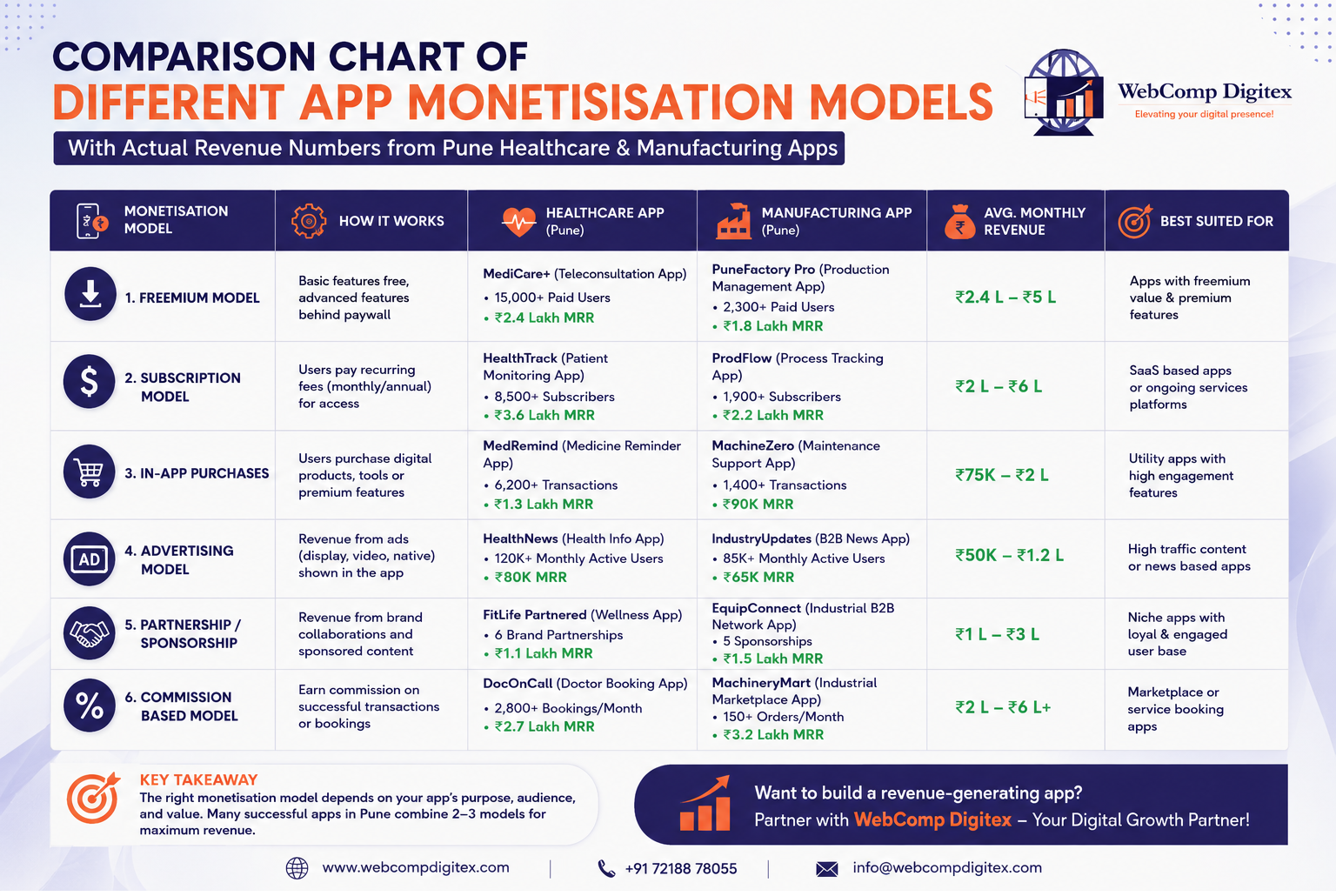
I know, I know. You want one clean business model. Subscription, done. Or ads, simple. But the mobile app developer agencies that actually make serious money? They’re running 2-3 monetisation methods simultaneously.
Think about Swiggy. They’ve got delivery fees (transaction-based), Swiggy One subscriptions, ads from restaurants wanting better placement, and commission from every order. That’s four revenue streams from one platform.
You don’t need to be that complex right away. But this “one perfect monetisation model” fantasy? It’s killing apps.
A real estate app we worked with in Hinjewadi started with just premium listings (freemium model). They were making about ₹45,000 a month. We added two things: featured placement for builders (advertising revenue) and a small transaction fee when users connected with verified agents. Three months later, they were at ₹2.8 lakhs monthly. Same app. Same user base. Just smarter monetisation.
Here’s the framework that actually works.
Freemium: The Model Everyone Gets Wrong
Freemium sounds simple. Free basic features, charge for premium stuff. Easy, right?
Wrong. Most businesses screw this up by making the free version either too good (nobody upgrades) or too useless (nobody sticks around long enough to see the premium value).
We worked with a manufacturing ERP app for factories in Pimpri-Chinchwad. Their first freemium split was a disaster. The free version let you manage up to 5 inventory items. Sounds reasonable until you realize even the smallest factory has 200+ items to track. Nobody could actually use the free version, so nobody signed up at all.
We rebuilt the split. Free version: unlimited inventory tracking, basic reporting, single user. Premium: multi-user access, advanced analytics, integration with accounting software, priority support. Started at ₹3,500/month.
Here’s what changed. The free version was genuinely useful. A small unit could actually run their business on it. But the moment they wanted their accountant to access data, or needed proper reports for GST filing, or hired a second person who needed access — boom, they hit the premium wall naturally.
Conversion rate went from 1.2% to 11% in four months. That’s not a typo.
The freemium rule we follow at Webcomp Digitex: free version should solve one complete problem really well. Premium should solve the problems that emerge when the business grows.
Your free tier isn’t about restricting features randomly. It’s about creating an upgrade path that feels inevitable, not forced.
Look at your analytics. Use Hotjar or GA4 to see where free users get stuck. Those friction points? That’s where your premium features should live.
Subscription Models That Don’t Make Users Want to Scream
Subscription fatigue is real, and it’s getting worse.
Your users are already paying for Netflix, Spotify, Amazon Prime, three different SaaS tools for work, and probably some fitness app they forgot about. Adding another ₹299/month subscription better deliver serious, ongoing value.
Here’s what works: subscriptions for consumable value, not one-time benefits.
A mobile application company we know built a GST compliance app. Their first model was ₹5,999/year for “access to the platform.” Sales were terrible. People couldn’t justify paying yearly for something they might use twice a month.
We repositioned it. ₹999/month. But here’s the shift — you’re not paying for access, you’re paying for ongoing services. Monthly automated GST filing, real-time tax liability tracking, automatic updates when tax laws change (which happens constantly in India), and priority support during filing deadlines.
See the difference? The first model was charging for a tool. The second was charging for continuous work being done on your behalf. Revenue jumped from ₹3.2 lakhs to ₹18 lakhs in seven months.
Your subscription model should answer one question clearly: “What am I getting this month that I didn’t have last month?”
If the answer is just “continued access to the same stuff,” you’re going to struggle. But if the answer is “new content,” or “ongoing protection,” or “work done for me automatically,” people will pay.
Pricing psychology matters here too. We tested this with a healthcare app in Kharadi. ₹2,999/year felt expensive. ₹249/month felt reasonable. Same annual value (actually ₹12 more), but monthly framing reduced the mental barrier.
Also? Offer annual plans at a discount. Not for the revenue (though that helps with cash flow). But because annual subscribers churn 60-70% less than monthly ones. Someone who paid ₹3,000 upfront is far more likely to actually use your app and see the value.

In-App Purchases: Not Just for Games Anymore
When most people hear “in-app purchases,” they think of Candy Crush and those annoying “buy more gems” prompts.
But in-app purchases work brilliantly for business apps too. You just need to think about them differently.
We built an app for a real estate firm in Baner. Free to download, free to browse properties. But want to save more than 5 favourite properties? That’s ₹99 one-time. Want to download floor plans and brochures offline? Another ₹149. Want direct contact details for the builder instead of going through the platform? ₹299 per property.
These aren’t subscriptions. They’re micro-transactions for specific, immediate value. And they added up to ₹4.7 lakhs in the first six months, from a relatively small user base of about 12,000 monthly active users.
The key insight: people are willing to pay small amounts for things that solve an immediate problem right now. They resist ongoing commitments, but ₹99 to unlock something they need this minute? That’s an impulse buy.
Think about what your users are trying to accomplish in the moment. What’s blocking them from their goal that you could unlock for a small fee?
A logistics app we advised in MIDC let users track their shipments for free. But want SMS alerts when your shipment reaches each checkpoint? ₹49. Want priority customer support if something goes wrong? ₹199 per shipment. Want insurance for high-value goods? ₹299-999 depending on value.
None of these are subscriptions. They’re pay-per-use add-ons that make perfect sense in context. And because they’re optional, users don’t feel forced. They feel like they’re choosing to enhance their experience.
Here’s what most mobile app development businesses miss: in-app purchases work best when they’re contextual. Don’t show the payment screen on your home page. Show it exactly when the user encounters the limitation. “You’ve reached your limit of 5 saved properties. Unlock unlimited for ₹99.” Right there, right when they care.
Advertisement Revenue: Why You’re Probably Leaving Money on the Table
Let me just say this upfront: banner ads suck.
Those little banner ads at the bottom of your screen that everyone ignores? They’ll make you maybe ₹8-15 per thousand impressions if you’re lucky. For an app with 10,000 daily active users, that’s about ₹2,400-4,500 a month. Barely covers your server costs.
But that doesn’t mean advertising revenue doesn’t work. It means you’re doing it wrong.
Native advertising — ads that look and feel like content — performs 10x better. Literally. We’ve tested this.
A food delivery app for Pune’s local restaurants (not one of the big national players, a local competitor) was running standard banner ads. Made about ₹6,000 monthly. We switched to native ads where restaurants could sponsor their listing to appear higher in search results or get a “Featured Today” badge. Charged ₹1,500-5,000 per restaurant per month depending on prominence.
Revenue jumped to ₹78,000 monthly within three months. Same number of users. Same app. Just better ad implementation that actually helped users discover restaurants rather than interrupting their experience.
The model we follow at Webcomp Digitex for ad revenue: advertising should feel like enhanced content, not interruption.
If your app is about property listings, let builders pay for better placement. If it’s about healthcare, let clinics sponsor their profiles. If it’s about manufacturing suppliers, let verified suppliers get a badge and better visibility.
This works because you’re not selling random display ads for VPNs or gaming apps (hello, Google AdMob’s usual suspects). You’re selling relevant visibility to businesses that your users actually want to discover.
And here’s the pricing model that works: don’t charge per impression (CPM). Charge a flat monthly fee for placement. Businesses understand ₹3,000/month for featured placement. They don’t understand CPM, CPC, and all that performance marketing jargon. Keep it simple.
Also, platform matters. If you’re building apps for businesses in sectors like manufacturing, real estate, or healthcare, direct advertising deals will always make more money than AdMob or Facebook Audience Network. Yes, it requires sales effort. But ₹15,000 from three direct advertisers beats ₹3,000 from automated ad networks.
Transaction Fees: The Model That Scales With Success
This might be my favourite monetisation model for apps that connect buyers and sellers, because it aligns your incentives with your users’ success.
You only make money when they make money.
A mobile app developer agency we consulted for built a B2B marketplace connecting Pune manufacturers with raw material suppliers. Their original model was a ₹9,999/year subscription for suppliers to list products.
Problem? Suppliers who didn’t make sales still had to pay. Created terrible word-of-mouth. “I paid ₹10,000 and got nothing.”
We flipped it. Free to list. But take 2.5% of every transaction that happens through the platform. Suddenly, suppliers loved it. Zero upfront risk. Only pay when you actually sell something.
First year revenue: ₹6.4 lakhs. Third year revenue: ₹34 lakhs. The model scaled naturally as transaction volume grew.
Transaction fees work beautifully for:
- Marketplaces (obviously)
- Booking platforms (appointments, reservations, tickets)
- Service platforms (connecting customers with service providers)
- Payment-enabled apps (any app where money changes hands)
The percentage matters. Too high, and you’ll push transactions off-platform. Too low, and you won’t make enough to sustain the business.
Here’s what we’ve seen work in Pune’s market:
- Physical products: 2-5% depending on margins
- Services: 5-15% depending on how much work you’re saving them
- High-value B2B transactions: 1-3% (when the order value is ₹5 lakhs, even 2% is significant)
The secret to making transaction fees work: you need to own the payment flow. If users can easily take transactions offline, they will. Build the payment gateway right into your app. Make it easier to pay through the app than to pay outside it.
And here’s the practitioner insight nobody talks about: your payment gateway fee matters. If you’re using Razorpay or PayU, you’re paying 2% plus GST. That’s about 2.36%. If you’re charging 2.5% transaction fee, you’re only netting 0.14%. That doesn’t work.
Either charge enough to cover payment gateway fees plus meaningful margin (4-5% minimum), or negotiate better rates with your payment processor once you hit volume.
The Hybrid Model That’s Making Real Money Right Now
Remember Rajesh from the beginning? The healthcare appointment app losing money?
Here’s what we did. We didn’t pick one monetisation model. We stacked three.
Base model: Freemium. Free for patients to book appointments. Doctors pay ₹2,499/month for a verified profile with calendar integration and automated reminders.
Layer two: Transaction fee. 3% on any consultation fees paid through the app (but free booking if patient pays at clinic directly — this kept doctors from resisting the platform).
Layer three: Featured placement. Doctors could pay ₹999/month extra to appear higher in search results for their speciality and location.
Three revenue streams, all working together without cannibalizing each other.
Results after 8 months:
- 67 paying doctor subscriptions (₹2,499 × 67 = ₹1,67,433/month)
- Average 340 monthly transactions at 3% of average ₹800 consultation fee (₹8,160/month)
- 23 doctors paying for featured placement (₹22,977/month)
Total monthly revenue: ₹1,98,570. Not life-changing money, but they recovered their entire development cost and became cash-flow positive in under a year. Now they’re scaling.
This is how real mobile app development businesses make money. Not with one perfect model, but with thoughtful combinations that serve different user needs and capture different types of value.
What Works in Pune’s Market Specifically
Look, I’ve worked with mobile application companies across India, and Pune has some specific characteristics that affect monetisation.
First: Pune users are price-sensitive but quality-conscious. They won’t pay for half-baked solutions, but they will pay fairly for real value. Don’t try to compete on price alone. Compete on quality, then charge appropriately.
Second: B2B apps in manufacturing and IT sectors (Hinjewadi, Pimpri-Chinchwad, MIDC) have much higher willingness to pay than consumer apps. A good B2B tool that saves time or reduces errors? Businesses will happily pay ₹5,000-25,000 monthly. Consumer apps? You’re fighting for ₹99-499/month.
Third: Pune’s app market is less saturated than Bangalore or Mumbai. This is good news. You have more room to experiment with monetisation before competition forces prices down.
We’ve seen this with clients at Webcomp Digitex. The same app model that needs to charge ₹199/month in Mumbai to stay competitive can charge ₹399 in Pune and still acquire customers easily, simply because there are fewer alternatives.
Use this window while it lasts.

When to Think About Monetisation (Hint: Not After Launch)
Here’s the mistake that kills apps: treating monetisation as an afterthought.
You build the app, launch it, get some users, then start thinking “okay, now how do we make money?”
Wrong order.
Your monetisation model should influence your feature development from day one. Not restrict it, but guide it.
If you’re planning a freemium model, you need to design features in tiers from the start. If you’re planning transaction fees, you need to build the payment system into the core user flow. If you’re planning advertising, you need to design ad placements that don’t destroy the user experience.
A mobile app development website client came to us with an app that was 80% built. They wanted to “add monetisation.” We looked at the architecture and realized their freemium plan wouldn’t work because they’d built everything as a single feature set. We’d have to rebuild significant portions to create proper feature gating.
Cost them an extra ₹3.2 lakhs and two months of delays. All because they didn’t think about monetisation during the design phase.
Don’t do that.
At Webcomp Digitex, we start every app project with monetisation strategy discussions before we write a single line of code. It’s not fun and exciting like designing interfaces, but it’s what separates apps that make money from apps that bleed it.
Frequently Asked Questions
How much revenue should I expect in the first year of my mobile app development business?
Honestly? Lower your expectations. Most apps don’t generate meaningful revenue in year one. You’re building user base, fixing bugs, and figuring out product-market fit. If you can recover 20-30% of your development costs in year one, you’re doing well. We’ve seen B2C apps take 18-24 months to become profitable, B2B apps can get there in 8-12 months if the product is solid. The apps making ₹10 lakhs monthly didn’t start there. They started at ₹15,000 and grew systematically.
Should I charge for my app download or make it free?
Make it free. Paid downloads are dead in India except for very specific premium tools. Your competition is free, and users expect apps to be free to try. Even Apple’s App Store data shows paid apps have 95% lower download rates than free apps in the Indian market. Monetise after users see the value, not before. The exception: highly specialized B2B tools where your target users expect to pay for quality software. But even then, a free trial before charging works better than upfront payment.
Can I change my monetisation model after launch?
Yes, but carefully. Users hate when free features suddenly become paid — you’ll get terrible reviews and high churn. But you can add new premium features, introduce subscriptions for power users, or add optional paid add-ons without much backlash. We helped a productivity app in Wakad transition from completely free to freemium by grandfathering existing users (they kept everything free) while new users got the freemium version. Worked well, minimal complaints. The key is not taking away value people already have.
How do I know which monetisation model is right for my app?
Look at who your users are and what problem you’re solving. If your app delivers ongoing value or content, subscriptions work. If it’s a one-time solution, consider in-app purchases or one-time payment. If you’re connecting buyers and sellers, transaction fees make sense. If you have high traffic but users won’t pay, advertising can work. Think about apps similar to yours that succeeded — what model did they use? Don’t try to innovate on monetisation. Use proven models and execute them well.
What’s better: monthly or annual subscriptions?
Offer both, but push annual with a discount. Annual subscriptions improve cash flow and reduce churn significantly. We typically price annual subscriptions at 10-12 months worth of monthly pricing (so users save 2 months). About 30-40% of users pick annual when offered, which dramatically improves your revenue predictability and user retention. Use tools like Chargebee or Stripe to handle subscription billing — don’t build this yourself unless you enjoy pain.
How much should I charge for my app subscription?
Test it, but here’s a starting framework. For consumer apps solving nice-to-have problems: ₹99-299/month works in India. For productivity or professional tools: ₹499-1,999/month. For B2B solutions: ₹2,499-9,999/month depending on value delivered. Don’t anchor to development cost when pricing. Anchor to value created for users. If your app saves a business ₹25,000 monthly, charging ₹5,000 is completely reasonable. Start high, you can always discount or lower prices, but raising prices on existing users is painful.
Ready to Build a Mobile App Development Business That Actually Makes Money?
Look, building an app is exciting. Designing beautiful interfaces, writing clean code, seeing your idea come to life — that’s the fun part.
But making it financially sustainable? That requires treating monetisation as a core part of your strategy, not an afterthought.
If you’re in Pune and serious about launching an app that generates real revenue, let’s talk. At Webcomp Digitex, we’ve worked with everyone from healthcare startups in Kharadi to manufacturing units in Pimpri-Chinchwad. We don’t just build apps — we build business models that work.
We’ll help you figure out which monetisation strategy fits your market, design the user experience around it, and build the technical infrastructure to support it from day one. Not after launch when it’s expensive to change. From the beginning.
We’re based in Pune, we understand the local market, and we’ve seen what actually works versus what sounds good in theory.
Call us at +91-9960802498 or check out our work at webcompdigitex.com. Let’s build something that doesn’t just get downloaded — let’s build something that makes money.


