
iOS App Development Agency: iOS vs Android – Which Should You Prioritise for Your Business?
Here’s a question I got last month from a real estate client in Baner: “We have ₹12 lakhs for app development. Should we build for iOS first, Android first, or both at once?”
Honest answer? It depends. But not on vague things like “your vision” or “long-term strategy.” It depends on three specific things: who’s actually buying from you right now, how much runway you have, and what happens after launch.
I’ve watched businesses in Pune make this choice dozens of times over the past 12 years. Some got it right and saw conversions within weeks. Others picked wrong and burned through their budget building something their customers couldn’t even use.
Let me walk you through how to actually make this call. Not theory — real math, real trade-offs, and what we’ve seen work at Webcomp Digitex with clients across manufacturing, healthcare, and e-commerce here in Pune.
The Money Reality: What Each Platform Actually Costs
Let’s start with what nobody wants to talk about but everyone needs to know: the actual rupee difference.
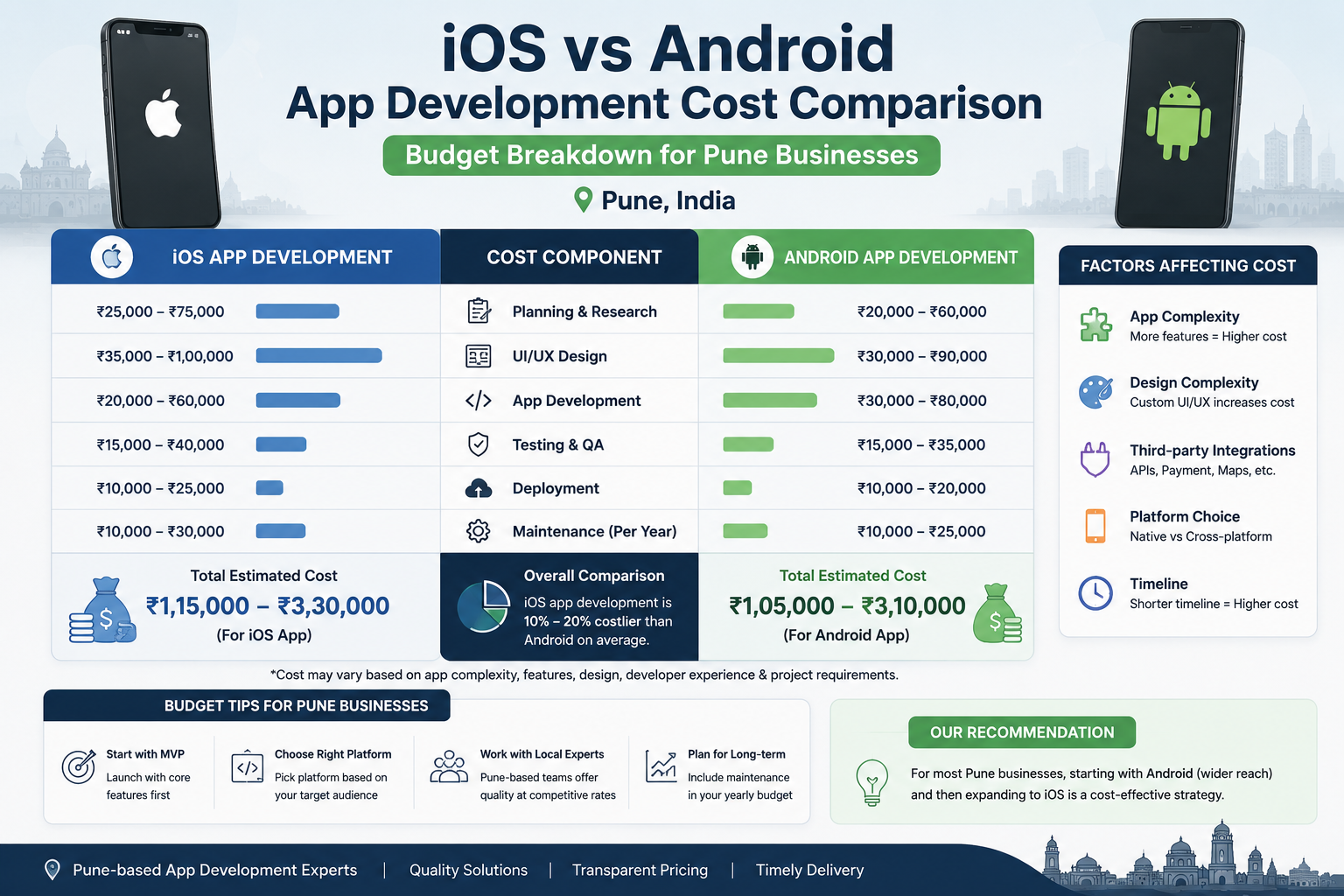
iOS development typically runs 15-20% cheaper than Android. Yeah, you read that right. Most people assume it’s the other way around.
Here’s why: iOS means you’re building for a smaller set of devices. iPhone 11, 12, 13, 14, 15. Mostly similar screen sizes, same operating system versions that users actually update. Your ios development company isn’t wrestling with fifty different Samsung models, each running a different Android version with different screen ratios.
A mid-complexity app — let’s say an e-commerce app with payment gateway, user profiles, and push notifications — runs about ₹8-10 lakhs for iOS. Same app for Android? ₹10-12 lakhs, sometimes more. That extra cost comes from testing and bug fixes across devices.
But here’s where it gets interesting: maintenance costs flip that equation.
Android has more users in India. Way more. Which means more support tickets, more device-specific bugs, more “it’s not working on my Redmi Note 7” messages. An iphone app development services provider will tell you — iOS users also tend to update their OS more regularly, which means fewer legacy compatibility headaches.
Think about it this way: iOS is cheaper to build, Android is cheaper to ignore after launch. Neither is actually cheap if you do it right.
Who’s Actually Using What in Your Market
This is where most businesses mess up. They make the iOS vs Android call based on general statistics instead of their actual customer data.
“Android has 95% market share in India!” True. But does your customer base reflect that?
We worked with a diagnostic lab chain operating across Kharadi and Hinjewadi. Their initial assumption: “Our patients are middle-class families, definitely Android users.” Then we checked Google Analytics on their website. 71% of their online appointment bookings came from iOS devices.
Turns out their actual paying customers — the ones booking premium health packages and executive check-ups — were largely iPhone users. Building Android first would have meant launching to the smaller, lower-value segment of their audience.
Here’s the specific insight only someone who’s done this dozens of times knows: Look at your payment completion rates by device type, not just traffic.
Open GA4. Go to Reports > Tech > Tech Details > Operating System. Now add a secondary dimension for transactions or conversions. You’ll often find that iOS users convert at 2-3x the rate of Android users, even when Android brings more traffic.
For e-commerce and premium services, iOS users in India typically show higher average order values. For a Pimpri-Chinchwad-based furniture manufacturer we work with, iOS users had an AOV of ₹43,000 vs ₹28,000 for Android users.
But flip the script: if you’re a hyperlocal grocery delivery service in MIDC areas, or a vernacular content app, or anything targeting mass-market audience? Android isn’t just bigger — it’s where 95% of your revenue will come from.
Don’t guess. Check your actual data.
The Speed Question: How Fast Do You Need to Test Your Idea?
Here’s something most android application development company teams won’t tell you upfront: iOS apps get approved faster and more predictably.
Apple’s App Store review typically takes 24-48 hours. Google Play? Sometimes 3 hours, sometimes 7 days. We’ve had Android apps stuck in review for random reasons (once because they flagged a generic icon as “misleading imagery”) while the iOS version sailed through.
If you’re a startup testing product-market fit, or launching a time-sensitive campaign, that predictability matters. A lot.
We worked with a healthcare startup launching a telemedicine app. They needed to go live before a specific government policy deadline. We recommended iOS first, not because their audience was primarily iOS (it wasn’t), but because launch risk was the bigger problem than market coverage.
They launched iOS in week one, got real user feedback, fixed three major UX issues, then built the Android version with those learnings already baked in. The Android app that finally launched was measurably better because it wasn’t the first attempt.
This is a legitimate strategy: iOS as your beta test with paying customers, Android as your refined version at scale.
But it only works if you’re honest about it. Don’t tell your Android users “coming soon” for six months. That’s how you kill trust.
Feature Parity: When You Can’t Choose Just One
Some businesses genuinely can’t prioritize. Banking apps. Utility apps. Anything where excluding either platform means losing customers to competitors.
In those cases, you’re looking at cross-platform frameworks: React Native or Flutter.
Here’s my take after watching both succeed and fail: Cross-platform is not cheaper, it’s faster. You’re not saving 50% of your budget. You’re maybe saving 20-30%, and you’re trading some performance and some platform-specific polish for speed to market.
React Native is more mature, bigger talent pool in Pune, tons of libraries. Flutter is newer, slightly better performance, beautiful UIs. Both will get you to both platforms faster than building native twice.
We used Flutter for a real estate client in Wakad who needed to launch simultaneously on both platforms for a property exhibition. Timeline was non-negotiable, budget was tight but not impossible. Flutter got them live in 4.5 months instead of the 7-8 months separate native builds would have taken.
But here’s what cross-platform frameworks can’t do well: deep OS integration, complex animations, cutting-edge features, and anything that needs to squeeze maximum performance. If you’re building a video editing app or something with heavy camera usage or AR features, go native. If you’re building forms, lists, content displays, and standard interactions, cross-platform works fine.
One specific thing I’ve learned the hard way: Test performance on actual mid-range Android devices early. A cross-platform app that runs beautifully on your iPhone 14 Pro might stutter on a Redmi Note 9. Don’t find that out two weeks before launch.
The Monetisation Angle Nobody Mentions
iOS users spend more money in apps. Not “a bit more.” Significantly more.
According to data we’ve tracked for e-commerce clients, iOS users are 3-4x more likely to complete in-app purchases. They’re also more tolerant of paid apps (though freemium still wins on both platforms).
If your revenue model depends on in-app purchases, subscriptions, or premium features, iOS gives you faster time to profitability even with fewer users.
But if you’re monetising through ads, volume beats value. Android’s massive user base means more ad impressions, even if the CPMs are lower. For a content app or news aggregator, Android first makes financial sense.
A manufacturing client in Chakan built an internal training app for their factory workers. Initially planned for iOS because “it feels more professional.” We pushed back: their 300+ floor workers were 100% Android users, mostly budget Samsungs and Xiaomis. Building for iOS would have meant buying 300 iPads or watching the app go unused.
Sometimes the right answer is painfully obvious once you look at actual device usage.
The Real Trade-off: Depth vs Reach
Here’s how I frame this decision with clients at Webcomp Digitex:
iOS first means: smaller audience, higher value per user, faster validation, lower initial cost, premium positioning.
Android first means: larger audience, more diverse revenue potential, longer development, higher testing complexity, mass market positioning.
Neither is wrong. But they’re different bets.
If you’re trying to prove a concept, raise funding, or serve a premium segment — iOS often wins. Your ios app development agency can move faster, polish harder, and show traction with less absolute scale.
If you’re going after volume, mass adoption, or markets outside metros — Android is non-negotiable. You can’t ignore 95% of the market forever.
The worst strategy? Building both poorly because you split the budget. I’ve seen ₹15 lakh budgets split into two ₹7.5 lakh builds, both of which felt incomplete and undercooked. Better to build one excellent app than two mediocre ones.
What We Actually Recommend (With Real Numbers)
Here’s the framework we use at Webcomp Digitex when clients ask this question:
Budget under ₹10 lakhs: Pick one platform. Use your GA4 data to decide which. Ship something excellent.
Budget ₹10-18 lakhs: Build iOS first for 60% of budget, learn, then Android with learnings integrated.
Budget ₹18 lakhs+: Consider cross-platform (Flutter preferred) or separate native builds if you need platform-specific features.
Timeline under 3 months: iOS only, revisit Android at month 4.
Timeline 4-6 months: Cross-platform or sequential native builds.
For one specific real example: We worked with a healthcare services company in Pune that had ₹14 lakhs budgeted. They wanted both platforms. We built iOS first (₹8 lakhs), launched, got 2,400 downloads in month one, conversion rate of 12%. Feedback told us users wanted two features we hadn’t built.
We added those features, then built Android (₹9 lakhs) with the improved feature set. Android launch had 18% conversion rate right out of the gate because we’d already fixed the problems. Total cost was ₹17 lakhs, slightly over initial budget, but the Android app performed better because it wasn’t the first draft.
That sequential approach with learning between builds? That’s the hidden value nobody talks about.
Look, I’m not 100% sure this applies to every single business. Your situation might genuinely be unique. But in 12 years of doing this in Pune with manufacturers, real estate developers, healthcare providers, and e-commerce brands, this framework has held true way more often than it’s failed.

Tools and Real Process Notes
If you’re evaluating this yourself, here’s what to actually do:
Check your analytics: GA4 > Tech Details > split by transactions or goal completions. Don’t just look at sessions.
Survey your existing customers: Not “would you use an app?” but “do you use an iPhone or Android?” Specific question, useful answer.
Competitive analysis: Use App Annie or SensorTower to see what your competitors launched first. It’s not gospel, but it’s a data point.
Talk to your support team: They know which devices cause problems, which customers are most engaged, which segment asks for an app most.
If you don’t have analytics because you don’t have a website or digital presence yet — honestly, you might not need an app at all. That’s a different conversation.
And one practitioner insight from actual client work: The real cost isn’t development, it’s updates. Budget for 12-18 months of updates, bug fixes, and feature additions. That’s another 30-40% of your initial development cost. An ios development company that quotes you ₹10 lakhs and doesn’t mention ongoing costs is either naive or dishonest.
At Webcomp Digitex, we’ve started including 12-month maintenance projections in every app proposal. Not because we want to scare clients, but because apps that don’t get updated die. Fast.

Frequently Asked Questions
Can we launch on one platform and add the other later without rebuilding?
Yes, but it’s not a flip-a-switch situation. If you build iOS first with native Swift, you’re rebuilding from scratch for Android in Java/Kotlin. What you keep: all your design decisions, user flow, API structure, backend logic. What you rebuild: the entire front-end. Budget 60-70% of your original development cost for the second platform if you’re going native. If you go cross-platform from day one (React Native or Flutter), you’re already building for both, so adding the second platform is more about testing and polish than rebuilding.
Is it worth building a progressive web app (PWA) instead of native apps?
PWAs make sense for content-heavy, information-based experiences where you don’t need device features like camera, push notifications, or offline functionality. But if you want app store presence, smooth animations, or deep device integration, PWAs feel like mobile websites pretending to be apps. Users can tell. For e-commerce, booking systems, or anything transactional where trust matters — native apps still win. That might just be my experience, but I’ve seen PWAs work well for news sites and blogs, and fail for almost everything else.
How long does it take to build an app for one platform vs both?
A medium-complexity native app: 3-4 months for iOS alone, 4-5 months for Android alone (slightly longer due to device testing). If you’re building sequentially, expect 7-8 months total for both. Cross-platform with Flutter or React Native: 4-6 months to launch on both simultaneously. These are realistic timelines with proper QA, not “best case if nothing goes wrong” estimates. Anyone promising you a complex app in 6 weeks is lying or doesn’t know what complexity actually means.
Do I need different designs for iOS and Android?
Not entirely different, but yes, you should adapt. iOS and Android have different design languages (iOS Human Interface Guidelines vs Material Design). Things like navigation patterns, button styles, swipe behaviors — users expect platform-specific conventions. A good ios app development agency will design for iOS patterns, then adapt (not copy-paste) for Android. Trying to make both platforms look identical makes both feel slightly off. Budget 15-20 hours of design adaptation time if you’re going sequential, more if your app is design-heavy.
What if my competitors are on both platforms already?
Then you’re behind on distribution, not behind on quality. Launching on one platform with an excellent experience beats launching on both platforms with buggy, half-finished apps. If your competitor is on both but their apps have 2.8-star ratings filled with complaints, you can win with one platform done right. Check their reviews in both app stores (App Store and Play Store). See what users complain about. Build your single-platform app without those problems. You’ll convert their frustrated users faster than you think.
Ready to Make the Right Call for Your Business?
Here’s the thing: iOS vs Android isn’t really the question. The question is who are you building for, and what’s the fastest path to finding out if they’ll actually use it?
At Webcomp Digitex, we’ve helped Pune businesses across manufacturing, healthcare, real estate, and e-commerce make this exact call. Not based on trends or what sounds good in meetings, but based on actual customer data, realistic budgets, and what actually drives revenue.
We’re not going to sell you both platforms if you only need one. We’re not going to recommend native builds if cross-platform gets you 90% of the way there for 60% of the cost. And we’re definitely not going to pretend app development stops at launch — the real work starts when users download it.
If you’re sitting on a budget and trying to decide how to split it, or if you’ve got customer demand but no clear direction, let’s talk. Not a sales pitch — an actual conversation about your numbers, your customers, and what makes sense for your business specifically.
Call us at +91-9960802498 or check out what we do at webcompdigitex.com. We’re based in Pune, we’ve done this dozens of times, and we’ll tell you what we actually think — not what you want to hear.
Whether you need an ios development company, an android application development company, or just someone to gut-check your plan before you spend lakhs on the wrong platform — we’ve been doing this long enough to give you a straight answer.
Let’s build something your customers will actually open more than once.


