Google PPC Management: How to Set Up a High-Converting Google Ads Campaign
You just logged into Google Ads, stared at the dashboard for 15 minutes, and thought “where the hell do I even start?”
I get it. Last month, a manufacturing client from Chakan came to us after burning through ₹2.8 lakhs in three months with another agency. Zero quality leads. Their cost-per-lead was sitting at ₹6,400. They were ready to give up on Google Ads entirely.
Here’s the thing: Google Ads isn’t broken. Your setup probably is.
After 12 years doing google ppc management for businesses across Pune — from real estate developers in Baner to healthcare clinics in Kharadi — I’ve seen the same mistakes over and over. And honestly? Most of them happen in the first 48 hours of campaign setup.
This isn’t another generic “Google Ads 101” post. I’m going to walk you through exactly how we set up campaigns that actually convert. The kind that brought that Chakan manufacturer’s cost-per-lead down to ₹1,900 in four months.
Let’s get into it.
Start With the Right Campaign Structure (Most People Get This Wrong)
Your campaign structure matters more than your ad copy. There, I said it.
Most businesses I meet have one campaign, one ad group, 47 keywords all jumbled together. That’s like throwing everything into one pot and hoping it tastes good.
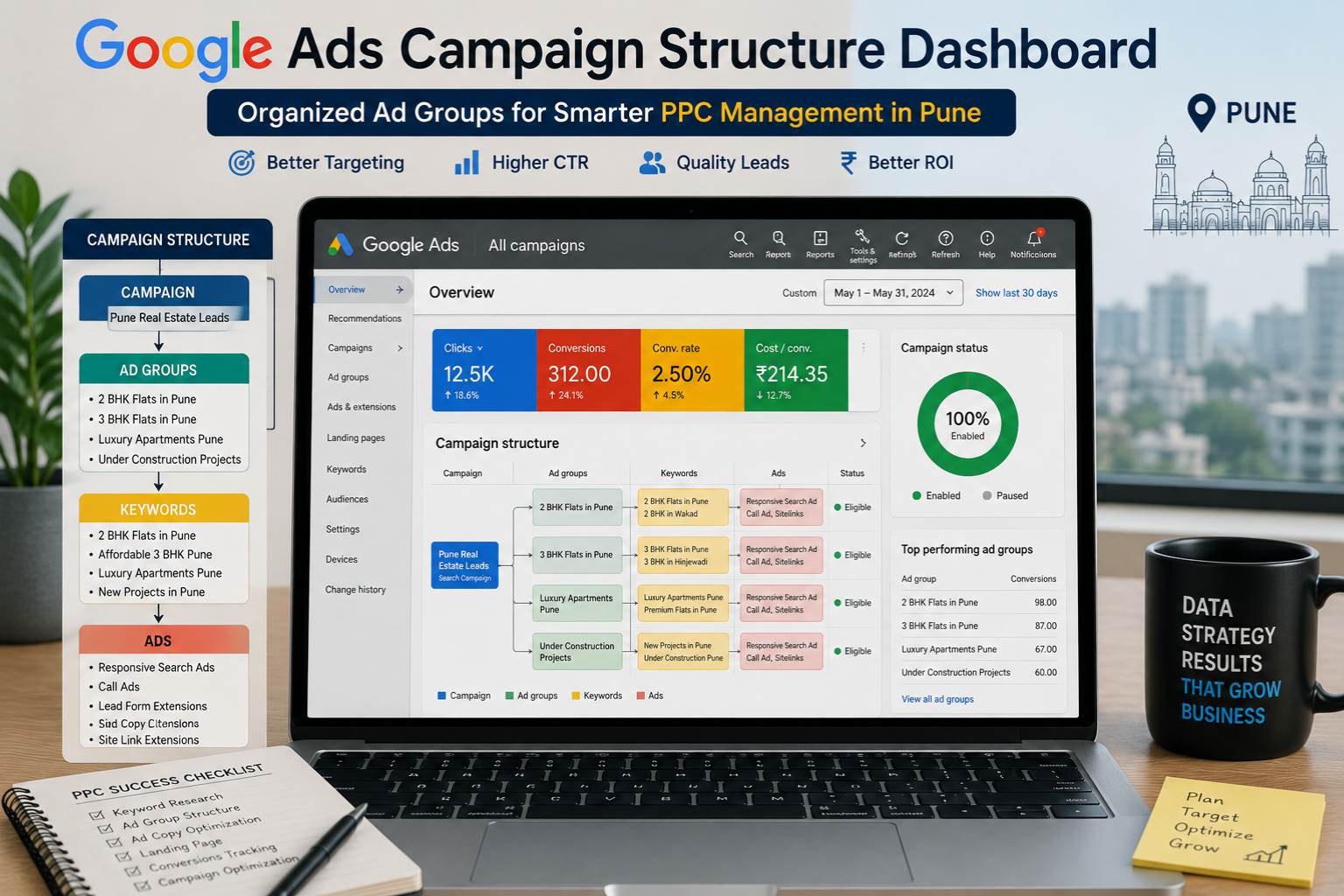
Here’s how we structure campaigns at Webcomp Digitex:
One campaign per product or service line. If you’re a real estate developer selling 1BHK and 3BHK apartments, those are two different campaigns. Different intent, different budget allocation, different landing pages.
One ad group per keyword theme. And I mean tight themes. We’re talking 5-10 closely related keywords per ad group. Not “real estate” and “property for sale” and “flats in Pune” all together. Break them up.
Match types that actually make sense. Start with phrase match and exact match. Broad match modifier is dead (Google killed it), and regular broad match is a budget-eating monster unless you really know what you’re doing.
Here’s something only people who’ve managed hundreds of campaigns know: your Quality Score improves dramatically when your ad group has tight keyword relevance. When someone searches “2BHK flat in Hinjewadi” and your ad group contains only Hinjewadi 2BHK keywords, your ad is more relevant, your CTR goes up, and Google rewards you with lower CPCs.
I’ve seen Quality Scores jump from 4/10 to 8/10 just by restructuring campaigns properly. That’s not theory — that’s from a real estate client in Wakad whose CPC dropped by 38% after we restructured their mess of a campaign.
Keyword Research That Goes Beyond Google’s Suggestions
Google’s Keyword Planner will suggest keywords. But it suggests the same damn keywords to your competitors.
Want an edge? Go deeper.
Check Google Search Console first. If you’ve been running any ads or have organic traffic, GSC shows you actual searches people used to find you. These are goldmines. Real language, real intent.
Use SEMrush or Ahrefs to spy on competitors. Look at what they’re bidding on. But here’s the trick: don’t just copy them. Look for gaps. Keywords they’re missing. Long-tail variations they haven’t thought of.
Talk to your sales team. Seriously. What questions do customers ask? What exact words do they use? A healthcare client in Pimpri-Chinchwad was targeting “knee replacement surgery” but their patients were searching “knee pain treatment options” and “alternatives to knee surgery”. Different intent, different stage in the buyer journey.
Negative keywords from day one. This is non-negotiable. Before you spend a single rupee, build your negative keyword list. For that Chakan manufacturer? We added 73 negative keywords on day one — terms like “jobs”, “careers”, “free”, “DIY”, “training courses”. Saved them thousands in wasted clicks.
Add negatives at campaign level for broad terms, and ad group level for specific exclusions. Check your search terms report every single week. You’ll be shocked at the garbage triggering your ads.
Landing Pages That Match Your Ad Promise
Your ad says “Get 20% off on CNC machining services”. Someone clicks. They land on your homepage with no mention of any discount.
Congratulations, you just paid ₹80 for nothing.
Every campaign needs its own landing page. Not “would be nice to have”. Needs.
Match the message exactly. If your ad headline is “2BHK Flats in Hinjewadi Starting at ₹65 Lakhs”, your landing page H1 better say something damn similar. Message match increases conversion rates by 30-40% in our experience at Webcomp Digitex.
One clear action. Stop giving people 15 options. One page, one goal. Fill the form. Call this number. Download this brochure. That’s it.
Load speed under 3 seconds. Use Google PageSpeed Insights. Compress images. Cut unnecessary scripts. We had an e-commerce client whose landing page took 8 seconds to load on mobile. Fixed it to 2.4 seconds. Conversion rate jumped 52%. Same ad spend, same traffic, more conversions.
Mobile-first everything. 70% of Google Ads clicks in Pune come from mobile. If your landing page looks like garbage on a phone, you’re dead.
Here’s a practitioner insight: use Hotjar on your landing pages for the first two weeks. Watch session recordings. You’ll see exactly where people get confused, where they drop off, what they click on that doesn’t work. It’s uncomfortable watching people struggle with your page, but it’s the fastest way to fix what’s broken.
Conversion Tracking Setup (Skip This and You’re Flying Blind)
You can’t manage what you don’t measure. Sounds cliché because it’s true.
Set up conversion tracking before you launch. Not “we’ll do it later”. Before. Day. One.
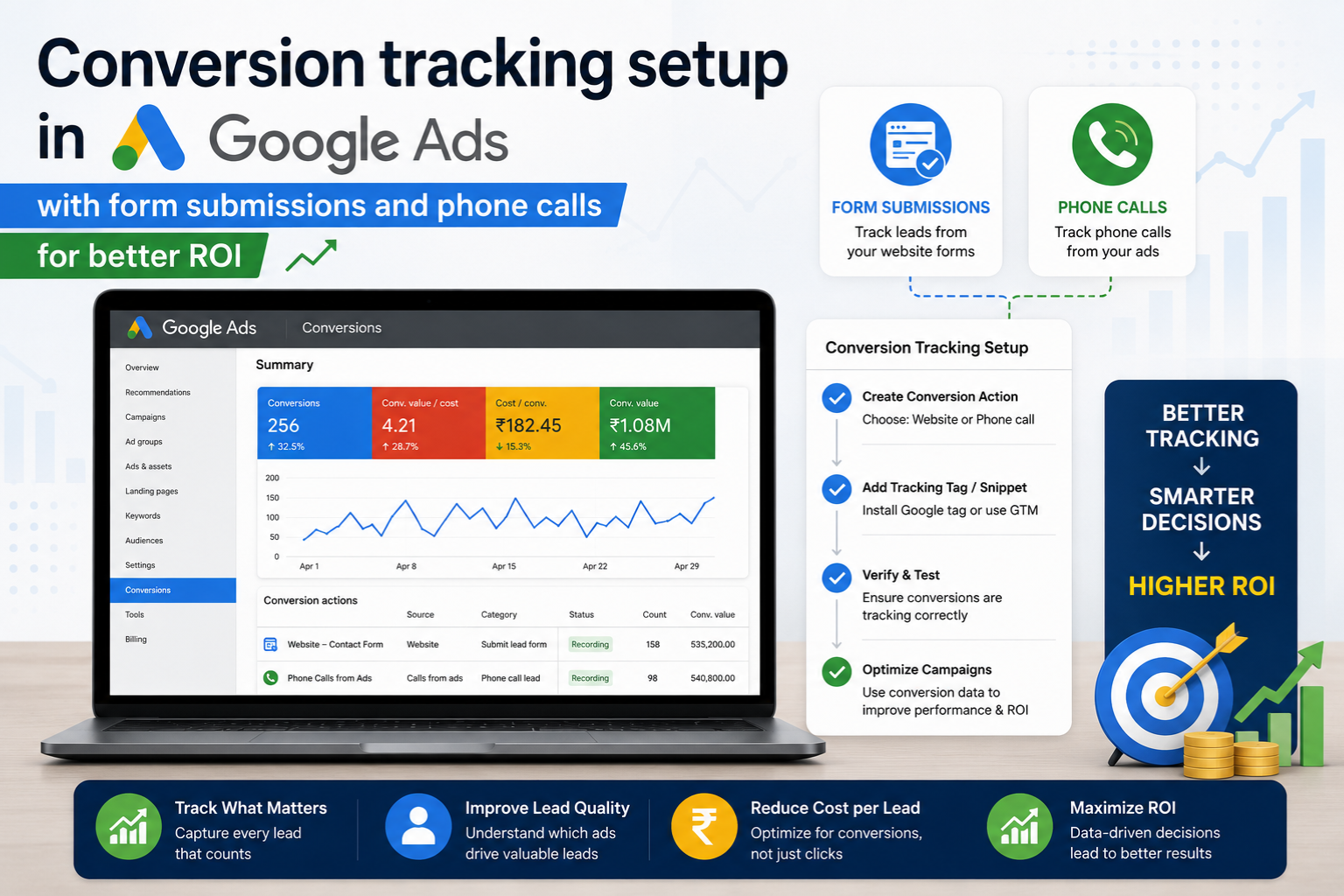
Google Tag Manager makes this easier. Install the GTM container on your site. Then set up conversion actions in Google Ads. Form submissions, phone calls, button clicks, purchases — track what matters to your business.
Import conversions into Google Ads. If someone fills a form but only becomes a customer two weeks later, track that in your CRM and import it back into Google Ads. Offline conversion tracking is criminally underused.
Track phone calls properly. Use Google’s call tracking or a service like CallRail. Half our clients get most leads via phone. If you’re not tracking calls, you’re missing half the picture.
We worked with a healthcare provider in Kharadi who thought their campaigns weren’t working. Turns out they were tracking form fills but not phone calls. When we set up call tracking, they discovered 68% of their conversions were phone calls. They were optimizing for the wrong thing.
Bidding Strategy That Matches Your Goals
Smart Bidding sounds great. “Let Google’s AI handle it!” they say.
Sometimes it works. Often it doesn’t. Especially not at the start.
Begin with Manual CPC. Yeah, I know, it’s old school. But it gives you control. You learn what different keywords cost, what actually converts, what’s worth paying for.
Run Manual CPC for at least 30 conversions. Let the campaign gather data. Understand your cost-per-conversion benchmarks.
Then test Maximize Conversions or Target CPA. Once you have conversion data, Smart Bidding gets smarter. We usually switch to Target CPA after 50 conversions. Set your target based on your acceptable cost-per-acquisition.
Never use Maximize Clicks. Ever. It sends you cheap, garbage traffic. You’ll get clicks, sure. But clicks don’t pay your bills. Conversions do.
For that manufacturing client I mentioned earlier, we started Manual CPC at ₹25 per click, optimized for three months, then switched to Target CPA at ₹2,200. Google’s algorithm had enough data by then to make smart decisions. Cost-per-lead dropped to ₹1,900 while volume increased 40%.
Ad Copy That Actually Makes People Click
Your ad copy has one job: make someone choose you over the three other ads staring at them.
Use the keyword in Headline 1. If they searched “google ads ppc management”, put it right there. Not clever wordplay. Not your company name. The thing they searched for.
State your unique value in Headline 2. What makes you different? “12 Years Managing Pune Business Ads” or “ROI-Focused Campaigns, No Long Contracts”. Specific beats vague every time.
Include a clear call-to-action. “Get Free Audit”, “Call Now for Quote”, “Book Site Visit Today”. Tell them what to do.
Use all your extensions. Sitelinks, callouts, structured snippets, call extensions, location extensions. Ads with all extensions get 10-15% higher CTR. More real estate on the page, more ways to communicate value.
Test multiple ads per ad group. Run at least three ad variations. Let them rotate evenly for the first 100 impressions, then optimize for conversions. You won’t know what works until you test.
Here’s something most google marketing agencies won’t tell you: don’t obsess over CTR early on. A 2% CTR that converts at 8% is better than a 6% CTR that converts at 1%. Focus on cost-per-conversion, not clicks.
Budget Allocation and Day-Parting
Start with a daily budget you can actually afford to lose while learning. Testing is expensive. Plan for it.
Set campaign daily budgets, not account-level. You want control over where money goes. Your best-performing campaign should get more budget than your experimental one.
Use ad scheduling (day-parting) wisely. Check when your conversions actually happen. We had a B2B client whose ads ran 24/7. Turns out 84% of their quality leads came between 9 AM and 6 PM, Monday to Friday. We adjusted scheduling, eliminated wasted weekend spend, and reallocated that budget to peak hours. Same monthly spend, 31% more leads.
Start small, scale what works. Begin with ₹10,000-15,000 per month per campaign. Enough to get data, not enough to bankrupt you if it fails. Once you hit profitable cost-per-conversion, pour gasoline on that fire.
Look, I’m not going to pretend google ppc management is simple. It’s not. We’ve spent 12 years at Webcomp Digitex figuring out what works for Pune businesses, and we’re still learning.
But if you follow this framework — proper structure, tight keywords, matched landing pages, solid tracking, smart bidding progression, and testing — you’ll be ahead of 80% of businesses fumbling around in Google Ads.
The First 30 Days: What to Watch
Your first month is about learning, not scaling.
Week 1: Watch search terms like a hawk. Check what actual searches triggered your ads. Add negatives daily. You’ll find weird stuff. Irrelevant stuff. Expensive stuff you don’t want.
Week 2: Check device performance. Are mobile users converting? Or just clicking and bouncing? If mobile isn’t working, adjust bids down for mobile. Don’t just kill it, but don’t pay the same price for traffic that doesn’t convert.
Week 3: Analyze hour-by-hour data. When do conversions happen? When are you wasting money? Start making scheduling adjustments.
Week 4: First optimization pass. Pause keywords with zero conversions and high spend. Increase bids on winners. Test new ad copy for underperformers.
We had a real estate developer in Baner who wanted to quit after week one because they’d only gotten two leads for ₹8,000. We convinced them to stick with the plan. By week four, after daily optimizations, they were at ₹3,200 per lead. By month three, ₹1,800. Month six, ₹1,400 and we scaled spend 3x.
Good ppc management services aren’t about magic. They’re about discipline, testing, and incremental improvement.
Common Mistakes That Kill Campaigns
Let me save you some money.
Sending all traffic to your homepage. Nobody cares about your company history or your team photos when they’re searching for a specific solution. Send them to pages that answer their search.
Ignoring Quality Score. If your Quality Score is 3/10, you’re paying 2-3x what competitors with 8/10 pay for the same click. Fix your relevance issues before throwing more money at the problem.
Not testing anything. Running the same ads, same keywords, same landing pages for six months? You’re leaving money on the table. Test constantly.
Checking campaign performance daily and panicking. Google Ads data gets weird day-to-day. Judge performance weekly, optimize based on trends, not Tuesday’s bad numbers.
Forgetting about brand searches. If people are searching “Webcomp Digitex” or your company name, you better show up with an ad. Even if you rank #1 organically. Protect that real estate.
When to Do It Yourself vs Hire Help
Real talk: you can learn to run Google Ads yourself. Google wants you to — more advertisers means more money for them.
But should you?
If you’re spending under ₹25,000 per month and have time to learn, give it a shot. Follow this guide. Watch YouTube tutorials. Make mistakes on a small budget.
If you’re spending ₹50,000+ per month, or you’re too busy running your actual business, get help. Not because it’s impossible to learn, but because experienced google ads ppc management will save you more than it costs.
We’ve taken over dozens of campaigns at Webcomp Digitex from business owners who tried it themselves. They’re smart people. But they don’t have time to check search terms daily, test ad variations weekly, adjust bids by device and location, analyze audience segments, and stay on top of Google’s constant changes.
There’s no shame in focusing on what you’re good at and hiring experts for the rest.

Track What Actually Matters to Your Business
Here’s what I care about for our clients:
Cost per conversion. What did it cost to get a lead, sale, or sign-up?
Conversion rate. What percentage of clicks turned into conversions?
ROAS (Return on Ad Spend). For e-commerce, what revenue came back for every rupee spent on ads?
Quality of leads. Are these leads actually closing? Or are they tire-kickers? Track this manually if you need to.
Everything else — impressions, CTR, average position — matters, but it’s secondary. If your cost-per-lead is ₹2,000 and your average customer value is ₹50,000, you’ve got a money-printing machine. I don’t care if your CTR is 1% or 10%.
Focus on business outcomes, not vanity metrics.
Frequently Asked Questions
How much should I budget for Google Ads as a small business in Pune?
Start with at least ₹15,000-20,000 per month per campaign. Less than that and you won’t get enough data to optimize properly. Think about it this way: if your average CPC is ₹40 and your conversion rate is 3%, you need roughly 333 clicks to get 10 conversions. That’s ₹13,320 just to start learning what works. Budget more if you’re in competitive industries like real estate or healthcare where CPCs run higher.
How long before I see results from Google Ads?
You’ll see clicks day one. But meaningful results? Give it 60-90 days. The first month is testing and learning. Month two is optimization. Month three is where things usually start clicking. That Chakan manufacturer I keep mentioning? They saw their first quality lead in week two, but the real cost-per-lead improvements didn’t happen until month three. Anyone promising instant results is lying.
What’s the difference between SEO and Google Ads?
SEO is long-term, Google Ads is immediate. SEO is earning visibility, ads is buying it. Both have their place. We usually recommend running both at Webcomp Digitex — ads give you leads today while your SEO builds up. Think of ads as your sprint, SEO as your marathon. Different race, different strategy.
Can I run Google Ads without a website?
Technically yes — you can use call-only campaigns or lead form extensions. But honestly? You’re handicapping yourself. A proper landing page converts 3-5x better than generic solutions. Invest in a decent landing page before you spend serious money on ads. It doesn’t need to be fancy, just clear and fast.
How do I know if my Google Ads campaign is working?
Simple: is your cost per conversion lower than your profit per customer? If you’re paying ₹2,000 per lead and making ₹20,000 profit per customer, it’s working. Even if only 20% of leads close, you’re profitable. Track conversions in Google Ads, tie them to actual sales, do the math. If the numbers work, scale up. If they don’t, fix what’s broken or pause and regroup.
Ready to Set Up Google Ads Campaigns That Actually Convert?
Look, you can absolutely do this yourself with enough time and patience. This guide gives you the framework we use at Webcomp Digitex for our clients across Pune.
But if you’d rather focus on running your business while someone who’s done this a few hundred times handles your google ppc management, we should talk.
We’re not going to promise you overnight success or make up numbers. What we will do is set up campaigns properly, optimize them daily, and focus obsessively on your cost-per-conversion.
We’ve done it for manufacturers in Chakan and MIDC, real estate developers in Hinjewadi and Baner, healthcare providers in Kharadi and Pimpri-Chinchwad, and e-commerce businesses across Pune.
Give us a call at +91-9960802498 or visit webcompdigitex.com. Let’s look at your business, run the numbers, and figure out if Google Ads makes sense for you. Sometimes it does, sometimes it doesn’t. We’ll tell you straight.
No long contracts. No unfulfilled promises. Just practical ppc management services focused on getting you more leads at a cost that makes sense for your business.


