
Digital Marketing Audit: How to Assess Your Current Performance with a Complete Services List
Last month, a real estate developer from Baner walked into our office with a problem I’ve seen a hundred times before. He’d been spending ₹1.2 lakhs every month on “digital marketing” for eight months. When I asked him what exactly he was getting for that money, he showed me some good-looking reports with charts and numbers. But when I asked about leads? Silence. He genuinely didn’t know if his campaigns were working or burning money.
Here’s the thing — most businesses in Pune don’t have a bad digital marketing strategy. They have no idea what they’re actually getting from their digital marketing services list. They’re paying for activities, not results. And that’s a massive difference.
Think about it this way: you wouldn’t run a manufacturing unit in MIDC without checking production output, quality metrics, and wastage rates. But somehow, we’re okay spending lakhs on digital marketing without really knowing what’s working and what’s just noise.
Let me walk you through how to actually audit your digital marketing performance. Not the corporate consultant version with vague recommendations. The real, practical version that tells you exactly where your money’s going and whether it’s working.

What Most Agencies Won’t Tell You About Their Digital Marketing Services List
Here’s what usually happens. An agency shows you their digital marketing services list: SEO, social media marketing, content creation, PPC, email marketing, analytics. Sounds complete, right?
But here’s what they don’t tell you: just because they’re doing all these things doesn’t mean any of them are actually moving the needle for your business.
I worked with a healthcare clinic in Kharadi that was getting “full-service digital marketing” from an agency. Their services list looked impressive on paper. The agency was posting on Facebook three times a week, running Google Ads, sending monthly newsletters, and “doing SEO.” The clinic was paying ₹65,000 a month.
When we audited their account, here’s what we found: their Facebook posts got an average of 4 likes (three were from staff members). Their Google Ads were showing for searches in Mumbai and Delhi, not Pune. The newsletters had a 3% open rate. And their SEO? The agency had built 400+ backlinks from random directory sites that Google probably ignored completely.
They were getting all the services. Getting zero results.
Compare that to what happened after we rebuilt their strategy. We cut their budget to ₹45,000. Focused only on Google Ads for high-intent local searches and Google Business Profile optimization. Within three months, they were getting 23-28 appointment requests per month. That’s the difference between checking boxes on a digital marketing services list and actually knowing what’s working.
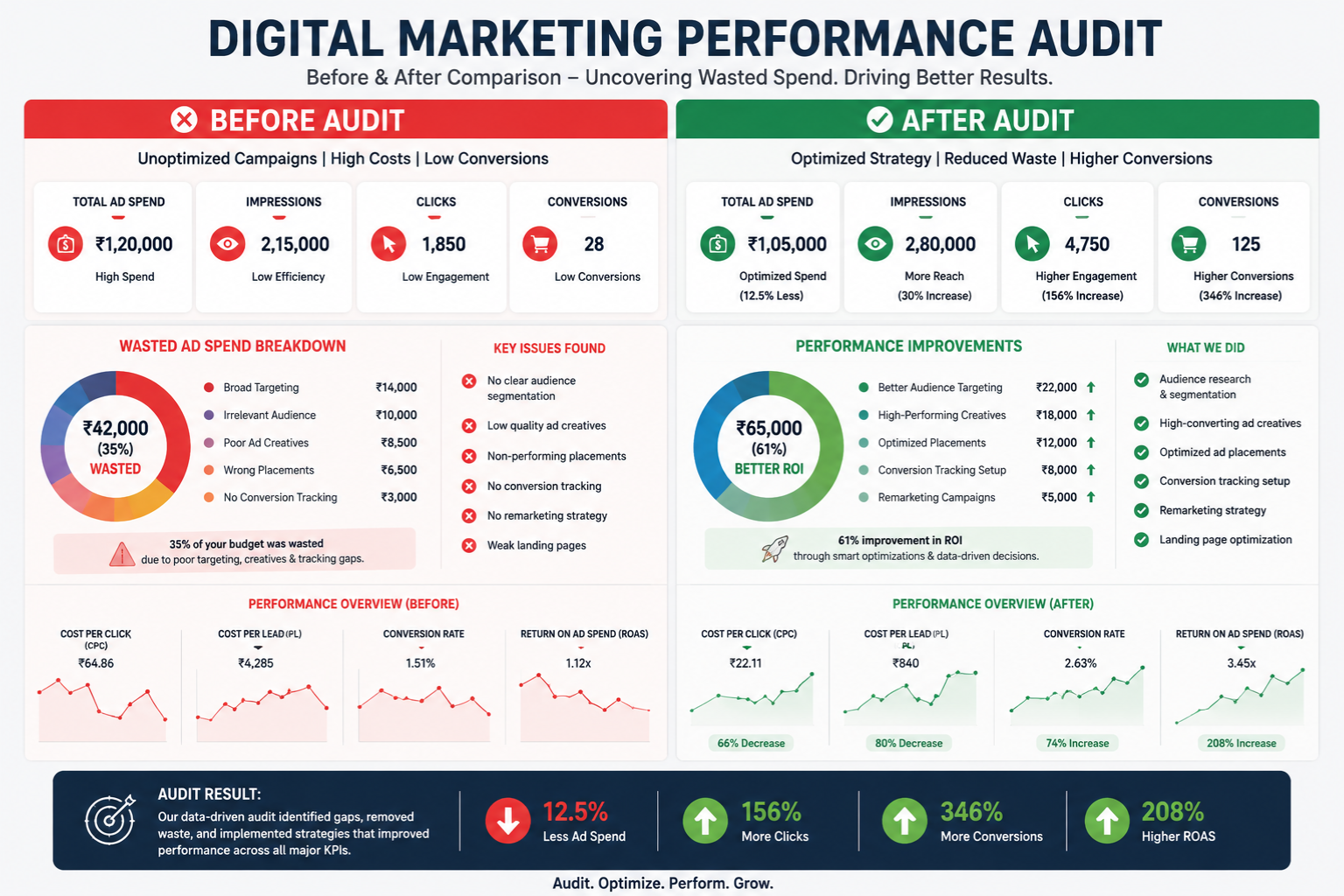
The Before vs After: What a Real Digital Marketing Audit Reveals
Let me show you what a proper audit looks like by walking through a real example.
A manufacturing company in Pimpri-Chinchwad making precision components came to Webcomp Digitex after spending nearly two years with another agency. They were frustrated but couldn’t pinpoint why. Their monthly spend was ₹85,000 across Google Ads, LinkedIn, and SEO.
Before the audit, here’s what they knew:
- They were getting website traffic (the agency showed them graphs going up)
- They were “ranking” for keywords (the agency sent monthly rank reports)
- Their ads were “performing well” (whatever that meant)
- They were getting some inquiries, but couldn’t connect them to specific channels
After our audit using GA4 and Search Console, here’s what we actually found:
Their traffic was going up, sure. But 64% of it was coming from random international locations they didn’t serve. Another 18% was bouncing within 5 seconds. Their actual target audience (B2B buyers in Maharashtra) made up maybe 12% of total traffic.
Those keyword rankings? They were ranking on page one for terms like “precision components manufacturer” — a term with 20 searches per month in India. Meanwhile, the terms their actual customers used (stuff like “CNC machining services Pune” or “automotive component supplier near me”) weren’t even being targeted.
Their Google Ads were the most painful. They were bidding on broad match keywords, showing ads to anyone searching anything vaguely related to manufacturing. Their cost-per-lead was ₹6,400. And here’s the kicker — they’d spent ₹4.2 lakhs over six months on clicks from people who would never, ever become customers.
We rebuilt everything from scratch. Focused on digital marketing analytics that actually mattered: qualified traffic from Maharashtra, inquiry-to-quote conversion rate, cost per qualified lead. Cut the budget to ₹72,000. Changed the entire targeting approach.
Four months later: cost-per-lead dropped to ₹1,900. Monthly qualified inquiries went from 11-13 to 34-37. They closed three new contracts worth ₹47 lakhs combined, directly traced to the campaigns.
That’s what an audit does. It shows you the difference between what you think is happening and what’s actually happening.

Your Digital Marketing Services List Audit: The Components That Actually Matter
Look, I’m not going to give you a 47-point checklist that takes three weeks to complete. Here’s what you actually need to check, organized by priority.
SEO Performance (the honest version)
Don’t look at keyword rankings first. I know every seo agency near me sends you ranking reports, but rankings without traffic are meaningless.
Start with Google Search Console. Look at these three things:
- Total clicks in the last 3 months vs the previous 3 months
- Which pages are actually getting clicks (not impressions, clicks)
- What queries people are actually using to find you
Then cross-reference with GA4. Of the people who found you through search, what did they do? How many converted? If you’re getting 500 visitors a month from SEO but zero conversions, something’s fundamentally broken in either your targeting or your landing experience.
Here’s something only someone who’s actually done this work knows: most local businesses in Pune get better ROI from ranking for 10 high-intent local keywords than from ranking for 100 generic industry terms. A construction company in Hinjewadi gets more value from ranking for “commercial construction company Hinjewadi” (maybe 40 searches/month) than “construction company in India” (thousands of searches but zero local intent).
Paid Advertising (where most money gets wasted)
Open your Google Ads account. Go to the search terms report. This is where you’ll have your moment of truth.
You’ll see exactly what people typed before they clicked your ad and cost you money. I guarantee you’ll find weird, irrelevant, sometimes hilarious search terms that have nothing to do with your business.
I once audited an account for a premium furniture store in Baner. They were bidding on “furniture.” Just “furniture.” Do you know what shows up for that? People looking for doll furniture. Minecraft furniture. “Furniture” as a vocabulary word. They’d spent ₹83,000 over four months on clicks from people who were never going to buy a ₹2.4 lakh sofa set.
Check these metrics:
- Search terms triggering your ads (add negatives ruthlessly)
- Conversion rate by campaign (anything under 2% needs investigation)
- Cost per conversion vs your actual profit margin
- Time of day performance (you might be wasting money on hours when your team can’t even answer the phone)
Social Media (the reality check)
Most businesses think they need to be on every platform. They’re posting consistently on Facebook, Instagram, LinkedIn, maybe even Twitter. Their agency shows them engagement rates and reach numbers.
Here’s what to actually check: how many inquiries, calls, or sales came from social media in the last quarter?
Pull the number from GA4 or your CRM. Look at conversions with source = social media.
For most B2B businesses in Pune, especially manufacturing and industrial services, the answer is close to zero. Not because social media can’t work, but because the strategy is completely wrong. They’re posting product photos and company updates when they should be building authority through actual insights and case studies.
For B2C businesses like retail, restaurants, or healthcare, social media can drive real results. But you need to track the actual path to purchase, not just likes and shares.
One e-commerce client selling home decor items was spending ₹30,000/month on Instagram content creation and ads. When we tracked it properly using UTM parameters and Facebook Pixel data, we found Instagram was driving sales, but only from specific types of content (room transformation videos) and specific audience segments (women 28-42 in Pune). We cut everything else, doubled down on what worked, and their cost per purchase dropped from ₹890 to ₹340.
Content Marketing (beyond the blog nobody reads)
Be honest: how many people are reading your blog? Not how many visits your blog section gets — how many people are actually reading the articles you’re paying someone to write?
Check these metrics in GA4:
- Average engagement time on blog posts
- Scroll depth (are people reading past the first paragraph?)
- Entry pages (which content is actually bringing in new visitors?)
- Content-assisted conversions (which pieces are in the path to conversion?)
I’ve seen so many companies publish 4 blog posts a month because that’s what their agency recommended, without ever checking if anyone cares. Meanwhile, a single well-researched guide or case study sitting on their website quietly brings in 20-30 qualified leads per month.
At Webcomp Digitex, we worked with a real estate developer who was publishing generic blogs like “5 Tips for Buying a Home” and getting zero traction. We created one detailed neighbourhood guide for their project location with actual data, school ratings, commute times, and amenities. That single page brought in 127 inquiries over six months and directly contributed to 11 sales. That’s content that works.
Small Budget vs Big Budget: How to Audit Based on What You’re Actually Spending
Your audit needs to match your budget reality. Here’s what I mean.
If you’re spending under ₹50,000/month:
You can’t do everything, so you need to know if you’re doing the right things. Focus your audit on these questions:
- Is 100% of your budget going to channels that can directly drive sales?
- Are you tracking every rupee to a specific outcome?
- Can you immediately turn off the thing that’s not working?
At this budget level, you can’t afford brand awareness campaigns or experimental content strategies. Every thousand rupees needs to be working hard. Your audit should be ruthless.
A small dental clinic in Wakad was spending ₹35,000/month split across Google Ads, Facebook, and SEO. The audit revealed Facebook was generating awareness but zero appointments. SEO would take 8-10 months to show results. We moved everything to Google Ads focused on “dentist near me” and Google Business Profile optimization. Within five weeks, they were consistently getting 40-50 appointment requests per month.
If you’re spending ₹50,000-₹2,00,000/month:
At this level, your audit needs to look at channel mix and digital marketing strategy efficiency. You probably have multiple things running. The question is whether they’re working together or just existing in parallel.
Check if your channels are actually complementing each other. Is your SEO strategy targeting the same audience as your paid ads? Is your content supporting your conversion goals? Are you remarketing to people who visited key pages?
Most importantly, check whether you’re measuring the full path to conversion. B2B buyers especially don’t convert on first visit. They might find you through SEO, come back via a direct search, then convert after seeing a retargeting ad. If you’re only giving credit to the last click, you’re missing the full picture.
If you’re spending over ₹2,00,000/month:
Your audit needs to focus on sophistication and scale. At this budget, you should have detailed attribution modeling, cohort analysis, customer lifetime value tracking, and proper marketing technology in place.
If you don’t, you’re basically flying blind in a very expensive plane.
Check these things:
- Are you using attribution modeling beyond last-click?
- Do you know the customer lifetime value by acquisition channel?
- Are you running proper A/B tests on landing pages and ad creative?
- Do you have a dashboard that shows real-time performance across all channels?
We recently audited an e-commerce business spending ₹4.5 lakhs monthly across multiple channels. They had data everywhere but no insights. We set up proper attribution in GA4, built a custom dashboard in Looker Studio, and implemented cohort analysis to track long-term customer value.
The findings completely changed their strategy. What they thought was their best-performing channel (Facebook Ads driving immediate sales) was actually bringing in one-time buyers with high return rates. Their email marketing, which they almost cut because of “low engagement,” was driving repeat purchases with 3x higher lifetime value.
The Tools You Actually Need (Not the Ones Agencies Upsell You On)
Let’s talk tools. Every agency has their “proprietary dashboard” or wants to sign you up for expensive analytics platforms. Here’s what you actually need.
Free tools that do 90% of the job:
Google Analytics 4 is free and incredibly powerful if you set it up right. Most businesses use about 5% of what it can do. Google Search Console shows you everything about your organic search performance for free. Meta Ads Manager and Google Ads platforms have built-in analytics that are more detailed than most paid tools.
The problem isn’t access to data. The problem is knowing what to look for and how to interpret it.
Paid tools worth the money:
If you’re serious about SEO, something like Ahrefs or SEMrush (₹8,000-15,000/month) is worth it for competitive analysis and keyword research. If you’re running serious conversion optimization, Hotjar (starts free, paid plans around ₹2,500/month) shows you exactly how people interact with your site through heatmaps and recordings.
But here’s my take after 12+ years: most businesses need better interpretation of basic data, not more tools. At Webcomp Digitex, we’ve helped dozens of companies get breakthrough results using just GA4, Search Console, and the native platform analytics — no fancy tools required.
The question isn’t what tools you have. It’s whether someone’s actually analyzing the data and making smart decisions based on it.
What to Do After Your Audit: The Action Plan That Actually Gets Implemented
You’ve done the audit. You’ve found problems. Now what?
Here’s where most audits die: in a beautifully formatted PDF that gets filed away and forgotten.
The audit only matters if it changes what you do. Here’s how to make that happen.
Prioritize by impact, not by ease:
You’ll find lots of issues. Some are easy to fix (like adding negative keywords). Some are hard (like rebuilding your entire website). Don’t start with easy. Start with what will actually move your business forward.
If your audit reveals that 70% of your budget is going to a channel that drives zero conversions, that’s your priority. Yes, it’s hard to redirect strategy mid-flight. Do it anyway.
Set actual benchmarks, not aspirational goals:
Don’t say “improve conversion rate.” Say “increase conversion rate from 1.3% to 2.8% in the next 90 days.” Don’t say “get more qualified leads.” Say “reduce cost-per-lead from current ₹4,200 to ₹2,800 by end of quarter while maintaining lead quality.”
Specific numbers make you accountable. Vague goals let you pretend you’re making progress when you’re not.
Review monthly, not quarterly:
Digital marketing moves fast. Something that worked in January might stop working in March. Set a monthly review meeting where you look at the same key metrics every single time. At Webcomp Digitex, we send our clients a simple one-page report every month with five key metrics and what changed. That’s it. No 40-slide presentations. Just the numbers that matter and what we’re doing about them.
Be ready to kill what’s not working:
This is the hardest part. You’ve invested time and money into a strategy. Your agency says it just needs more time. Your team is attached to it.
But if your audit shows clearly that something isn’t working after a reasonable testing period (3-4 months for most tactics), stop doing it. Redirect that budget to what is working.
I’ve seen businesses waste an additional 6-8 months and several lakhs of rupees because they couldn’t accept that their initial strategy was wrong. Don’t be that business.
Frequently Asked Questions
How often should I audit my digital marketing performance?
Do a deep audit every six months and a quick check monthly. The monthly check should take maybe 30-45 minutes and cover your core metrics: traffic, leads, conversions, cost per acquisition. The six-month deep dive should look at everything — strategy fit, channel mix, competitive positioning, new opportunities. Think of monthly reviews as your health check and six-month audits as your complete medical examination.
What’s a realistic cost-per-lead for my industry in Pune?
Honestly, it varies wildly. For B2B manufacturing, we’re typically seeing ₹2,000-5,000 for qualified leads depending on deal size. Real estate can be ₹800-2,500 for genuine buyer inquiries. Healthcare (clinics, hospitals) usually ₹400-1,200 for appointment requests. E-commerce is different — you’re looking at cost per purchase, which could be anywhere from ₹150 to ₹1,500 depending on product price and margin. But here’s what matters more than industry benchmarks: is your cost-per-lead lower than your profit per customer? If yes, scale it. If no, fix it.
Should I hire a new agency or try to fix things with my current one?
Have an honest conversation with your current agency first. Show them your audit findings. See how they respond. If they get defensive, make excuses, or promise vague improvements, that’s your answer. If they acknowledge the issues, show you a specific action plan with timelines, and commit to transparent reporting, give them 90 days to turn it around. But if your audit reveals they’ve been completely misleading you about results or wasting your budget on obviously wrong tactics, don’t wait. You can reach out to agencies like Webcomp Digitex for a second opinion — we do free initial audits for businesses in Pune spending over ₹40,000/month on digital marketing.
Can I do this audit myself or do I need an expert?
You can do a basic audit yourself using the frameworks in this article. Check your Google Analytics, look at your conversion data, review your ad spend vs results. That’ll reveal the obvious problems. But for a deep audit that finds the less obvious issues — like technical SEO problems, advanced conversion optimization opportunities, or audience targeting inefficiencies — you’ll benefit from someone who’s done this hundreds of times. It’s like car maintenance. You can check your oil and tire pressure yourself, but you need a mechanic for the complex diagnostics.
What if my audit shows everything is broken?
Take a breath. It’s fixable. I’ve seen businesses waste ₹10-15 lakhs over a year on completely wrong strategies and still turn things around in 4-6 months. Start with one channel that can drive quick results (usually Google Ads for local businesses) and get that working profitably. Use the results and learnings from that to fix your other channels systematically. Don’t try to rebuild everything at once. You’ll overwhelm your team and probably make new mistakes. Fix one thing, get momentum, then move to the next.
Ready to Find Out What’s Really Happening with Your Digital Marketing?
Look, if you’ve read this far, you probably suspect something’s not right with your current digital marketing setup. Maybe you’re spending money without clear returns. Maybe you’re getting reports that look impressive but results that don’t move your business forward.
Here’s what I’d suggest: spend two hours this week doing a basic audit using the framework in this article. Open your Google Analytics. Check your conversion data. Look at what you’re actually getting for your money.
If you find issues you don’t know how to fix, or if you want someone with experience to look at your specific situation, that’s exactly what we do ats Webcomp Digitex. We’ve been helping businesses in Pune — from manufacturing units in Chakan to healthcare provider in Kharadi to real estate developers across the city — figure out what’s working and fix what’s not for over 12 years.
We’re not going to sell you a huge digital marketing services list of things you don’t need. We’re going to tell you honestly what’s broken, what’s working, and what you should do about it.
Want us to look at your digital marketing performance? Call us at +91-9960802498 or visit webcompdigitex.com. We’ll start with a free audit conversation — no 47-page reports or sales pressure, just straight talk about what we’re seeing and whether we can help.
And if you’re in Pune, come meet us in person. Sometimes the best marketing conversations happen over chai, not over email.


