
Why This Custom Web Application Development Company Stopped Recommending Premium Themes (And When We Still Do)
Three months ago, a manufacturing client from Chakan called us at 11 PM. Not unusual in this business, honestly.
His website had gone down. Again. Third time that month. He’d paid someone ₹15,000 for a “premium” Avada theme setup six months earlier, loaded with demos and features his business would never use. The site looked fine in the screenshots. But now? His contact forms weren’t working, page speed was abysmal, and he couldn’t figure out why certain sections just… broke after the last update.
“Should we have just built something custom from scratch?” he asked.
Here’s the thing. Sometimes yes. Sometimes absolutely not.
After 12+ years running Webcomp Digitex and working with SMBs across Pune — from real estate developers in Baner to healthcare clinics in Kharadi — I’ve seen both approaches work beautifully. And I’ve seen both approaches crash and burn.
But nobody really explains when to choose which path. Or what “custom” actually means when we’re talking about WordPress. Because here’s what most people don’t know: even as a custom web application development company, we don’t always recommend building from zero. That would be dishonest.
Let me walk you through what we’ve learned the hard way, so you don’t have to.
What “Custom” Actually Means (And Why It Matters For Your Business)
When that Chakan manufacturer said “custom,” he was imagining something built specifically for his business. No bloat. No features he’d never touch. Just what he needed.
That’s partly right. But custom web application development for WordPress can mean different things, and the differences matter for your budget and timeline.
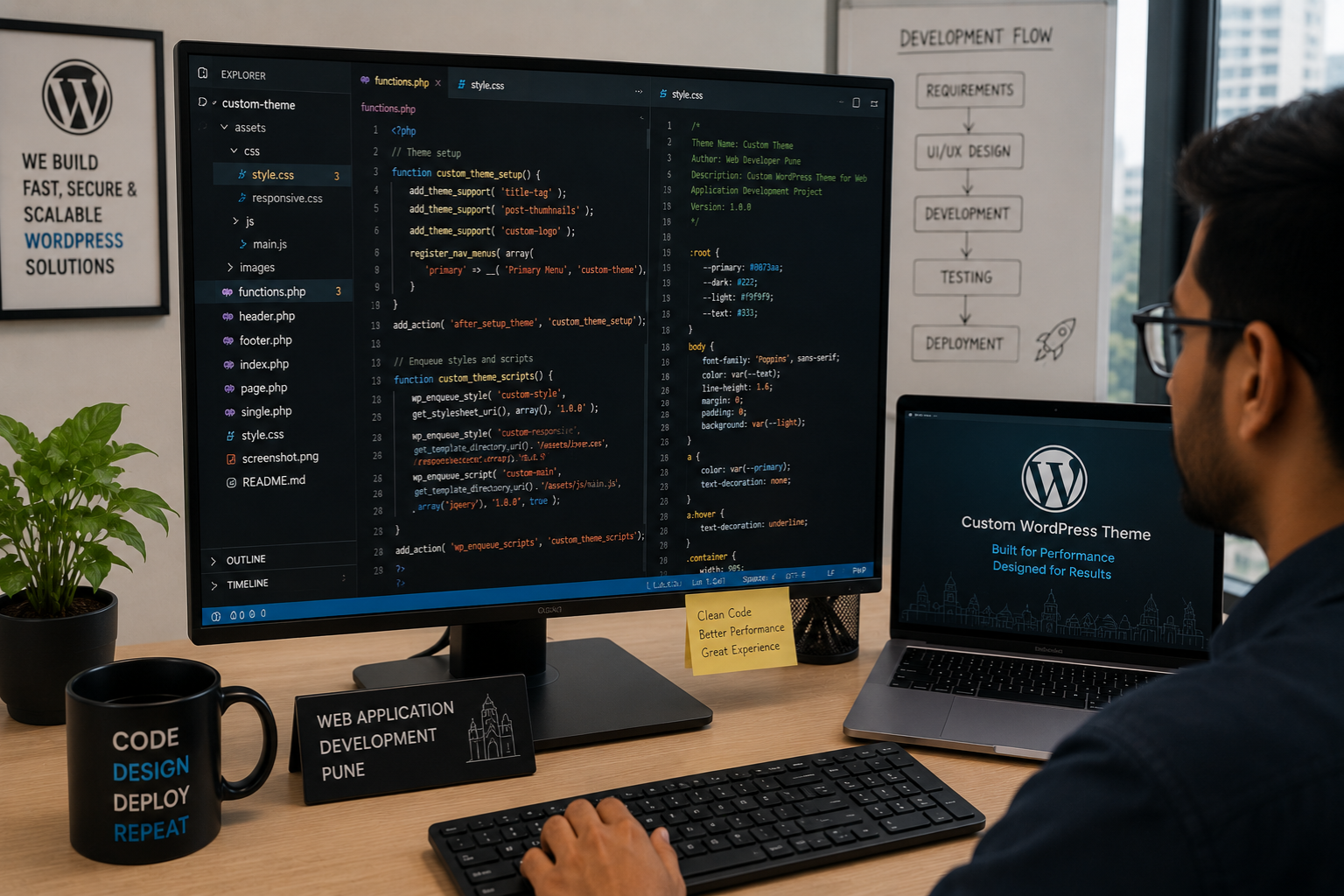
True custom theme development means we start with a blank slate. We write the PHP, build the template files, create custom post types if you need them, design every component specifically for your workflow. When we built a custom portal for a Pimpri-Chinchwad industrial equipment distributor last year, we created a entire product filtering system that matched exactly how their sales team worked. Nothing off-the-shelf could do that.
Starter theme customization means we begin with something like Underscores or GeneratePress (the actual framework, not the pre-built version) and build your design on top. You get custom appearance and functionality, but with a tested foundation. Faster than true custom. Still tailored to you.
Premium theme customization means we take something like Astra or Divi and modify it heavily. This is what that manufacturer had, except the “modification” was just filling in demo content. Not really custom at all.
The cost difference? True custom typically starts around ₹1,50,000 for a solid business site. Starter theme projects might begin at ₹80,000. Premium theme setups can run ₹25,000 to ₹60,000 depending on complexity.
But here’s what I’ve learned: price isn’t the real deciding factor. It’s what happens six months from now.
The Premium Theme Trap (That Catches Almost Everyone)
Look, premium themes aren’t evil. We use them sometimes at Webcomp Digitex, especially for specific situations I’ll get to in a minute.
But there’s a pattern we see constantly with Pune SMBs who come to us for web application development services after a premium theme disaster.
They bought the theme because it looked perfect in the demo. Real estate developer in Wakad? There’s a demo for that. Healthcare clinic? Yep, demo for that too. E-commerce store selling industrial supplies? Got a demo.
So they install it. Or pay someone ₹10,000 to install it. And initially, it looks… pretty good? Not exactly like the demo, but close enough.
Then reality hits.
The theme came with 47 different header styles, 23 footer options, 6 different portfolio layouts, and a page builder with 180 elements. Sounds like value, right? More features, more flexibility?
Except now you have 180 elements loading on every page, whether you use them or not. Your homepage weighs 4.2 MB. Google PageSpeed Insights shows 23/100 on mobile. Your bounce rate is 68% because people on Jio connections in Pune can’t wait for your site to load.
And when you try to remove the features you don’t need? Good luck. Everything’s interconnected. That portfolio slider you never use? It’s tied into the same scripts that run your contact form. Remove one, break the other.
We had an e-commerce client in Hinjewadi whose premium theme loaded 14 different JavaScript files and 8 CSS files just for the homepage. Their actual custom functionality? Maybe 20% of what was loading. The rest was bloat for features they’d never touch.
Think about it this way: premium themes are built to appeal to the widest possible market. They need to work for photographers, restaurants, lawyers, manufacturers, everyone. So they include everything. And you pay the performance price.
When Custom Web App Development Actually Makes Sense
Not everyone needs custom. Let’s be honest about that.
If you’re a small consulting firm that needs five pages, a contact form, and a blog, spending ₹1,50,000 on custom development is overkill. A well-configured premium theme or a starter theme with light customization will serve you perfectly fine.
But here’s when custom web application development becomes not just worthwhile, but actually cheaper in the long run:
When you have specific workflows that don’t fit standard patterns. We built a custom solution for a real estate developer in Baner who needed to manage property listings with complex availability calendars, customized pricing based on floor plans, and integration with their internal CRM. Premium theme with plugins? Maybe possible, but we’d spend more time hacking it together than building it right from scratch.
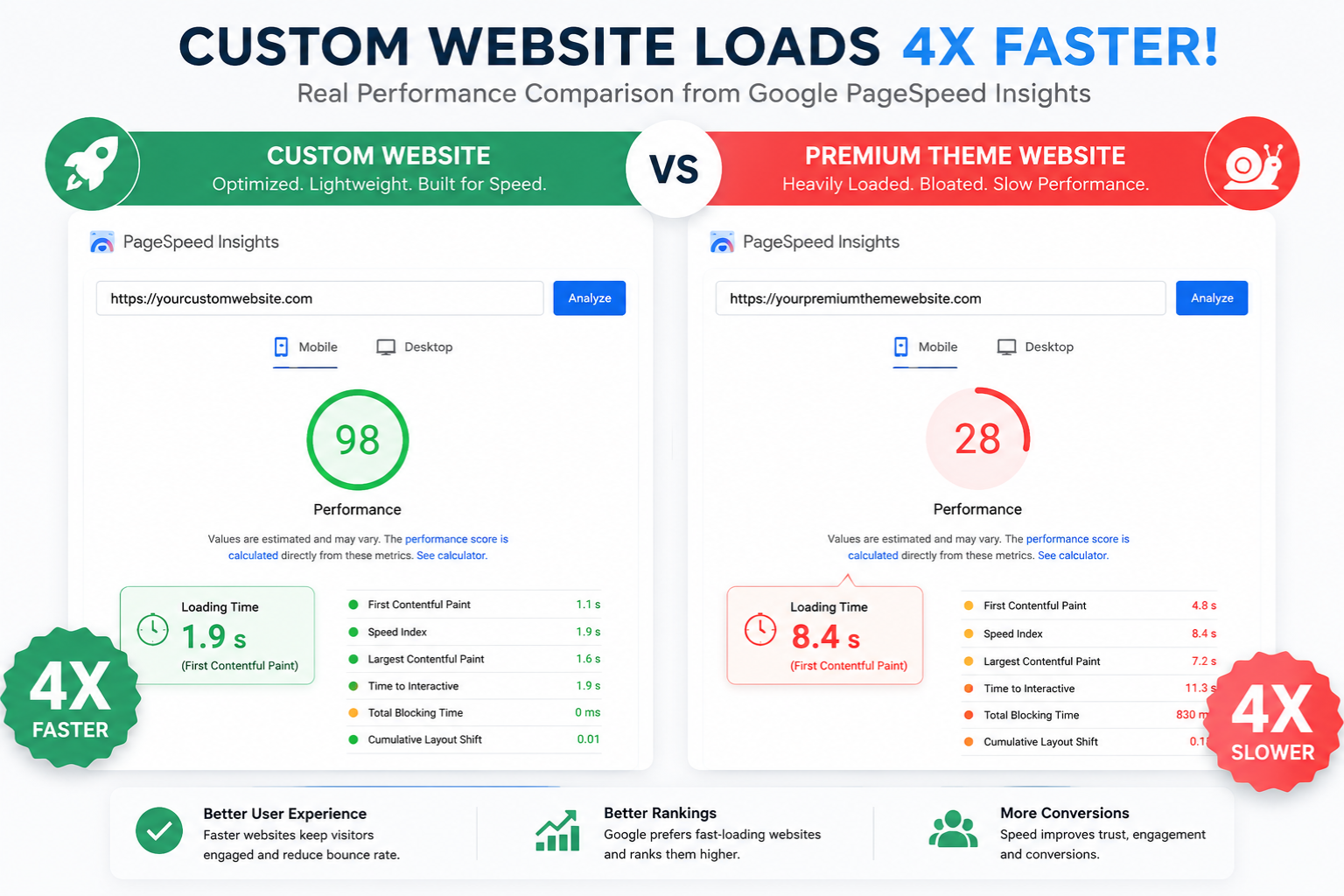
When performance directly impacts your revenue. That manufacturing client from Chakan I mentioned earlier? Once we rebuilt his site as a custom web app, his page load time dropped from 8.4 seconds to 1.9 seconds. His form submissions increased 34% in the first month. For him, slow speed wasn’t just annoying — it was costing him leads.
When you’re scaling and need control. A healthcare group with multiple clinics across Pune needed a system where each location could update their own doctors, timings, and services, but corporate maintained brand control. We built custom post types, custom user roles, and a dashboard that made sense for their team. Try doing that with Divi’s visual builder. You’ll lose your mind.
When you’ve already tried premium and hit the ceiling. Sometimes businesses come to us after outgrowing their premium theme. They’re spending more and more time fighting with page builders and plugin conflicts. At that point, custom becomes an investment in sanity.
Here’s a practitioner insight you won’t read in most articles: the decision often comes down to whether your website is your product or just describes your product. If your site is primarily a marketing tool — sharing information, building trust, capturing leads — a well-chosen premium theme often works. If your site does something — manages workflows, handles complex data, provides custom tools for users — you probably need custom development.
What Actually Goes Into Custom WordPress Development (The Part Nobody Explains)
When we quote ₹1,50,000 or ₹2,00,000 for a custom web application, clients sometimes think that sounds high compared to a ₹3,000 premium theme. Fair enough. Let me show you what you’re actually paying for.
Discovery and planning that’s specific to your business. We spend time understanding your workflow, not just your design preferences. For that industrial equipment distributor in Pimpri-Chinchwad, we interviewed their sales team, watched how they currently managed product inquiries, mapped out their ideal process. This alone took 12 hours. You don’t get this with a premium theme. You get a demo import button.
Architecture designed for your growth. We’re thinking about custom post types, taxonomies, meta fields, user roles, permissions. When you need to add a new product category or a new type of content two years from now, it should be straightforward, not a hacked-together mess. We use Advanced Custom Fields Pro for most projects because it gives us that flexibility without bloating the site.
Performance baked in from day one. We only load what each page actually needs. We write efficient database queries. We implement proper caching strategies. One of our real estate clients in Kharadi got to a 95/100 mobile score on Google PageSpeed Insights with a custom theme. Try that with ThemeForest’s bestseller.
Code you can actually maintain. This matters more than people realize. When we hand over a custom theme, any competent WordPress developer can read our code, understand it, modify it. Premium themes? I’ve opened some that have 80,000 lines of PHP spread across 200 files, half of it obfuscated, all of it interdependent. If you ever want to move away from that theme, you’re basically rebuilding from scratch.
Integration with the tools you actually use. Need Zoho CRM integration? Custom fields in WooCommerce? A specific way to handle leads in your existing system? With custom development, we build exactly that. With premium themes, we’re trying to bend their structure to your needs, and it usually shows.
At Webcomp Digitex, we typically build custom themes using Underscores as a starter if speed matters, or completely from scratch if the project needs it. We use Sass for CSS, webpack for asset management, and we test in real conditions — actual Pune internet speeds, actual devices our clients’ customers use.
The Middle Path Most Agencies Won’t Tell You About
Here’s something I’m probably not supposed to admit: we don’t always recommend the most expensive option.
Sometimes a client needs custom web application development. Sometimes they just need a smart theme choice and good configuration.
For businesses that need to launch fast and iterate. A clinic opening in Baner next month doesn’t have time for two months of custom development. We’ll set them up with GeneratePress Pro (the premium version, which is actually lightweight), configure it properly, add custom CSS for their branding, and get them live in two weeks. Once they understand what they actually need after six months of operation, we can discuss custom if it makes sense.
For content-heavy sites without complex functionality. If you’re running a blog, a news site, a content marketing platform, premium themes like Kadence or Blocksy actually work well. They’re built for content, they’re relatively lightweight, and they get regular updates. We’ve set up several of these for clients, and they’re happy.
For e-commerce with standard requirements. If you’re selling products in a typical way — add to cart, checkout, done — WooCommerce with a good theme like Storefront or Flatsome can work. You don’t need custom development just because you’re doing e-commerce. You need it when your checkout flow is unusual, your products have complex variations, or you’re integrating with specific systems.
But here’s the key: even when we use a premium theme, we approach it differently than most agencies. We don’t install everything. We don’t import the demo. We start with the bare theme, add only the features you need, write custom CSS instead of using the theme’s style options (which often generate bloated code), and we disable every component you’re not actively using.
Think of it like buying a car with every possible feature, then methodically disconnecting the ones you don’t need so it’s lighter and faster. Not ideal, but sometimes it’s the pragmatic choice.
The Real Costs Nobody Mentions Upfront
That Chakan manufacturer’s ₹15,000 premium theme setup? He’s now spent another ₹45,000 fixing it, three months of dealing with a broken site, and he’s lost leads he can’t even quantify.
Sometimes the cheap option is the most expensive choice you’ll make.
Ongoing maintenance differs drastically. Premium themes update regularly. Sometimes those updates break your customizations. Sometimes they conflict with plugins. We’ve seen clients spend ₹8,000 to ₹15,000 every few months troubleshooting issues after updates. Custom themes? We control the update cycle. We test before we deploy. Updates happen on your schedule, not when ThemeForest pushes a change.
Plugin dependence is a hidden cost. Premium themes often require 10, 15, sometimes 20 plugins to achieve their demo functionality. Each plugin is a potential security vulnerability, a potential conflict, a potential performance drag. And each one probably costs ₹1,500 to ₹5,000 per year for the premium version. Those costs add up faster than you think.
The cost of lost opportunity. This one’s harder to measure but often the most significant. If your site loads slowly, looks generic, or doesn’t match your actual business process, you’re losing customers. That real estate developer in Baner estimated he lost at least 15 qualified leads during the two months his premium theme setup was poorly performing. At his average deal size, that’s ₹30,00,000+ in potential revenue. Suddenly, ₹2,00,000 for custom development seems pretty reasonable.
Developer availability matters. When something breaks with a custom theme we built, you call us at Webcomp Digitex. We know every line of code in that theme. We can diagnose and fix issues quickly. When something breaks with a premium theme, you’re either posting in a support forum hoping for a response in 48-72 hours, or you’re trying to find a developer who knows that specific theme’s architecture. We’ve had clients pay rush fees to other developers just to get emergency fixes because the original setup person wasn’t available.
I’m not trying to scare you away from premium themes. I’m trying to give you the full picture so you can make an informed decision.
How We Actually Decide at Webcomp Digitex
When a Pune SMB comes to us asking about web application development services, here’s honestly how we think through it:
Budget vs. timeline vs. requirements. If you have ₹40,000, need to launch in three weeks, and have relatively standard needs, we’re not going to pitch you a ₹2,00,000 custom build. That would be ridiculous. We’ll find the right premium solution, configure it properly, and get you live.
Your technical capacity. Do you have someone on your team who can handle WordPress updates and basic maintenance? Or will you depend entirely on us? If you’re fully self-managing, a well-documented premium theme might actually serve you better. If we’re doing ongoing support anyway, custom makes more sense because we can build it exactly right from the start.
Your growth trajectory. Are you testing a business idea, or scaling something that already works? Startups testing product-market fit don’t need custom. Established businesses scaling up often do. A healthcare group planning to add 6 more clinics over the next two years needs a foundation that can scale. A single clinic just opening their doors doesn’t.
How specific your needs are. General business site with services, about page, contact form, blog? Premium theme is probably fine. Complex product filtering, user dashboards, custom workflows, specific integrations? Custom web app development makes sense.
We actually maintain a decision framework in our project docs. It’s not complex. Just honest questions about what you actually need versus what sounds impressive in a sales pitch.
For what it’s worth, about 40% of our projects use premium or starter themes with customization. The other 60% are true custom development. Both approaches work when applied to the right situation.
The Questions You Should Ask Before You Decide
Whether you’re talking to us or any other custom web application development company in Pune, here are the questions that’ll tell you if they’re being straight with you:
“What happens if I outgrow this solution in two years?” If they say “oh, it’s infinitely scalable,” they’re probably overselling. Both premium and custom solutions have limits. The question is whether those limits align with your realistic growth plans.
“What’s the total cost of ownership over three years?” This includes initial setup, hosting, plugins, maintenance, updates, likely modifications. Get this number for both approaches. Sometimes custom is cheaper over time.
“Can you show me a similar project you’ve done and talk about what went wrong?” Anyone who says nothing ever went wrong is lying. We’ve had projects where premium themes worked perfectly. We’ve had custom builds where our first architecture choice wasn’t ideal and we had to refactor. The learning is in the problems, not the highlight reel.
“Who owns the code when this is done?” With custom development, you should own everything. With premium themes, you’re licensing someone else’s code. Make sure you understand the difference.
“What specifically would you build custom versus use existing solutions for?” For example, we almost never build custom sliders. Libraries like Swiper.js exist and work great. We do build custom post type architectures, custom admin interfaces, custom API integrations. A good development company knows when to build and when to integrate existing, well-maintained solutions.
That Chakan manufacturer asked these questions during our first call after the midnight crisis. Within 15 minutes, it was clear his needs actually required custom work. Not because custom is “better,” but because his specific situation — the workflows, the integrations, the performance requirements — made it the right fit.
We rebuilt his site as a custom web application over six weeks. It cost him ₹1,85,000. Three months later, his cost-per-lead dropped from ₹6,400 to ₹1,900 because the site loaded faster and his forms actually worked reliably. He’s not dealing with plugin conflicts or emergency fixes anymore.
Was custom worth it for him? Absolutely. Would it be worth it for everyone? Absolutely not.
When Premium Themes Actually Win
Because look, I don’t want to end this making it sound like premium themes are always the wrong choice. They’re not.
When you need to launch in days, not weeks. We had a client in Hinjewadi who needed a landing page for a trade show they were attending in 10 days. Custom development? Not happening. We used Kadence, configured their branding, set up the lead capture form, done. They collected 83 leads at that trade show. Mission accomplished.
When your budget is genuinely tight and you have simple needs. Not every business can invest ₹1,50,000+ in a website, especially early on. If you’re a solo consultant or a small service business, a ₹30,000 premium theme setup done properly can serve you for years.
When design flexibility matters more than performance optimization. Some clients like being able to drag-and-drop and redesign sections themselves. They’re willing to accept slightly slower load times for that flexibility. That’s a valid choice if you go in with open eyes.
When you’re in a very standard industry. Restaurants, basic service providers, simple portfolio sites — these have been done a million times. Premium themes for these niches are well-tested and work well. You’re not doing anything unusual enough to need custom work.
The key is honest assessment. Don’t let anyone tell you there’s one right answer for every situation.
Making Your Decision (What Actually Matters)
After 12 years doing this work across Pune — from MIDC manufacturers to Baner startups to Kharadi tech companies — here’s what I think actually matters:
Alignment with your business reality. Not your aspirations, your reality. Where are you now? What do you actually need in the next 6-12 months? Build for that, not for some imagined future that may never come.
Performance that matches your customer expectations. If you’re targeting premium clients, your website better load fast and look polished. If your industry typically has slow, clunky sites, even a well-configured premium theme will look professional by comparison.
Maintainability you can actually afford. Whether it’s your time or your money, factor in ongoing costs honestly. A ₹25,000 premium setup that needs ₹10,000 of fixes every few months isn’t cheaper than a ₹1,50,000 custom build that runs smoothly for years.
Flexibility for real changes you’ll actually make. Not hypothetical changes. Real ones. Will you add new product categories? New service areas? New team members with profiles? New types of content? Choose the solution that makes those real changes straightforward.
Start by writing down exactly what your website needs to do (not what you want it to look like). Then talk to a custom web application development company that’s willing to recommend the right solution, even if it’s not the most profitable one for them.
At Webcomp Digitex, we’ve walked away from potential custom projects when the client genuinely didn’t need custom work. And we’ve pushed clients toward custom when they were trying to make a premium theme do something it was never designed for.
The right answer isn’t about custom versus premium. It’s about honest assessment of your specific situation.

Frequently Asked Questions
Is custom WordPress development always more expensive than premium themes?
Upfront? Yes, usually by a significant margin. Custom development typically starts around ₹1,50,000 for a solid business site, while premium theme setups might cost ₹25,000 to ₹60,000. But when you factor in ongoing costs — plugin licenses, troubleshooting, performance fixes, modifications — custom can actually be cheaper over 2-3 years. We’ve seen clients spend ₹60,000+ fixing and maintaining premium theme sites that would’ve cost ₹1,50,000 to build custom from the start. Calculate total cost of ownership, not just initial price.
How long does custom web application development take compared to using a premium theme?
Premium theme setup can be done in 1-3 weeks if you’re working with someone competent. Custom development usually takes 6-12 weeks depending on complexity. But here’s what most people don’t factor in: premium themes often need significant troubleshooting and adjustments after launch, which can stretch over months. Custom builds tend to be more stable from day one. That Chakan manufacturer’s premium site was “done” in 2 weeks but needed fixes for the next 3 months. His custom rebuild took 6 weeks and has needed minimal maintenance since.
Can I start with a premium theme and move to custom later?
Technically yes, but it’s basically a complete rebuild. You can’t just “convert” a premium theme to custom. You’ll salvage your content, images, and maybe some design ideas, but the code gets rewritten. We’ve done this for several clients who outgrew their premium themes. It works, but you’re essentially paying twice — once for the premium setup, once for custom. If you already know you’ll need custom functionality within a year or two, it’s usually more cost-effective to build custom from the start. If you’re genuinely testing an idea and might pivot, premium makes sense as a starting point.
What if I need changes after the custom development is complete?
This depends on your agreement with your development company. At Webcomp Digitex, we provide documentation and a handover session so you understand how to manage content. For actual code changes or new features, we typically work on a retained support model or project basis. With properly built custom themes, modifications are usually straightforward because the code is clean and documented. Premium themes, ironically, often cost more to modify because you’re working within someone else’s framework and trying not to break their complex dependencies.
Do custom websites load faster than premium theme websites?
Usually, yes, if built competently. Custom sites only load what they need, while premium themes load assets for features you’ll never use. We’ve seen custom sites score 90-95+ on Google PageSpeed Insights while premium themes struggle to break 60. But poorly built custom sites can be slow too. What matters is the developer’s approach. A lightweight premium theme like GeneratePress, properly configured with unnecessary features disabled, can outperform a bloated custom theme. It’s about the execution, not just the approach. Tools like GTmetrix and Google PageSpeed Insights will show you the real performance difference.
Is it worth hiring a custom web application development company for a small business?
Depends entirely on what “small” means and what you need. Small consulting firm with 5 static pages? Probably not worth custom. Small manufacturer with complex product catalogs and specific workflow needs? Definitely worth considering. We work with plenty of Pune SMBs where custom made sense because their process was specific, even if their company was small. Size of business doesn’t determine need for custom development. Complexity of requirements does. Have an honest conversation about what you actually need, not what sounds impressive. Any development company telling every small business they need custom work isn’t being honest.
Ready To Make the Right Choice for Your Business?
Look, I can’t tell you whether your specific situation calls for custom web application development or a well-configured premium theme. I’d need to understand your business, your budget, your timeline, and your actual requirements.
But what I can tell you is that at Webcomp Digitex, we’ve been doing this work across Pune for over 12 years. We’ve built custom web applications for manufacturers in Chakan, real estate developers in Baner, healthcare groups in Kharadi, and e-commerce businesses in Hinjewadi. We’ve also set up premium themes for dozens of clients where that was genuinely the right choice.
We’re not interested in selling you the most expensive option. We’re interested in solving your actual problem in a way that makes business sense.
If you’re trying to figure out the right approach for your website or web application, let’s talk. We’ll ask questions, understand your situation, and give you an honest recommendation — even if that means we tell you to start with a premium theme and come back to us later.
Call us at +91-9960802498 or visit webcompdigitex.com. We’re based in Pune, we understand the local business environment, and we’ve probably worked with companies in your industry before.
Sometimes you need a quick, pragmatic solution. Sometimes you need something built exactly right for your specific needs. We’ll help you figure out which situation you’re actually in.
